How to A/B Test Voiceover Styles Without Re-Recording Everything

TL;DR
- ✓ Use AI voice cloning to generate infinite style variations from one script.
- ✓ Replace expensive studio re-recordings with efficient style transfer and parameter tuning.
- ✓ Apply the five-second hook test to identify high-converting audio variations quickly.
- ✓ Leverage SSML tags to control AI breathing, pacing, and emotional emphasis precisely.
- ✓ Treat audio as a dynamic data point to boost video click-through rates.
To A/B test voiceover styles without re-recording, keep the script and visuals the same and change only the voice delivery. Generate 2 or 3 versions with an AI voice generator, such as calm versus energetic. Test them on the hook first, pick one metric before you start, then roll out the winner.
Last updated: October 6, 2026. We removed unsourced performance figures and rewrote the workflow around tools we could verify.
This guide is for creators, marketers and course makers who want data, not opinions, on which voice works. It covers what to test, how to create variations from one script, how to run a fair test and how to read the results.
Key Takeaways
- Change one thing at a time. Same script, same visuals, different voice delivery. Otherwise you can't tell what made the difference.
- AI removes the re-recording cost. One script can produce several voice versions in minutes by changing the voice, emotion tags, speed or pitch.
- Test the hook first. The opening seconds decide whether viewers stay, so test there before you voice the full video.
- Pick 1 metric before you start: click-through rate for ads, average view duration or retention for long videos.
- Stay inside your brand. Test variations within your brand's tone, not voices that would confuse your audience.
On this page: What to test · Create variations · Hook test · Run the test · Read results · Brand guardrails · FAQ
What can you A/B test in a voiceover?
A voiceover has several variables. Test one at a time, starting with the one you're least sure about.
| Variable | Example A | Example B | Good first test for |
|---|---|---|---|
| Voice | Male, deep | Female, bright | New channels or brands without a set voice |
| Emotion or tone | Calm and confident | Excited and fast | Ads and hooks |
| Speed | Normal | Slightly faster | Tutorials and explainers |
| Accent or language variant | American English | British English | Videos for a specific market |
| Script wording | Question hook | Statement hook | Only after the voice is settled |
Script wording is technically a copy test, not a voice test. Keep it separate so your results stay clean.
How to create voiceover variations without re-recording
With a human voice actor, each new style means a new session. With an AI voice, you change settings and regenerate.
- Lock the script. Finalize the wording before you create any variations.
- Pick a base voice, or use a voice clone of your own voice if you want to keep your sound.
- Create version A and version B by changing one setting: the voice, an emotion tag, the speed or the pitch.
- Name files clearly, for example
hook_calm_v1.mp3andhook_excited_v1.mp3. - Swap the audio on the same video edit so the visuals are identical in every version.
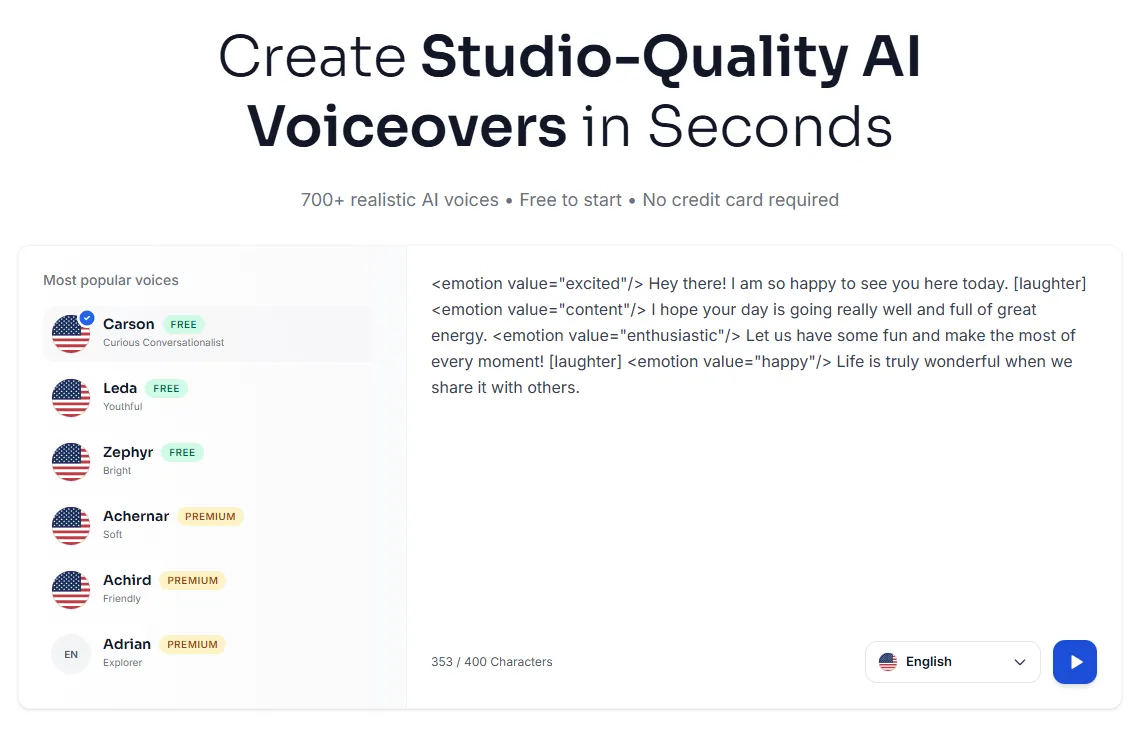
In Kveeky, you can generate each version from the same script with a different voice from the 700+ library. Or keep the voice and switch an emotion tag, such as <emotion value="calm"/> versus <emotion value="excited"/>. You can also adjust tone, pitch and speed, and every plan includes voice clones (5 on the free plan).
For more on what each emotion setting does, see our guide to voice emotion control in AI voiceovers.
Start with a hook test
You don't need to voice the whole video to learn which style works. The opening seconds decide whether a viewer stays, so test there first.
- Voice only the hook (the first 1 or 2 sentences) in 2 or 3 styles.
- Pair each version with the same opening visuals.
- Run them as short ads or clips and compare how many people keep watching or click.
- Voice the full video in the winning style once you have a clear result.
This saves credits and editing time, because you only produce the full video once. For product videos, the 60-second product demo script framework shows how to build a hook worth testing.
How to A/B test voiceover styles step by step
- Write a hypothesis. For example: "A calm voice will get more clicks than an excited one on this finance ad."
- Choose one metric. Click-through rate for ads, average view duration for long videos, completion rate for courses.
- Limit yourself to 2 or 3 versions. More versions split your audience and take longer to give a clear answer.
- Split the audience fairly. Use your ad platform's built-in A/B or experiment feature so each version reaches a similar audience at the same time.
- Run until you have enough data. Don't call a winner after a few hundred views; small numbers swing a lot by chance.
- Roll out the winner, then test the next variable.
To fit testing into a regular publishing schedule, see our 30-minute script-to-upload voiceover workflow.
Organic videos are harder to split, because most platforms show one audio track to everyone. For organic content, compare similar videos posted at similar times, and treat the result as a direction, not proof.
How to read your voiceover test results
Look at the shape of the retention curve, not just the final number.
- If viewers drop at the same moment in every version, the problem is the script or the visuals, not the voice.
- If one version holds viewers longer through the first 30 seconds, the voice is likely doing its job.
- If click-through rates are almost equal, the voice style isn't the deciding factor. Keep the cheaper or simpler option and test something else.
Match the winner to the intent. A warm, slower voice may suit testimonials, while a clear, quicker voice may suit tutorials. Let your own data decide.
Keep variations inside your brand voice
Testing shouldn't turn your brand into something it isn't. Set guardrails before you start.
- Define your brand's tone in 3 words, such as "clear, warm, expert".
- Only test variations that fit those words, for example "warm expert" versus "brisk expert".
- Keep the winner consistent across a series, so returning viewers hear the same voice.
Our guide to matching AI voice tone to your niche helps you choose a starting point. If you write the script yourself, our AI voiceover scriptwriting guide helps make every version sound natural.
Frequently asked questions
How do I A/B test a voiceover without re-recording?
Use an AI voice generator. Keep the same script and visuals, then create versions by changing one setting, such as the voice, an emotion tag or the speed. Swap each audio file into the same video edit.
How many voiceover variations should I test at once?
Test 2 or 3. More versions split your audience into smaller groups, so it takes longer to see a clear winner.
How do I know which voice style is performing better?
Pick one metric before you start, such as click-through rate or average view duration. If viewers drop at the same point in every version, the script is the issue, not the voice.
Should I test the voiceover before or after the final edit?
Before. Test the hook with a rough cut, choose the winning style, then voice the full video and finish the edit. This avoids redoing polished work.
Can I use a cloned voice in my tests?
Yes, if it's your own voice or one you have clear permission to use. Every Kveeky plan includes voice clones, including 5 on the free plan.
How we checked this guide
This guide is written by Ankit Agarwal for the Kveeky team. Disclosure: Kveeky makes an AI voice generator.
- The testing method is an editorial recommendation based on standard A/B testing practice, not a measured Kveeky study.
- Kveeky features (700+ voices, emotion tags, tone, pitch and speed control, voice clones on every plan) come from kveeky.com/pricing and kveeky.com, retrieved 2026-10-06.
- No Kveeky usage data is used in this guide.
Next step: take one ad or video hook, generate a calm and an excited version from the same script, and run them as a 2-way test. For ad-specific voice ideas, see our page on AI voiceover for advertisements.