AI's Role in Shaping the Future of Marketing

TL;DR
- ✓ AI has shifted from simple assistance to autonomous agentic infrastructure for marketing teams.
- ✓ Traditional SEO is evolving into Answer Engine Optimization to secure AI citations.
- ✓ Moving to self-optimizing engines is now critical for maintaining competitive marketing visibility.
- ✓ Brands must prioritize becoming the definitive source of truth for generative AI models.
- ✓ Innovation fatigue can be avoided by focusing on structural AI marketing investments.
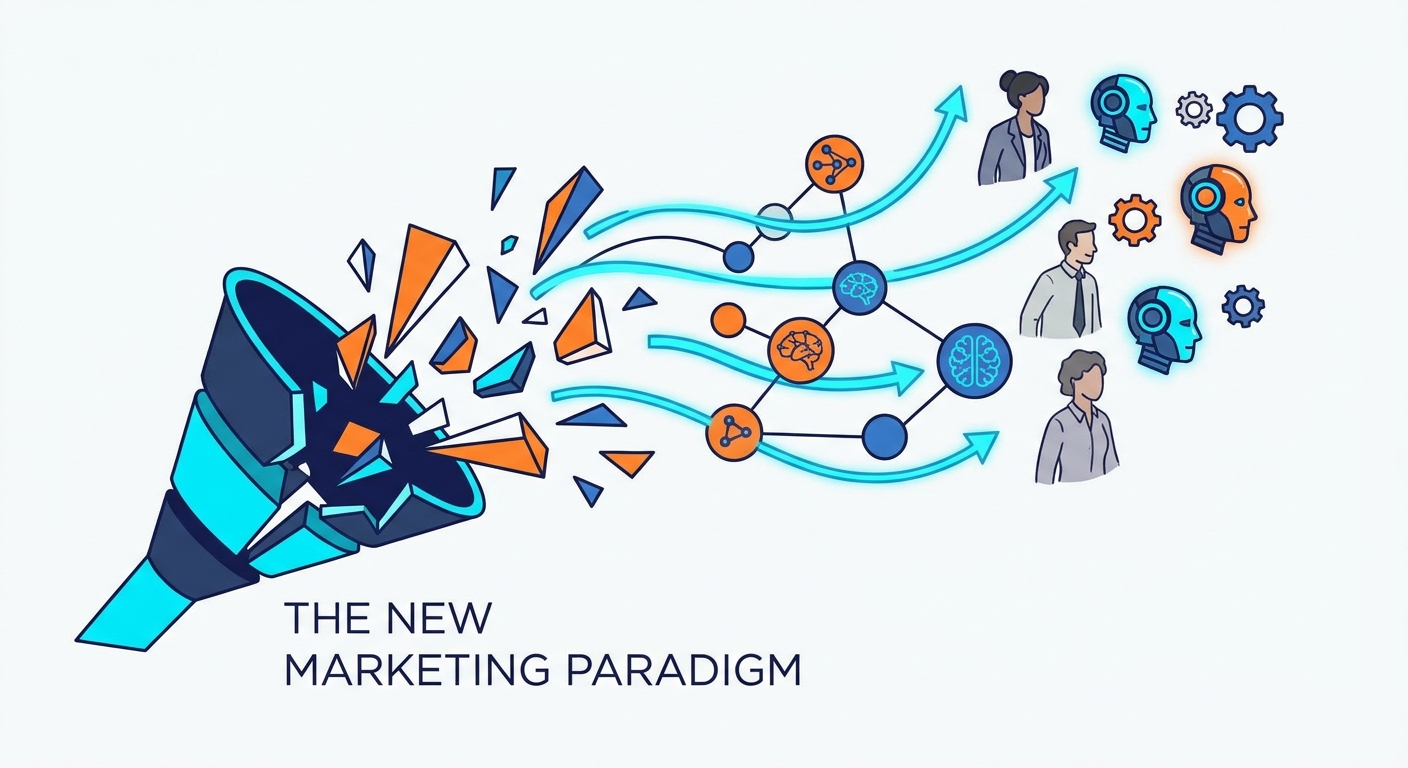
The traditional marketing funnel is dead. For decades, we played by a predictable rhythm: grab attention, bait the click, nurture the lead, and pray for a conversion. That linear path? It’s been shattered by an autonomous, AI-driven reality.
We’ve moved past the "AI-assistant" phase—where a writer uses a bot to spit out a blog post or a designer generates a generic hero image—and straight into the era of agentic infrastructure. As noted in the latest AI Marketing Trends 2026 report, we are witnessing a 527% increase in AI search traffic. This isn't just a trend; it’s a total rewrite of the rules of engagement. If your 2026 strategy still relies on chasing clicks, you aren’t just behind the curve. You’re invisible.
How is AI Changing from a Tool to Core Infrastructure?
In 2024, AI was a shiny toy kept in a "sandbox" folder. In 2026, it’s the foundation of the house. The leap from AI-assisted tasks to agentic workflows is the difference between doing the work and orchestrating it.
An AI-assisted task is simple: you ask a model to write an email. An agentic workflow is structural: you deploy an autonomous agent that monitors CRM data, spots a drop in engagement for a specific cohort, triggers a hyper-personalized content sequence, and tweaks ad spend in real-time—all without a human lifting a finger. This isn't about saving five minutes on a draft; it’s about building a self-optimizing engine. For companies struggling to bridge the gap between legacy systems and this new reality, custom marketing automation solutions aren't just "nice-to-haves." They are the pipes through which your entire marketing intelligence must flow.
What is Answer Engine Optimization (AEO) and Why Does it Matter?
The "Zero-Click" era isn't a prediction. It’s here. Thanks to the rise of generative search, users are getting exactly what they need from an AI summary. They don't need to visit your website. Gartner and industry analysts have already flagged a potential 50% drop in organic traffic for informational queries.
This environment demands a pivot from traditional SEO—which focuses on ranking for high-volume keywords—to Answer Engine Optimization (AEO). AEO is the art of becoming the verified source of truth for an AI model.
In the AEO era, your goal isn't just to get the click; it’s to ensure your brand is cited as the authority within the AI’s summary. If you aren't the definitive answer, you aren't just losing a visitor. You’re losing the conversation entirely.
How Should You Prioritize Your AI Investments?
The biggest danger right now is "innovation fatigue." Every vendor promises the world, but your budget is finite. To cut through the noise, map your initiatives on a 2x2 matrix of Readiness vs. Urgency.
- Automate Now (High Urgency, High Readiness): This is your low-hanging fruit. Think routine data reporting, basic lead categorization, and CRM hygiene. If it’s manual and data-heavy, automate it today.
- Build Infrastructure (High Urgency, Low Readiness): This is where you focus on data governance. If your data is siloed and messy, no amount of "agentic" AI will save you. Clean your internal house before you try to deploy advanced agents.
- Monitor/Pilot (Low Urgency, High Readiness): These are the experiments, like generative video for social ads. Keep an eye on them, but don't bet the farm.
- Ignore/Deprioritize (Low Urgency, Low Readiness): If it’s complex and doesn't solve a core business problem, stop trying to force AI into the workflow.
Why is "Human-in-the-Loop" the New Competitive Moat?
The internet is becoming a landfill of synthetic, AI-generated content. Because of this, the "Human Premium" has never been higher. AI is great at summarizing facts, but it is historically awful at expressing unique, provocative, or contrarian opinions.
Tone-deaf AI branding is the fastest way to lose trust in 2026. When a brand sounds like a generic chatbot, it signals that the company doesn't care enough to have a point of view. The brands that win will use AI to handle the scale while reserving the highest-value content for human strategy. By leveraging AI-powered content strategy services, you can ensure your brand voice remains distinct, opinion-led, and human-verified. That’s a moat no algorithm can replicate.
How Does the Marketing Roadmap Vary by Industry?
AI isn't a monolith; its application depends entirely on your sector. According to PwC’s 2026 AI Predictions, the divide is widening:
- B2B SaaS: The focus has shifted from top-of-funnel lead gen to high-intent qualification agents. These agents act as digital SDRs, analyzing intent signals to prioritize which leads get human attention and which get automated nurturing.
- E-commerce: It’s all about hyper-personalized orchestration. AI isn't just recommending products; it’s managing the entire customer journey, from predicting churn to dynamically adjusting loyalty rewards based on real-time behavior.
- Fintech: Governance is king. In a heavily regulated industry, "black box" AI is a liability. The roadmap here focuses on "Explainable AI" (XAI), ensuring every automated decision can be audited for compliance.
The Infrastructure Mandate: Is Your Data Ready?
"Garbage in, garbage out" is the oldest warning in computing, and in 2026, it is the most expensive one. If your data is fragmented across disconnected platforms, your AI agents will hallucinate based on incomplete information.
The shift toward a unified data stack is the absolute prerequisite for agentic AI. You need a single source of truth where your CRM, website analytics, and customer support logs converge. As OpenAI usage statistics continue to climb, it’s clear that AI is becoming the primary interface for information retrieval. If your data isn't structured to feed that interface, you are essentially invisible to the future of search.
How to Future-Proof Your Brand Against the "Zero-Click" Reality
If the traffic never lands on your site, how do you capture value? You stop measuring success by "visits" and start measuring it by "influence" and "community depth."
- Cultivate First-Party Data: When you rely on rented land—like social media or search engines—you are at the mercy of their algorithms. Build a direct relationship with your audience through newsletters, private communities, and proprietary platforms where you own the data.
- Prioritize Brand Equity: In a world where AI provides the answers, people will still choose the brand they trust. If you are the source of the authoritative, human-centric opinion, the AI will cite you.
- Invest in "Human-First" Storytelling: AI can mimic facts, but it cannot mimic experience. Share your failures, your internal culture, and your unique perspective. That is the only thing that remains uncommoditized.
The future of marketing isn't about out-working the machine; it’s about architecting a brand that the machine is forced to recognize as an authority.
Frequently Asked Questions
What is Answer Engine Optimization (AEO) and why does it matter in 2026?
AEO is the process of structuring your digital content so that generative AI models (like ChatGPT, Perplexity, or AI search overviews) can easily extract, summarize, and cite your brand as the primary authority. It matters because users are increasingly relying on AI summaries to answer questions, bypassing traditional search results entirely.
Will AI replace organic SEO entirely?
AI will not replace SEO, but it will kill "volume-based" SEO. The focus is shifting from ranking for thousands of low-intent keywords to becoming the trusted source for high-intent, complex queries. If you provide deep, authoritative, and unique insights, you will remain relevant as the primary source for AI-generated summaries.
How can brands maintain a human connection in an AI-dominated marketing landscape?
Brands maintain connection by doubling down on what AI cannot do: original research, contrarian opinions, personal storytelling, and community building. Use AI to handle the heavy lifting of data and distribution, but ensure that your brand’s voice, values, and strategic decisions are always human-led.
Is it too late to start an AI marketing strategy?
It is not too late, but the window for "easy wins" is closing. You don't need to be first, but you do need to be intentional. Use the Readiness vs. Urgency matrix to stop chasing tools and start building the data infrastructure necessary to support autonomous, agentic marketing.