AI Translation and Captioning Solutions for Meetings and Events
TL;DR
- ✓ Combine AI and human interpreters for a cost-effective, high-quality hybrid event strategy.
- ✓ Eliminate vendor fatigue by centralizing your translation and captioning workflows into one dashboard.
- ✓ Prioritize zero-friction access by using browser-based, QR-code-driven solutions instead of proprietary apps.
- ✓ Reserve human interpreters for high-stakes sessions while using AI for high-volume breakout rooms.
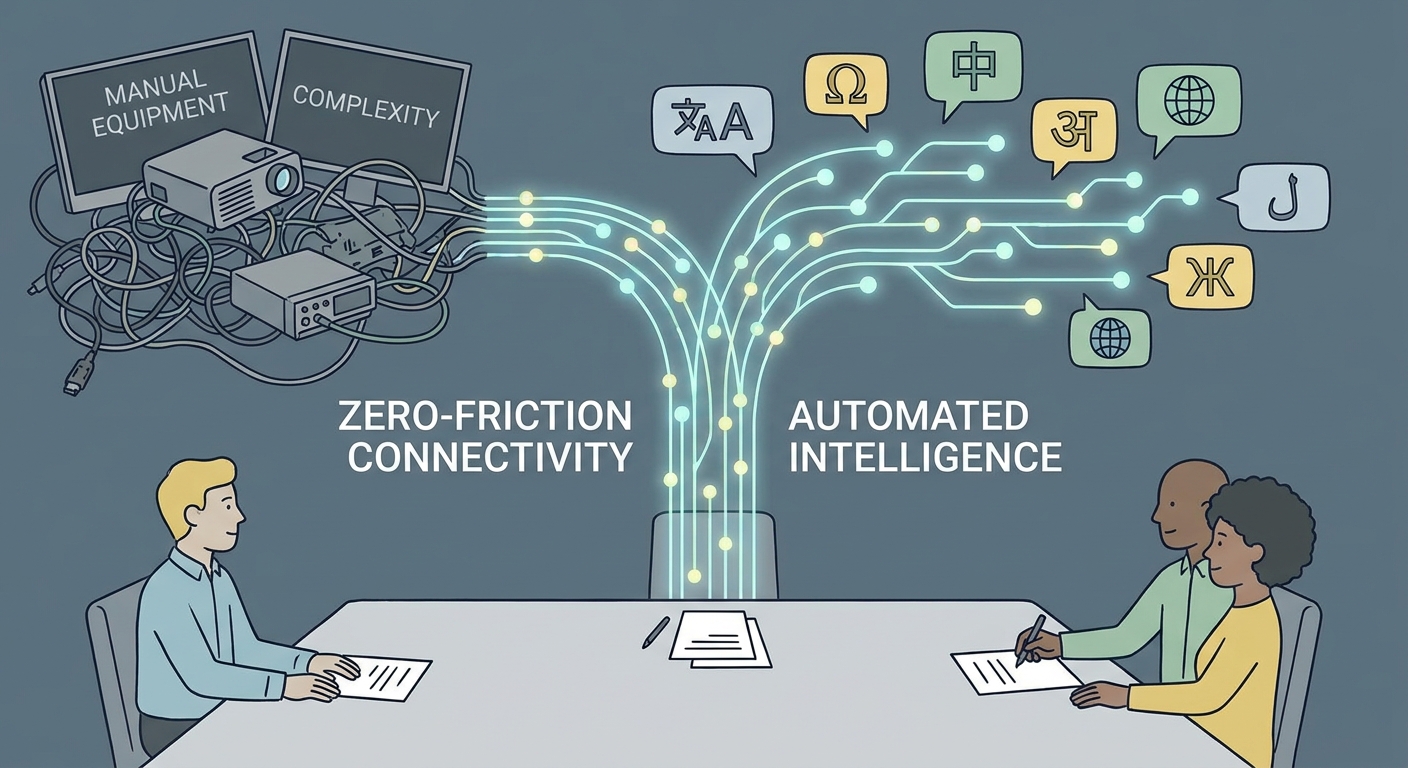
The days of sweating over manual vendor contracts, shipping crates of proprietary hardware to venues, and praying the interpreter’s feed doesn’t cut out are officially over. By 2026, the standard for global gatherings has shifted. We’ve moved away from the clumsy, human-only logistical nightmares of the past toward a friction-free, automated reality.
Success is no longer just about having a translation stream running in the background. It’s about "Zero-Friction Access." It means that every single person in the room—regardless of their native language or physical ability—feels like a first-class participant. As noted in recent AI Translation Trends 2026, the industry is sprinting toward real-time processing that prioritizes raw speed and accessibility without shredding the integrity of your message.
Why "Hybrid" is the New Operational Default
Let’s kill the "AI versus Human" debate right now. It’s a ghost of the past. The top-tier event planners I work with have realized that the real magic happens in the middle ground—the hybrid model.
This isn’t about choosing sides. It’s about using the right tool for the specific job.
AI is a workhorse. It excels at scale. For breakout sessions, internal town halls, or those high-volume Q&A segments where you don’t have the budget for a fleet of human interpreters, AI provides immediate, reliable, and cost-effective coverage. But let’s be real: when the stakes involve high-level strategy, legal nuances, or deep cultural context, human interpreters are still the gold standard.
A hybrid approach lets you optimize your spend. Deploy AI for the transactional stuff, and save your human budget for the mission-critical moments that define your organization’s reputation.
By pulling these workflows into a single dashboard, you kill the "vendor fatigue" that plagues so many planners. Stop managing three different companies for captioning, AI translation, and human interpretation. Centralize everything through our interpretation solutions to keep your quality consistent across every single session.
How to Nail "Zero-Friction" Access
If you ask an attendee to download a proprietary app just to hear a translation, you’ve already lost 40% of your audience. That’s a fact. The modern event baseline is browser-based, QR-code-driven access.
If a user can scan a code and hear their language within three seconds, you’ve won. If they have to create an account, download a package, and troubleshoot a login? You’ve failed.
We’re done caring about "accuracy percentage" as the only KPI. In a live room, accuracy means nothing if the latency is five seconds behind the speaker. Today, we prioritize "Zero-Friction" metrics: latency, stream stability, and ease of entry. If your technology forces the user to fight their Wi-Fi or device settings, the translation doesn't exist. Period.
Is Your Tech Stack Ready for Global Scale?
The biggest point of failure in global events isn't the translation engine—it’s the integration. Planners often treat translation as an "add-on," daisy-chaining audio cables from a console into a laptop. This is a recipe for disaster: echoes, clipping, and total signal failure.
In 2026, you need native, API-first integration. If you’re hosting on Zoom, Teams, or Webex, your translation tool should be a plugin, not a workaround. As highlighted in recent Event Tech Trends, the winning tools are the ones that disappear into the background of your stack.
Before your next event, run a "Tech Stack Audit." Can your platform handle 5,000 users jumping onto a translation stream at once? Have you stress-tested the venue bandwidth? If the answer is "we hope so," you aren't ready.
Beyond Translation: Why Captioning is Mandatory
We need to stop treating "captioning" and "translation" as interchangeable. Captioning is a DEI (Diversity, Equity, and Inclusion) mandate. When you provide real-time, high-quality captions, you aren't just helping non-native speakers; you are providing essential access for neurodivergent attendees and those who are hard of hearing.
Frame this as an accessibility necessity, not a "nice-to-have" feature. It moves from a budget line item to a core value. If your event isn't accessible, it isn't successful. For organizations aiming for true inclusivity, our meeting accessibility services provide the backbone for ensuring every voice in the room is heard.
The Planner’s Playbook: Managing Live Support
The most dangerous thing an event planner can say is, "We’ll figure it out on site." Translation is high-pressure. If you don't have a rehearsal strategy, you’re inviting a train wreck.
A proper "dry run" is non-negotiable. Don't just test the tech; coordinate the humans. If you have human interpreters working alongside AI, they need to know the hand-off protocols cold. They need to understand the speaker's cadence and be familiar with your industry's technical jargon. Drawing from a simultaneous interpretation guide, the best planners treat their interpreters like key production crew members, not just outside contractors.
Conclusion: Choosing the Right Partner
The gap between machine efficiency and human quality is exactly where your event’s reputation is won or lost. The right partner understands that technology is just a tool—not the solution itself. You need a platform that scales with you while maintaining the rigorous standards your high-visibility sessions demand.
Don't settle for a tool that forces you to compromise on quality or accessibility. If you’re ready to modernize your approach to global meetings, contact our event team and let’s bridge the gap for your next international gathering.
Frequently Asked Questions
Can AI translation completely replace human interpreters for my event?
Not entirely. AI is incredibly efficient for breakout sessions, internal meetings, and high-volume content. However, for high-stakes keynotes, legal proceedings, or sensitive medical discussions, human oversight is essential to capture nuance, cultural context, and tone that AI might misinterpret. The most effective strategy is a hybrid model that uses both.
What is the biggest risk when using AI for live events?
The primary risks are technical latency and "hallucination." If the latency is too high, the translation becomes distracting. In technical or regulatory discussions, the risk of an AI "hallucination"—where the software confidently mistranslates a specific technical term—can be problematic, which is why human quality assurance is vital for critical sessions.
Do my attendees need to download an app to access translations?
They shouldn't have to. Modern, professional solutions prioritize browser-based access via QR codes or direct links. This removes the barrier to entry and significantly increases participation rates, as attendees are far more likely to join a stream if it doesn't require installing proprietary software.
How do I ensure my translation solution integrates with Zoom/Teams?
You must prioritize API-first platforms. Avoid solutions that rely on manual audio routing or "bridge" hardware. By selecting a platform that offers native plugins and direct API integration with your video conferencing tools, you ensure a stable, low-latency experience that doesn't require a constant "on-site" technical babysitter.