
By 2026, the "prompt-and-pray" era of AI video is dead. We’ve finally crawled out of the uncanny valley, leaving behind the morphing faces and flickering backgrounds that plagued early experiments. We aren't just playing with parlor tricks anymore. AI video has matured into a heavy-duty production tool.
Today, it’s about utility. It’s about speed. Teams are turning around high-fidelity concepts in hours, not weeks. But here’s the kicker: the real competitive edge doesn't go to the person who can write the cleverest prompt. It goes to the director who knows how to build a pipeline. It’s about marrying LLM-driven scripting with surgical, frame-by-frame control.
The State of AI Video: From Viral Clips to Cinematic Production
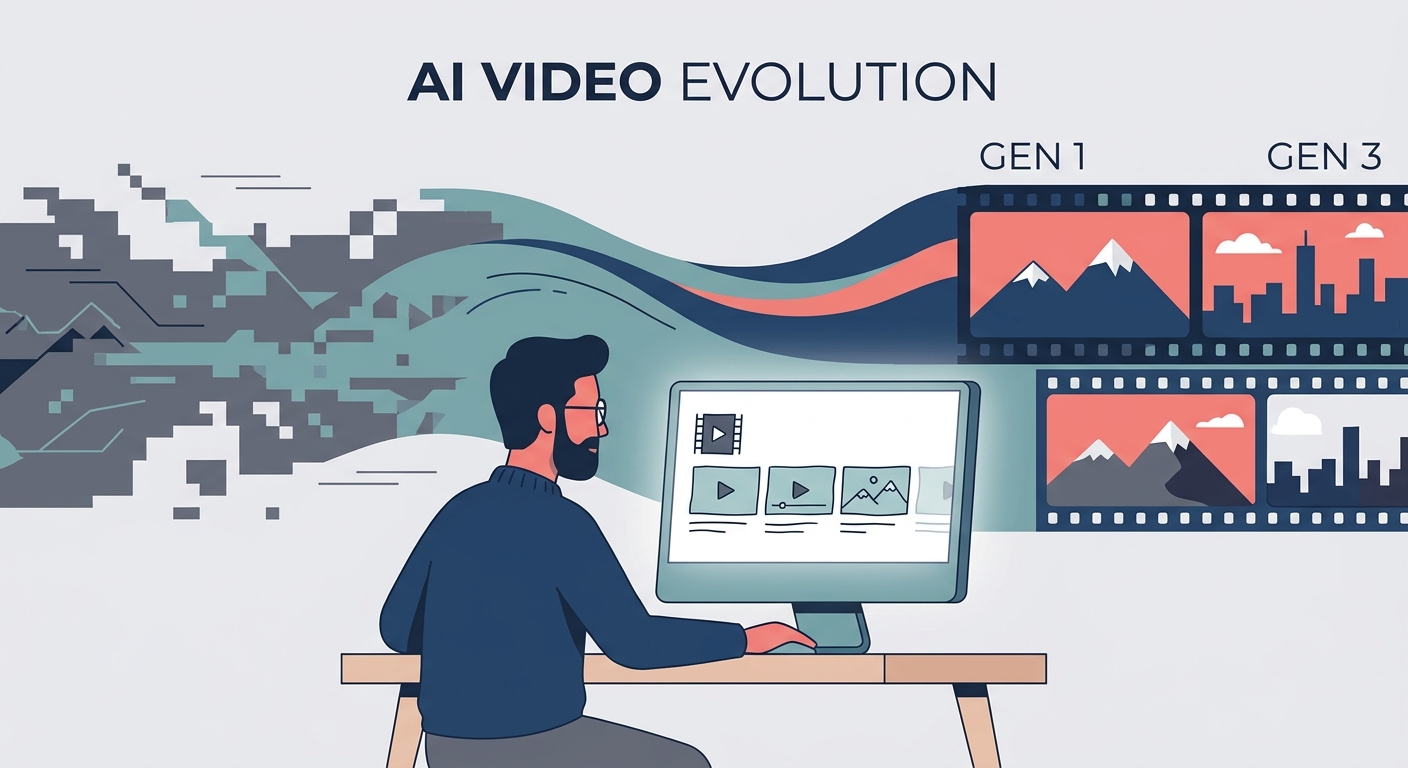
Two years ago, we were impressed if an AI could keep a subject’s eyes steady for three seconds. That bar has been obliterated. Modern models—like the latest from Sora (OpenAI)—now deliver the temporal consistency required for actual long-form storytelling.
The transition from 2024 to 2026 is defined by "production-ready" assets. The AI model is no longer the star of the show; it’s just one member of the ensemble. Industry leaders like Runway Research have pivoted toward granular control. You aren't just asking for a video; you’re defining camera paths, focal lengths, and character continuity. You’ve moved from being a "content generator" to a creative director steering a machine-learning engine.
How We Evaluate AI Video Quality: Our Stress Test
Marketing hype is cheap. To cut through the noise, we ran a standardized "Stress Test" protocol. We didn't care about the polished, curated demos on the homepage. We cared about reliability.
Our test was simple but brutal: five scenes requiring high-motion, consistent character geometry, and specific lighting. (e.g., "A barista in a sun-drenched cafe pouring latte art, camera zooming slowly").
We fed this prompt set through the "Big Five" models of 2026. We weighted our scores as follows:
40% Controllability: Can you force the model to do exactly what you want?
30% Temporal Consistency: Does the video jitter, or does it hold together?
20% Cinematic Fidelity: Lighting, texture, and resolution.
10% Speed: How long until we get a result?
This isn't about which model looks best in a gallery; it’s about which one holds up under the pressure of a real production schedule.
The Top 5 AI Video Generators for 2026
Tool | Best For | Controllability | Price Tier |
|---|---|---|---|
Sora (OpenAI) | Cinematic Storytelling | High | Enterprise/Pro |
Runway (Gen-3) | Professional Directing | Elite | Tiered/Subscription |
Kling 3.0 | High-Motion Action | Medium-High | Competitive |
Luma Dream Machine | Rapid Prototyping | Medium | Freemium |
Veo 3.1 | Commercial Advertising | High | Enterprise |
Sora (OpenAI): The gold standard for world-building. If you need physics that make sense and long-form sequences that don't fall apart, this is your engine.
Runway Research: This is the director’s choice. Their "Motion Brush" and camera controls are still the best in the business for dictating exactly how a subject moves.
Kling 3.0: A brute-force powerhouse. When you need intense, high-energy interactions between a character and their environment, Kling handles the physics better than most.
Luma Dream Machine: Built for speed. When you’re in a brainstorm and need to visualize a storyboard concept right now, Luma is the fastest way to get a usable output.
Veo 3.1: Designed for the ad world. It offers the tightest brand control and resolution scaling required for commercial deployment.
Building a Professional AI Video Workflow
Stop treating AI like a "one-click" magic button. It’s not. Think of it as a modular assembly line. A professional workflow isn't a prompt—it's a stack.
The assembly line needs a generation stage that survives contact with a brief. An AI video generator like invideo earns its place here less for raw model output than for what surrounds it: one prompt turns a script into scenes, you regenerate a single shot without rebuilding the sequence, and the project keeps hold of the takes you already approved. That last part is the whole difference between a pipeline and a folder of downloads. Treat the generator as the stage that produces takes, not finished films - the director's work starts when the takes come back.
The Workflow Revolution
You start with an LLM to build your screenplay. You feed those descriptions into your video model. Once you have your visual assets, you move to audio. Never skip this. High-fidelity voice-over is non-negotiable for professional work, and ElevenLabs is still the industry leader for emotional, naturalistic speech.
If this stack feels like a headache to manage—or if you’re struggling to keep your brand voice consistent across these tools—our Content Strategy services are built specifically to help you bridge these gaps and sharpen your pipeline.
Writing Prompts That Actually Work
The secret to a great prompt isn't creativity; it’s technical specificity. When you leave the model to "guess," you get generic, soulless results.
Use this formula to command the AI:
[Camera Angle] + [Lighting/Mood] + [Subject Action] + [Cinematic Style]
- Example: "Low-angle tracking shot, golden hour, warm cinematic lighting, a focused architect reviewing blueprints on a construction site, shot on 35mm film, hyper-realistic, shallow depth of field."
Notice the lack of fluff? No "stunning," no "breathtaking." The AI doesn't care about your adjectives. It cares about your parameters. By defining a focal length (35mm) and a movement (tracking shot), you strip away the model's ambiguity and force it to deliver something usable.
Brand Consistency: The Enterprise Hurdle
Consistency is the biggest challenge in enterprise AI. You cannot have your spokesperson’s face shifting subtly between cuts. The solution? "Seed Control" and "Training Data Hygiene."
When working with clients, we insist on locked-in seeds and consistent LoRA-tuning. If you want to see how we maintain brand identity across these automated pipelines, check out our Kveeky Resources. We break down exactly how to keep your visuals on-brand while using generative tools.
The Legal and Ethical Reality Check
"Human-in-the-loop" isn't just a trendy phrase. It’s a legal requirement. Copyright law regarding AI is still the Wild West, but one thing is becoming clear: the more human oversight, editing, and creative intent you inject into the process, the stronger your claim to the output.
Corporate compliance also demands you know where your data comes from. Always favor enterprise platforms that offer "clean" models. It mitigates the risk of copyright infringement—a legal nightmare no one wants to deal with.
Frequently Asked Questions
Can AI video generators create professional-grade marketing content in 2026?
Yes, provided you treat AI as one step in a wider workflow that includes professional scripting, high-end voice-over, and human-led post-production.
What is the biggest limitation of current AI video tools?
Long-form narrative coherence. Maintaining 100% character and environment consistency over several minutes of footage is still difficult, though we are getting closer every month.
Are videos generated by AI copyrightable?
Pure AI output is generally not copyrightable. However, if you incorporate significant human creative input, editing, and assembly, your work is increasingly recognized as protected.
How do I get the best results from my text prompts?
Focus on technical cinematography cues—lighting, camera movement, and lens types. Be as descriptive as a director giving instructions to a camera crew.
What is the difference between "generation" and "controllability" in AI video?
Generation is the ability to create a video; controllability is the ability to dictate what happens in that video, such as specific character placement, movement, and camera timing.