How Much Does AI Voiceover Actually Cost Per Video? (Real Numbers)

TL;DR
- ✓ AI voiceover costs range from 0.05 to 5.00 dollars per finished minute.
- ✓ Character-based pricing is best for high-volume short-form content creators.
- ✓ Duration-based billing offers better predictability for long-form video narrations.
- ✓ Always verify if your plan includes commercial rights to avoid legal issues.
- ✓ Watch out for hidden overage fees that spike your monthly subscription expenses.
AI voiceover cost per video is about $0.50 to $2.50 for a 10-minute video on a paid plan, if you use most of your monthly minutes. On prices checked October 6, 2026, effective rates ran from about $0.05 to $0.25 per minute across 4 tools. Free plans cost $0 but cover only a few minutes a month.
Last updated: October 7, 2026. Every price was checked on the vendor's own pricing page on October 6, 2026 and re-checked on October 7, 2026; per-minute figures are our calculations.
This guide is for creators and small teams budgeting narration for YouTube, social video or training content. It turns plan prices into a cost per minute and per video, then shows the costs that make the real number higher.
Key Takeaways
- The basic formula: monthly plan price ÷ minutes you actually use = your cost per minute. Multiply by your video length.
- Cheapest per minute at full use: Fish Audio Pro, at about $0.05/minute billed yearly. Kveeky Business is about $0.08 billed yearly, and Kveeky Basic $0.075 to $0.09.
- Unused minutes raise your real cost. A $9 plan used for 20 minutes a month costs $0.45 per minute, not $0.09.
- Retakes count. Every regenerated line uses credits, so budget 10% to 20% extra (our estimate).
- Commercial rights vary by plan. Every paid Kveeky plan includes them; ElevenLabs' free plan doesn't.
On this page: Cost per minute · Per video · Your real cost · Pricing models · Hidden costs · AI vs human · Choosing a plan · Monthly prices · FAQ
AI voiceover cost per video and per minute, by tool
ANALYSIS. We divided each plan's price by the minutes it includes. This assumes you use every minute, so treat it as the best case.
| Tool and plan | Price (monthly / yearly per month) | Included per month | Cost per minute (monthly / yearly) | Commercial use |
|---|---|---|---|---|
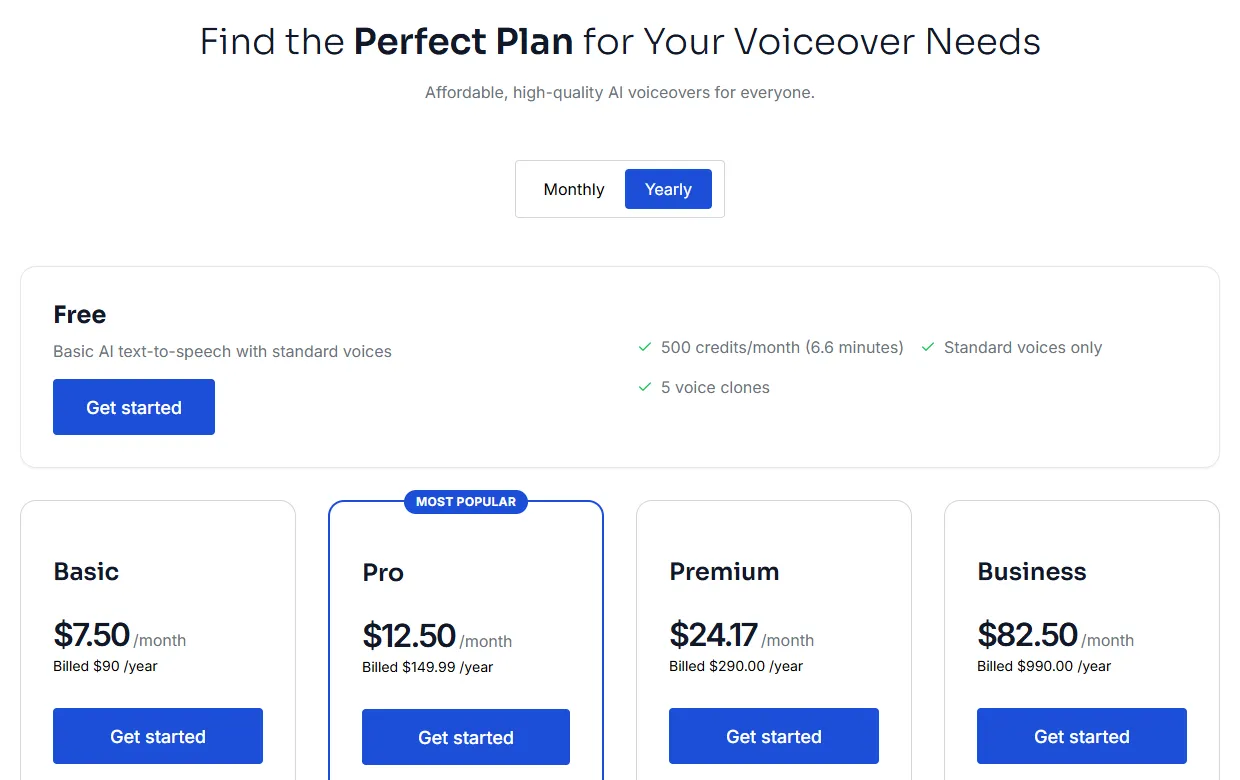
| Kveeky Basic | $9 / $7.50 | 100 min | $0.09 / $0.075 | Yes, every paid plan |
| Kveeky Pro | $19.99 / $12.50 | 133 min | $0.15 / $0.094 | Yes |
| Kveeky Premium | $29 / $24.17 | 200 min | $0.145 / $0.121 | Yes |
| Kveeky Business | $99 / $82.50 | 1,000 min | $0.099 / $0.083 | Yes |
| ElevenLabs Starter | $6 / $5 | About 30 min | $0.20 / $0.167 | Yes, from Starter |
| ElevenLabs Creator | $22 / $18.33 | About 121 min | $0.182 / $0.151 | Yes |
| ElevenLabs Pro | $99 / $82.50 | About 600 min | $0.165 / $0.138 | Yes |
| Fish Audio Plus | $11, billed yearly | Up to 200 min | $0.055 (yearly) | Yes, stated on plan |
| Fish Audio Pro | $75, billed yearly | Up to 1,620 min | $0.046 (yearly) | Yes |
| Wavel AI Basic | $25 / $16 | 100 credits (1 credit = 1 min of voiceover) | $0.25 / $0.16 | Check plan terms |
Where Kveeky loses: at full use, Fish Audio's yearly plans are cheaper per minute, and ElevenLabs Starter is the cheapest paid entry point at $6/month. Kveeky's strength is a low entry price with 100 minutes, all 700+ voices and commercial rights on every paid plan.
ElevenLabs and Fish Audio state minutes as approximate or "up to", because their credits depend on characters and models. First-month promotions are not included.
What a Short, a 5-minute and a 10-minute video cost
ANALYSIS. Cost per video = cost per minute × narration length, at full use of the plan.
| Plan (monthly billing unless noted) | 1-minute Short | 5-minute video | 10-minute video |
|---|---|---|---|
| Kveeky Basic | $0.09 | $0.45 | $0.90 |
| Kveeky Basic, billed yearly | $0.075 | $0.38 | $0.75 |
| Kveeky Business | $0.10 | $0.50 | $0.99 |
| ElevenLabs Starter | $0.20 | $1.00 | $2.00 |
| ElevenLabs Creator | $0.18 | $0.91 | $1.82 |
| Fish Audio Plus, billed yearly | $0.06 | $0.28 | $0.55 |
| Wavel AI Basic | $0.25 | $1.25 | $2.50 |
The free plans sit at $0 per video until you hit their limits. Kveeky's free plan gives about 6.6 minutes a month with standard voices, which covers several Shorts but not a weekly 10-minute video.
How to calculate your real cost per video
Most creators don't use every minute they pay for. Use your real usage instead of the best case.
- Add up your monthly narration. Videos per month × average narration length.
- Add 10% to 20% for retakes (our planning estimate; your number depends on how often you regenerate lines).
- Pick the smallest plan that covers that total.
- Divide the plan price by the number of videos. That is your real cost per video.
Example (ANALYSIS): 4 videos a month × 5 minutes = 20 minutes, plus retakes ≈ 24 minutes. On Kveeky Basic at $9/month, that's $2.25 per video. Doubling to 8 videos halves it to about $1.13.
Character vs duration pricing: what is the difference?
Tools bill in 2 main ways, and the difference changes how you budget.
- Character-based credits. ElevenLabs charges credits per character of text; for its V2 Multilingual models, 1 character = 1 credit. Long scripts, spaces and punctuation all count.
- Minute-based or minute-equivalent credits. Kveeky's pricing page states each plan's allowance in minutes, and Wavel AI states that 1 credit = 1 minute of voiceover.
For budgeting, minutes are easier: you know your video length before you write the script. With character-based plans, estimate from your word count and test one script first.
The costs that don't show on the pricing page
- Retakes. Every regenerated line uses credits. Fix pronunciation in a short test before you generate a full script.
- Unused allowance. Some plans let unused credits carry over. ElevenLabs says unused credits roll over for up to 2 months while your paid plan stays active; Wavel AI's page says credits roll over every month. Check before you commit.
- Commercial rights. A free plan may not allow monetized use. ElevenLabs' free plan has no commercial license; every paid Kveeky plan includes commercial usage rights.
- Your editing time. A voice that needs many fixes costs you time, even if the plan is cheap.
- Annual lock-in. Yearly billing lowers the monthly price, but test a monthly plan first at your normal volume.
If you want to know how long the whole video takes, not just the voice, see our guide on how long AI video creation takes.
How does AI voiceover cost compare with a human voice actor?
Human narration costs far more per video, but it buys performance and direction. Published rates checked on October 6, 2026 show the range:
- VoiceBros, a voice-over marketplace, lists $80 to $180 for a 5-minute YouTube or social video (about 700 words).
- Voice Crafters summarizes rates based on the GVAA rate guide at $450 to $550 for 3 to 5 minutes of non-broadcast narration.
ANALYSIS: the same 5-minute video costs about $0.45 on Kveeky Basic at full use. That gap is why many channels use AI for regular uploads and a human voice for flagship videos. Our full breakdown of the cost of hiring a voice actor for 100 YouTube videos shows the assumptions.
Which plan fits your video volume?
| Monthly narration | Kveeky plan | Price (monthly / yearly per month) |
|---|---|---|
| Under 6 minutes (a few Shorts) | Free | $0 |
| Up to 100 minutes (about 2 videos a week of 10 minutes) | Basic | $9 / $7.50 |
| Up to 133 minutes, plus voice localization | Pro | $19.99 / $12.50 |
| Up to 200 minutes | Premium | $29 / $24.17 |
| Up to 1,000 minutes (teams, agencies, course libraries) | Business | $99 / $82.50 |
Still choosing a tool, not just a plan? Our comparison of the best free AI voiceover tools for YouTube covers features as well as price.
How much does an AI voice generator cost?
An AI voice generator costs $0 on a free plan and about $5 to $25 a month for the first paid plan. That's based on vendor pricing pages checked October 7, 2026. Plans for regular creators and small teams mostly cost $20 to $100 a month, and the largest business tiers cost more.
Developer APIs charge per character instead. Free plans are for testing: most cap minutes, block downloads or exclude commercial use. The table shows each tool's free plan and its cheapest paid plan, read on the vendor's own page.
| Tool | Free plan | Cheapest paid plan | What the paid plan includes | Commercial use |
|---|---|---|---|---|
| Kveeky | 500 credits/month (about 6.6 min), standard voices, no card | Basic: $9/month, or $7.50/month billed yearly | 100 min/month, all 700+ voices, 5 voice clones | Every paid plan |
| ElevenLabs | 10,000 credits/month (about 10 min), no commercial license | Starter: $6/month, or $5/month billed yearly | 30,000 credits (about 30 min), Instant Voice Cloning | From Starter |
| Fish Audio | 8,000 credits/month (up to about 7 min), 500 characters per generation | Plus: $11/month billed yearly ($132/year) | Up to about 200 min/month | Listed on every plan, including free |
| Voicemaker | 250 characters per conversion, personal use only | Starter: $5/month | 200,000 credits (about 4 hours) | Every paid plan |
| WellSaid | Trial: 3 download min/month, no commercial rights | Starter: $10/month billed yearly ($120/year) | 240 download min/year, English voices | Full commercial rights |
| Wavel AI | 15 one-time credits, 7-day trial, no downloads | Basic: $25/month, or $16/month billed yearly | 100 credits/month (1 credit = 1 min of voiceover) | Check plan terms |
| Narakeet | 20 conversions, no commercial use | $6 one-time for 30 minutes | Pay-as-you-go minutes that don't expire | Paid packs |
| Google Cloud Text-to-Speech (API) | 1M characters/month for Chirp 3: HD voices, 4M for WaveNet; billing required | Pay per use: $30 per 1M characters (Chirp 3: HD), $4 per 1M (WaveNet) | API only, for developers | See Google Cloud terms |
Where Kveeky loses: Voicemaker and ElevenLabs have cheaper entry plans, and Fish Audio allows commercial use on its free tier. Kveeky's Basic plan is the better fit if you want 100 minutes a month and all 700+ voices for $9. Promotional first-month prices aren't included, and prices change often, so confirm on the vendor's page before you buy.
Frequently asked questions
How much does AI voiceover cost per video?
On paid plans used to their full allowance, a 10-minute video costs about $0.50 to $2.50 in narration, based on prices checked October 6, 2026. On Kveeky Basic it's $0.90, or $0.75 billed yearly.
What is the cheapest AI voiceover per minute?
Of the plans we checked, Fish Audio Pro billed yearly was cheapest at about $0.05 per minute at full use. Kveeky Business billed yearly works out to about $0.08 per minute.
Why does my real cost per video come out higher?
Because you rarely use every minute you pay for, and retakes use credits too. Divide your plan price by the videos you actually make each month to see your real cost.
Is character-based or minute-based pricing better?
Minute-based pricing is easier to budget, because you know your video length in advance. Character-based pricing can work out similar, but you need to estimate from your script length.
Do I need a paid plan for commercial use?
Usually, yes. Every paid Kveeky plan includes commercial usage rights, and ElevenLabs' free plan has no commercial license. Check the terms of any plan before you monetize.
How much does an AI voice generator cost?
Free plans cost $0 but cover only a few minutes or block commercial use. The cheapest paid plans we checked on October 7, 2026 cost about $5 to $25 a month; Kveeky Basic is $9/month, or $7.50/month billed yearly, for 100 minutes.
How we checked this guide
This guide is written by Govind Kumar for the Kveeky team. Disclosure: Kveeky makes an AI voice generator.
- Prices, allowances and terms come from each vendor's own page, retrieved October 6, 2026: Kveeky pricing, ElevenLabs pricing, Fish Audio plans and Wavel AI pricing.
- The monthly price table was read on each vendor's own page on October 7, 2026: Kveeky, ElevenLabs, Fish Audio, Voicemaker, WellSaid, Wavel AI, Narakeet and Google Cloud, Text-to-Speech pricing. Murf's pricing page did not load for us that day, so Murf is left out.
- Human rates come from VoiceBros voice-over rates and Voice Crafters industry rates, retrieved October 6, 2026.
- Every per-minute and per-video figure is our own calculation from those prices, marked ANALYSIS. Prices change often, so confirm on the vendor's page before you buy.
- No Kveeky usage data is used in this guide.
Ready to price your own channel? Add up next month's narration minutes, then compare them with the plans on our AI voice plans and prices page and start on the free plan. For more on where voice fits in production, see our hub on AI voiceover for video production.