Why Your Explainer Videos Aren't Converting (Hint: It's the Voice)

TL;DR
- ✓ Poor voiceover choices create cognitive dissonance that destroys your video conversion rates.
- ✓ Aligning your brand voice with your target persona builds immediate trust and authority.
- ✓ Overloading scripts with too much information causes viewers to tune out before the CTA.
- ✓ Keep explainer videos concise to maintain viewer focus and ensure your value proposition lands.
If your explainer video gets views but few clicks, check the explainer video voiceover first. The usual problems are a voice that doesn't fit the buyer, a script crammed with features, no pauses after key points and a rushed call to action. Each one is quick to fix, and AI voice makes it cheap to test the fix.
Last updated: October 6, 2026.
This guide is for marketers, founders and video producers whose explainer videos aren't turning viewers into sign-ups or demo requests. It covers the 5 voice problems behind most underperforming explainers, a script structure that leaves room for the voice, and how to test changes.
Key Takeaways
- Match the voice to the buyer. An energetic, salesy read can put off a cautious B2B buyer. A calm, confident guide usually works better.
- Cut the script before you fix the voice. Too many features force a rushed read.
- Pause after your main benefit. A short silence gives viewers time to take it in.
- Slow down and get direct at the call to action. Ask for 1 clear next step.
- Test 1 change at a time. AI voiceovers let you try a new voice or pace without a new recording session.
On this page: Can the voice hurt conversions · 5 problems · Match the voice · Script structure · The CTA · AI or human · Make it in Kveeky · Audit · FAQ
Can an explainer video voiceover hurt conversions?
Yes. The voice carries most of the message in an explainer. Viewers hear the benefit before they read it on screen.
When the voice is wrong, viewers lose trust or attention. A playful voice can make serious software feel like a toy. A rushed read makes a simple product sound complicated. A flat read makes it sound like nobody cares.
The good news: the voiceover is the cheapest part of the video to change. You can usually fix it without touching the animation.
5 voiceover problems that stop explainer videos converting
| Problem | What viewers notice | Fix |
|---|---|---|
| Voice doesn't fit the buyer | "This doesn't sound like a company I'd trust." | Pick a voice that matches your buyer's mood and your price point |
| Script too crowded | Fast, breathless read; nothing sticks | Cut to 1 problem, 1 solution and 1 proof point |
| No pauses | Benefits blur together | Add a short pause after the main benefit and before the CTA |
| "We" instead of "you" | Sounds like a feature list | Rewrite lines around the viewer's problem |
| Weak or rushed CTA | Viewers don't know what to do next | Slow down and name 1 action that matches what's on screen |
Fix them in this order. A crowded script makes every voice sound rushed, so cut first, then choose the voice.
How to match the voice to your buyer
Think about the buyer's state of mind when they watch. Then pick the voice they would trust.
| Product and buyer | Voice that fits | Voice to avoid |
|---|---|---|
| Enterprise or security software | Calm, measured, confident | Upbeat, "infomercial" energy |
| SMB SaaS and productivity tools | Friendly, clear, brisk | Slow and formal |
| Fintech and health | Steady, warm, reassuring | Playful or very fast |
| Consumer apps and games | Bright, expressive, energetic | Stiff and corporate |
| Education and training | Patient, clear, mid pace | Dramatic or salesy |
Keep the voice the same across your explainer, ads and product videos. Our brand voice guide template for AI voiceovers helps you write that choice down.
A script structure that leaves room for the voice
We suggest 60 to 90 seconds for most explainers. For a 60-second video, this structure gives the voice space to breathe:
| Section | Time | What the voice does |
|---|---|---|
| Problem | 0–10 seconds | Names 1 specific pain in the viewer's words |
| Pause | About 1 second | Lets the problem land |
| Solution | 10–35 seconds | Shows how the product solves that 1 problem |
| Pause | About 1 second | Lets the main benefit sink in |
| Proof | 35–48 seconds | 1 fact you can back up: a feature, a customer you may name or a result you can show |
| Call to action | 48–60 seconds | Slower, direct, 1 action |
Do the read-aloud test before generating anything. If you run out of breath on a sentence, split it. For a shorter format, see our 60-second product demo script framework.
How to fix a weak call to action
The last 10 seconds decide whether the viewer acts. "Contact us to learn more" is too vague to act on.
- Name 1 action: "Start your free trial" or "Book a 15-minute demo."
- Slow the voice slightly and drop the energy a little. It sounds more confident.
- Match the screen. If the voice says "click the button below," show only that button.
- Remove competing sound. Lower the music under the CTA so the voice is clear.
Should your explainer video use an AI or human voice?
Both can work. Choose based on how often you'll change the video and how personal it is.
| Situation | Better fit | Why |
|---|---|---|
| Product explainer you'll update often | AI voice | Edit the script and regenerate in minutes |
| Testing 2 or 3 script or voice versions | AI voice | Variants cost no extra recording sessions |
| Explainers in several languages | AI voice | Same script, a voice per language |
| Brand film or founder story | Human voice | Personal delivery is part of the message |
| Long-form storytelling with a lot of emotion | Human voice | A skilled actor still handles subtle emotion better |
A practical path: test script versions with AI, keep the winner, and decide then whether a human re-record is worth it. For many product explainers, the AI version is good enough to ship.
How to generate a marketing video voiceover in Kveeky
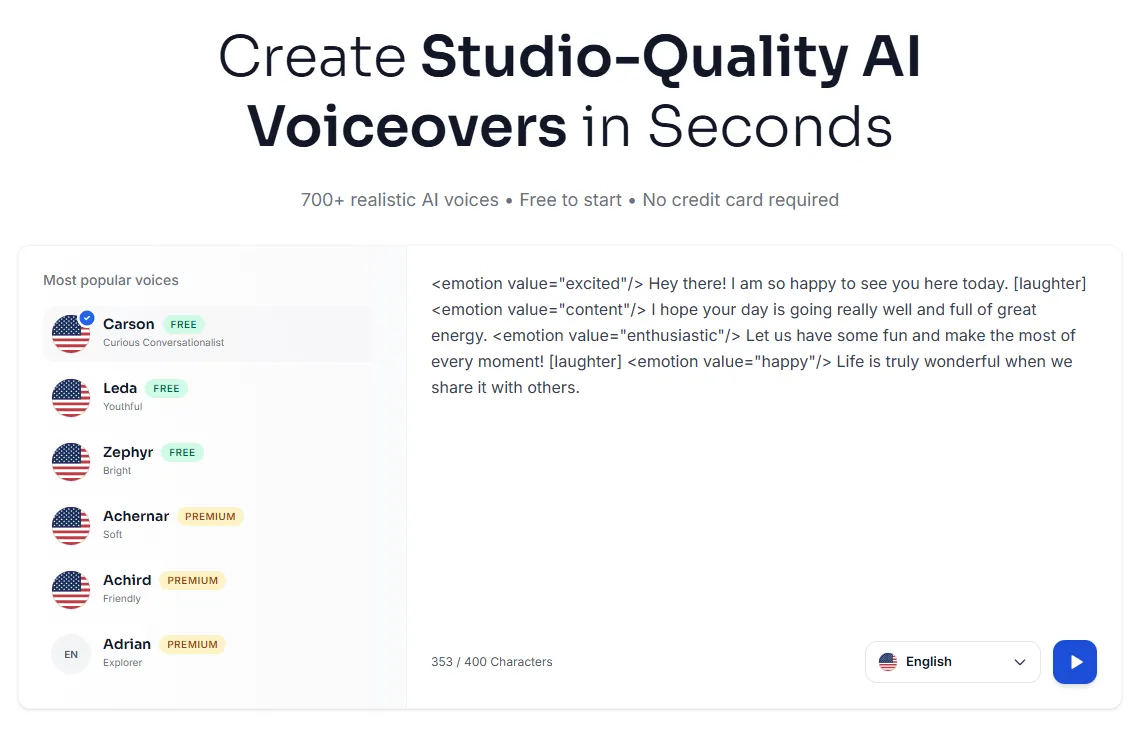
Here's how to make an explainer or marketing video voiceover in Kveeky.
- Paste your script into the voice generator.
- Choose a voice from 700+ AI voices in 40+ languages, or use a voice clone.
- Set tone, pitch and speed. Slow down slightly for the CTA.
- Add pauses with punctuation after the main benefit.
- Use emotion tags sparingly, such as
<emotion value="excited"/>on the opening hook. - Download MP3 or WAV and add it to your video editor under the animation.
The free plan gives you 500 credits a month (about 6.6 minutes) with standard voices and no credit card. Every paid plan includes commercial usage rights, so you can publish the video on your site and in ads. See the Kveeky pricing page.
How to audit an explainer video that isn't converting
- Check where viewers stop. Use your video host's analytics to find the drop-off point.
- Read the script at that point. Is it crowded, vague or about "we"?
- Count "you" vs "we." If "we" wins, rewrite around the viewer.
- Listen without the visuals. Does the voice alone make the benefit clear?
- Change 1 thing and test. Swap the voice, slow the pace or rewrite the CTA, not all 3 at once.
- Compare clicks, not views. The goal is sign-ups or demo requests.
Our guide on how to A/B test voiceover styles without re-recording shows how to set up the test. The same principles apply to short ads; see AI voiceovers for LinkedIn video ads.
Frequently asked questions
Does the voice in an explainer video affect conversions?
It can. A voice that doesn't fit the buyer, a rushed read or a weak CTA can lose viewers before they act. The voice is also the easiest part of the video to change and test.
Should I use an AI voiceover for my explainer video?
For most product explainers, yes. AI voice is fast to update and cheap to test in several versions and languages. For a brand film or founder story, a human voice may be worth the cost.
How long should an explainer video be?
We suggest 60 to 90 seconds for most explainers. Focus on 1 problem, 1 solution and 1 call to action. If you have more to say, make a short series instead of 1 long video.
Why is my explainer video getting views but not clicks?
Usually the call to action is vague, rushed or doesn't match the screen. Name 1 clear action, slow the voice down for it and show only that action on screen.
What voice works best for a B2B explainer video?
A calm, confident, conversational voice usually fits B2B buyers. Avoid a hard-sell "infomercial" read, especially for enterprise, security or finance products.
How we checked this guide
This guide is written by Deepak Gupta for the Kveeky team. Disclosure: Kveeky makes an AI voice generator.
- Kveeky features, free plan and rights come from kveeky.com/pricing, retrieved on October 6, 2026.
- The timing table and voice-matching table are practical guidance, not results from a study.
- No Kveeky usage data is used in this guide. We removed earlier references to market reports we could not trace to a primary source.
Ready to test a new voice on your explainer? Take your current script, trim it to 1 problem and 1 solution, and generate 2 versions with AI voiceovers for explainer videos. For more ways teams use AI voice in marketing, see our hub on how businesses use text-to-speech tools.