Internal Training Videos Nobody Wants to Watch? Fix the Voice First

TL;DR
- ✓ Poor audio quality causes employees to categorize training as low-priority noise.
- ✓ Cognitive load increases when learners struggle to decode muddy or robotic voiceovers.
- ✓ High-quality audio establishes authority and signals that the content is worth learning.
- ✓ Matching your voiceover tone to your company persona improves employee connection and retention.
If employees skip or half-watch your internal training videos, fix the corporate training voiceover first. A muddy, rushed or monotone voice makes even good content hard to follow. Audit 3 things: clarity, pace and tone. Then rewrite the script for the ear and choose AI or a human voice by content type.
Last updated: October 6, 2026. Accessibility rule checked against the W3C WCAG 2.2 Understanding pages on that date.
This guide is for L&D teams, HR, compliance owners and managers who make internal training videos. It shows how to find what's wrong with the voice, how to fix the script, and when AI voice is the faster, cheaper choice.
Key Takeaways
- Listen with your eyes closed. If you can't get to the end without checking your phone, your employees can't either.
- Check clarity, pace and tone, in that order. Clear sound comes before everything else.
- Write for the ear. Short sentences, contractions and "you." Policy documents read aloud sound robotic, human or AI.
- Use AI voice for content that changes often: compliance, software and process training. Use a human for leadership and culture messages.
- Caption every training video. It's a WCAG Level A requirement for prerecorded audio in synchronized media, and it helps everyone.
On this page: Why employees tune out · How the voice affects engagement · Audit · Match the voice · Write for the ear · AI or human · Recording basics · In Kveeky · Keep it current · FAQ
Why do employees ignore internal training videos?
Most internal training is built to tick a box, not to teach. Employees learn quickly that the video will play whether they listen or not, so they open email in another tab.
The common causes are:
- Too long. One 30-minute video where five short ones would do.
- Dense scripts. Policy text read word for word, full of passive voice and jargon.
- Poor audio. Echo, background noise and changing volume.
- A flat voice. Every sentence at the same speed and pitch.
- No reason to care. The video never says why the topic matters to the viewer's job.
The voice touches 4 of these 5. That's why it's the best place to start.
How does the voiceover affect training video engagement?
Learners only have so much attention. If they have to work to hear the words, they have less left to understand them.
Clarity. Echo, noise and mumbling make learners strain. That effort comes straight out of their attention for the content.
Pace. A rushed read leaves no time to process a new rule or step. A slow, flat read invites multitasking. Good pacing slows down for new ideas and keeps moving through familiar ones.
Tone. A voice that sounds like it's talking to the learner holds attention better than one reading at them.
For the learning research behind this, see our summary of what studies say about voice and learning retention.
How to audit your corporate training voiceover
Pick your most important training module. Close your eyes and listen to the first 5 minutes. Then score it.
| Check | Question to ask | Common fix |
|---|---|---|
| Clarity | Is every word clear on a laptop speaker and cheap earbuds? | Re-record closer to the mic, or regenerate with a clear AI voice |
| Volume | Does the level stay steady from start to end? | Normalize the audio in your editor |
| Pace | Is there time to absorb each new rule or step? | Add pauses after key points; slow down for new ideas |
| Tone | Does it sound like a person talking to you? | Rewrite for the ear; choose a warmer voice |
| Fit | Does the voice match the topic? | Use the voice-matching table below |
Fix clarity first. A perfect script won't help if people can't hear it.
Which voice fits each type of training?
Different training needs a different voice. Use this as a starting point.
| Training type | Voice style | Pace |
|---|---|---|
| Safety and compliance | Steady, clear, authoritative | Measured, with pauses after each rule |
| Software and process how-tos | Friendly, neutral, precise | Default; slow down for each click |
| HR and new-hire onboarding | Warm, welcoming | Relaxed |
| Leadership and culture | Personal, ideally a real leader | Natural speaking pace |
| Sales and product enablement | Confident, brisk | Slightly faster |
Keep 1 voice per training program so the series feels connected. New-hire onboarding has a lot in common with customer onboarding; our guide to AI voiceovers in customer onboarding sequences covers sequencing.
How to write training scripts for the ear
The biggest mistake in corporate training is pasting a policy document into a script. Written policy is built for reading. Spoken training needs to sound like a person explaining it.
Written for the eye: "Employees are required to ensure that all expense submissions are accompanied by itemized receipts prior to the end of the reporting period."
Written for the ear: "When you submit an expense, attach an itemized receipt. Do it before the end of the month, or it can't be paid."
Use these rules:
- Use "you." Talk to the learner, not about "employees."
- Use contractions. "You'll" and "don't" sound natural.
- Keep sentences short. If you run out of breath reading it aloud, split it.
- Lead with why. Say why the rule matters before you explain it.
- One idea per video. Split long modules into short videos.
- Recap at the end. Repeat the 1 or 2 things the learner must remember.
AI voice or human voice actor for corporate training?
Choose by 2 questions: how often will this content change, and how personal is it?
| Content | Changes often? | Personal? | Best fit |
|---|---|---|---|
| Compliance and policy updates | Yes | No | AI voice |
| Software and tool training | Yes | No | AI voice |
| Process and safety procedures | Sometimes | No | AI voice |
| Training for a multilingual workforce | Yes | No | AI voice in each language |
| Leadership messages and company values | Rarely | Yes | A real leader or a human voice actor |
There's also a middle path: clone a trainer's or leader's voice, with their written consent. You keep a familiar voice and can still update scripts without booking their time.
If someone in your team records many hours of narration, our guide on how to narrate a long course without vocal strain helps protect their voice.
If you record in-house, fix the audio basics
You don't need a studio. These 3 fixes solve most in-house audio problems:
- Move the mic closer. About a hand's width from the mouth reduces room echo.
- Use a pop filter. It stops hard "p" and "b" sounds from distorting.
- Soften the room. Record in a small room with curtains, carpet or soft furniture, not a glass-walled meeting room.
Also caption every training video. WCAG 2.2 success criterion 1.2.2 (Level A) requires captions for prerecorded audio in synchronized media. Captions help employees who are deaf or hard of hearing, non-native speakers and anyone watching without sound. Our course accessibility guide covers captions and transcripts.
How to make a corporate training voiceover in Kveeky
- Rewrite the script for the ear using the rules above.
- Choose a voice from 700+ AI voices, or clone a trainer's voice with their consent.
- Set tone, pitch and speed to match the training type.
- Add pauses with punctuation after each rule or step.
- Fix pronunciation of product names and acronyms by re-spelling them.
- Export MP3 or WAV and add it to your training video or authoring tool.
- Translate and regenerate for other offices. Kveeky has voices in 40+ languages.
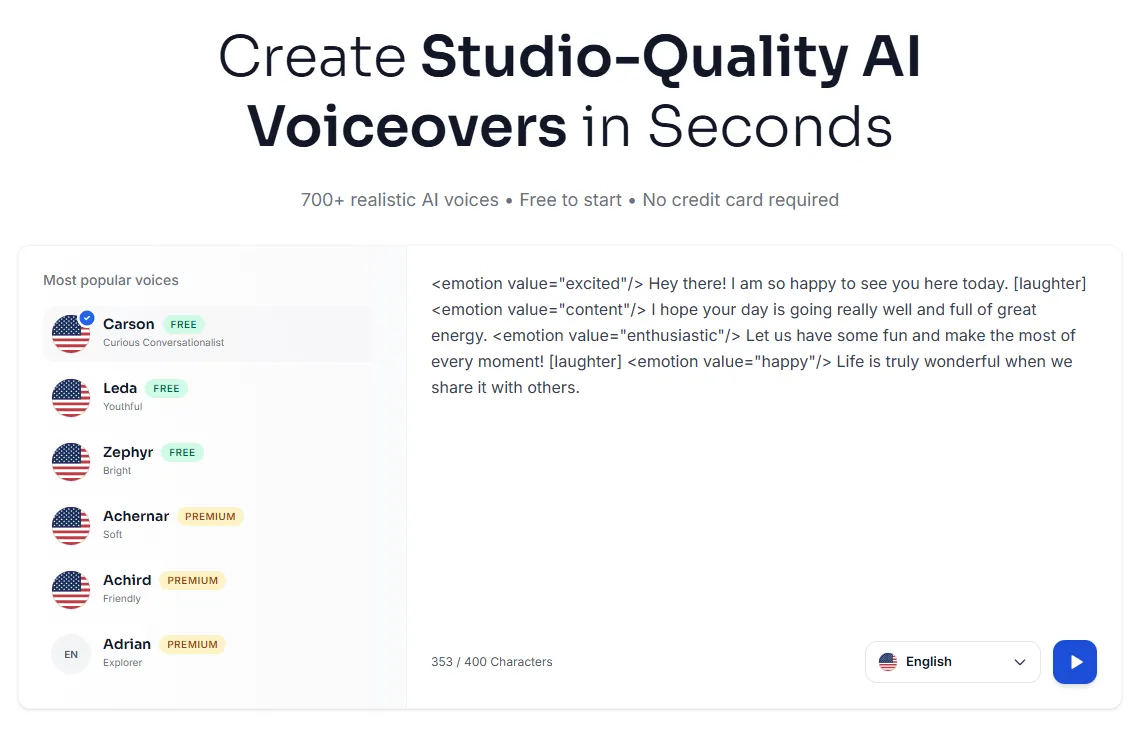
The free plan includes 500 credits a month (about 6.6 minutes) to test a module. The Business plan includes 1,000 minutes a month and 20 voice clones for larger training libraries. Every paid plan includes commercial usage rights. See the Kveeky pricing page for all plans.
How to keep training videos up to date
Outdated training teaches the wrong process. Keep it current with a light routine.
- Store scripts next to the policy they describe. When the policy changes, the script owner sees it.
- Give each module an owner and a review date.
- Regenerate only the changed lines with the same voice and settings, so the update matches.
- Review the library once a year, and retire videos for tools you no longer use.
Frequently asked questions
Why do employees ignore training videos?
Usually the video is too long, the script reads like a policy document and the audio is unclear or monotone. Shorter videos, scripts written for the ear and a clear, well-paced voice fix most of it.
Should I use AI voice or a human voice actor for corporate training?
Use AI voice for compliance, software, process and multilingual training that changes often. Use a real leader or a human voice actor for leadership and culture messages, where the personal voice is part of the point.
How does audio quality affect training videos?
Unclear audio makes learners work harder to hear the words, leaving less attention for the content. Clear sound, steady volume and good pacing make training easier to follow and finish.
What is the biggest mistake in training video scripts?
Reading a written policy word for word. Rewrite it for the ear: use "you," short sentences and contractions, explain why the rule matters and recap at the end.
Do internal training videos need captions?
You should caption them. WCAG 2.2 success criterion 1.2.2 (Level A) requires captions for prerecorded audio in synchronized media. Captions also help non-native speakers and anyone watching without sound.
How we checked this guide
This guide is written by Deepak Gupta for the Kveeky team. Disclosure: Kveeky makes an AI voice generator.
- The captions requirement is quoted from the W3C's Understanding SC 1.2.2 Captions (Prerecorded), retrieved on October 6, 2026.
- Kveeky features and plan details come from kveeky.com/pricing, retrieved on October 6, 2026.
- No Kveeky usage data is used in this guide. The audit and voice-matching tables are practical guidance, not results from a study.
Ready to fix your most-skipped module? Rewrite its script for the ear and generate a new version with AI voiceovers for training videos. For more business uses of AI voice, see our hub on how businesses use text-to-speech.