The Hidden Cost of Inconsistent Voice Across Your Marketing Content

TL;DR
- ✓ Inconsistent brand voice creates a trust gap that severely damages B2B conversion rates.
- ✓ Voice drift occurs when content teams and AI tools lack a unified framework.
- ✓ Brand consistency is proven to increase annual revenue by up to thirty-three percent.
- ✓ Psychological skepticism triggers when brands fail to maintain a predictable, coherent identity.
Inconsistent brand voice is the silent parasite of the B2B SaaS world.
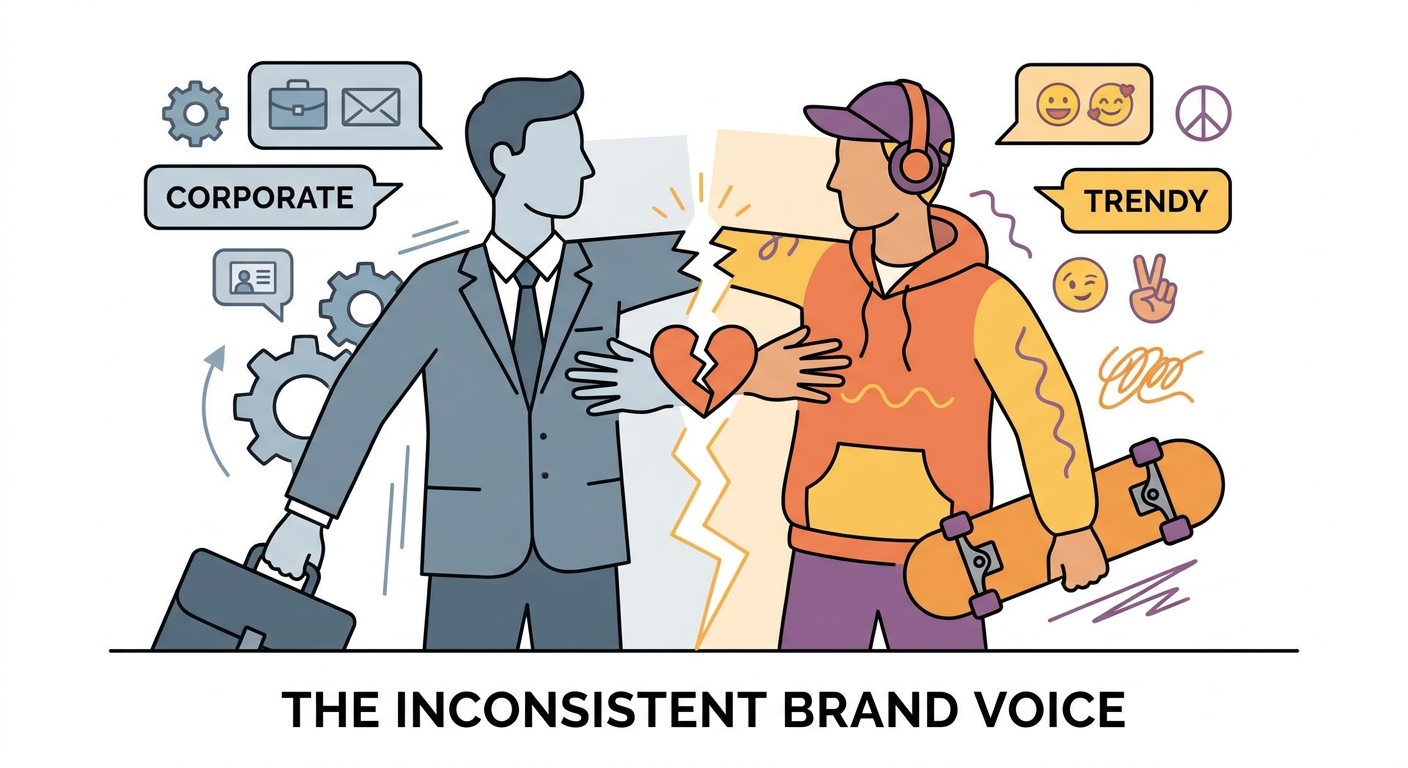
Think about the last time you met someone who couldn't decide who they wanted to be. One minute they’re speaking in stiff, academic riddles; the next, they’re throwing around awkward slang like they’re trying to win a "cool human" award. You wouldn't trust them with your keys, let alone your business. Yet, this is exactly what happens when your marketing content lacks a unified pulse.
This "personality disorder" creates a friction-filled customer journey that bleeds revenue, confuses your best prospects, and forces your team to overspend just to keep the lights on. According to 50+ Branding Statistics for 2026, a broken brand narrative isn't just a cosmetic flaw—it’s a fundamental growth killer that turns interested prospects into hardened skeptics.
What is "Voice Drift" and Why is it Killing Your Conversion Rates?
To fix the problem, we have to stop confusing identity with expression. Your brand identity is the bedrock—it’s your mission, your values, and your vision. Your brand voice? That’s the filter. It’s the specific way that identity shows up in a conversation.
When you lack a rigorous framework, you fall victim to "voice drift."
Voice drift happens the second your content team, sales reps, and automated AI tools stop talking to each other. One day you’re a "thought leader," the next you’re a "salesy hustler," and by Wednesday, you’re reading like a technical manual from 1998.
This inconsistency triggers deep-seated psychological skepticism. Humans are hardwired to look for patterns. When a brand fails to provide a consistent signal, our brains flag it as a glitch. This is the inverse of the "Mere Exposure Effect." Normally, familiarity breeds trust. But if your brand doesn't sound like the same entity across every touchpoint, the customer subconsciously assumes you don't know who you are. And if you don't know who you are, why on earth should they entrust their infrastructure to you?
Does Inconsistency Really Impact the Bottom Line?
The financial stakes are far higher than most CMOs care to admit. Research consistently shows that a coherent brand presentation is one of the most reliable predictors of financial growth. Data suggests that staying consistent across all platforms can bump your revenue by as much as 33%, as noted in the Brand Consistency Statistics (2026).
When you fragment your voice, you aren't just losing brand equity; you’re losing cold, hard cash. The Role of Consistency in Brand Messaging makes it clear: messaging alignment is the primary driver of perceived reliability in high-stakes B2B purchasing. If your whitepapers sound like a tenured professor and your sales emails sound like a desperate used-car salesman, the dissonance creates a "trust gap." That gap is exactly where your deals go to die.
What are the Hidden Costs of a Fragmented Voice?
The damage usually shows up in three specific, painful ways:
The Cognitive Load Tax: Every time a prospect hits a piece of your content that feels "off," they have to work to decode it. They’re performing mental gymnastics just to figure out if you're the same company they talked to yesterday. In B2B SaaS, where attention spans are measured in seconds, this friction leads to an immediate bounce.
CLV Erosion: Customer Lifetime Value is built on relationships. Relationships are built on consistency. If you can’t maintain a coherent identity, you can’t build a long-term connection. Customers who feel the "mood swings" of a brand are less likely to advocate for it and are the first to churn the second a competitor offers a more stable, predictable experience.
CAC Inflation: Poor campaign performance is almost always a symptom of voice inconsistency. If your ads, landing pages, and email sequences aren't singing from the same songbook, your conversion rates will tank. When conversion rates drop, your Customer Acquisition Cost skyrockets. You end up spending more to acquire the same lead simply because your brand is failing to "land" the message.
How Does AI-Induced Fragmentation Change the Game?
In 2026, the challenge has shifted from human error to algorithmic drift. Generative AI is a double-edged sword. It can churn out content at a blistering pace, but without strict governance, it defaults to the "generic middle."
If you feed an AI a weak prompt without a rigid style guide, it will produce content that sounds exactly like your competitors—bland, predictable, and devoid of the nuance that makes your brand yours.
To manage this, you must implement a "Content Governance Loop." Treat AI like a junior drafter, not a final authority.
How Can You Fix the Disconnect Between Sales and Marketing?
The most common failure point in B2B is the "Aspirational vs. Transactional" gap. Marketing writes copy that is high-level and aspirational. Sales writes copy that is tactical and transactional. When these two voices collide, the customer experiences a jarring disconnect.
Bridging this silo requires a shared lexicon. Marketing shouldn't just hand over a brand book; they should build a messaging playbook that defines how to talk about features, handle objections, and frame value propositions across every stage of the funnel. If you need help professionalizing your messaging architecture, exploring Brand Strategy Services can provide the objective, outside-in perspective required to align these internal departments.
How to Build an Unbreakable Brand Voice (The Actionable Framework)
Consistency is a discipline, not a one-time project. Here is how you build a resilient, unbreakable voice:
Step 1: The Content Audit You can't fix what you haven't identified. Perform a deep-dive audit of your last 20 pieces of content—emails, blog posts, sales decks, and ad copy. Highlight every instance where the voice feels like a different person wrote it. You’ll be shocked by how much your "voice" changes based on who happened to be at the keyboard.
Step 2: Developing the Brand Voice Style Guide Stop using vague terms like "professional" or "friendly." Define your voice through pillars. Are you "The Challenger" or "The Collaborator"? "Technical" or "Accessible"? Create a living document that includes "Yes/No" examples of phrasing. If your internal capacity for this is stretched, Content Creation Services can help establish the initial baseline for these assets.
Step 3: Implementing AI Guardrails Stop using generic prompts. Create a library of "System Prompts" that include your brand’s specific tone, forbidden words, and preferred sentence structure. Every AI-generated draft should be run through a "Brand Voice Check" that compares the output against your style guide before it ever reaches a human editor.
Can You Measure the ROI of Consistency?
Measuring the ROI of "voice" isn't about vanity metrics; it’s about tracking the friction points in the funnel. You can measure "Voice Alignment" by analyzing the conversion rates of unified campaigns versus fragmented ones. A unified voice reduces the cognitive load on the prospect, leading to a smoother, faster path from awareness to decision.
By tracking the time-to-conversion and the cost-to-acquire for prospects who engage with multiple pieces of consistent content, you will find that the "Voice Alignment" metric is directly correlated with your bottom-line profitability.
Frequently Asked Questions
How do I measure the ROI of brand voice consistency?
Measure it through the lens of conversion rate optimization (CRO) and CAC. When your voice is consistent, prospects move through the funnel with less friction, which manifests as higher conversion rates at each stage and a lower total cost to acquire a customer.
What is the difference between brand voice and brand tone?
Brand voice is your brand’s personality—it is constant and unchanging. Brand tone is the situational application of that voice. You might sound authoritative in a whitepaper (voice) but empathetic in a customer support email (tone). The underlying personality remains the same, but the "volume" adjusts based on the context.
How can I ensure AI-generated content stays on-brand?
Implement a "Golden Copy" reference library in your AI system prompts. By providing the AI with high-performing, on-brand examples and explicit "do-not-do" rules, you lock the model into your specific brand frequency, preventing it from regressing to the generic mean.
How often should we audit our brand voice for drift?
At a minimum, conduct a full voice audit quarterly. If your organization undergoes a major strategic pivot, a GTM change, or a significant expansion into a new market, perform an immediate audit to ensure your messaging hasn't drifted away from your core identity.