
The honeymoon phase with generative AI is dead. If you spent the last two years treating your creative process like a slot machine—typing a prompt into a chatbot and praying for a miracle—you’ve likely realized that the "magic" has hit a wall. We’re moving past the novelty act. We’re entering a phase, as highlighted in 2026 Generative Media Trends, where the internet has developed an allergy to generic, machine-made sludge. The demand now is for verifiable, high-fidelity, strategically sharp work. The era of the "prompt-and-pray" hobbyist is over. The era of the Agentic Workflow has arrived.
What Does an "Agentic" Creative Workflow Actually Look Like?
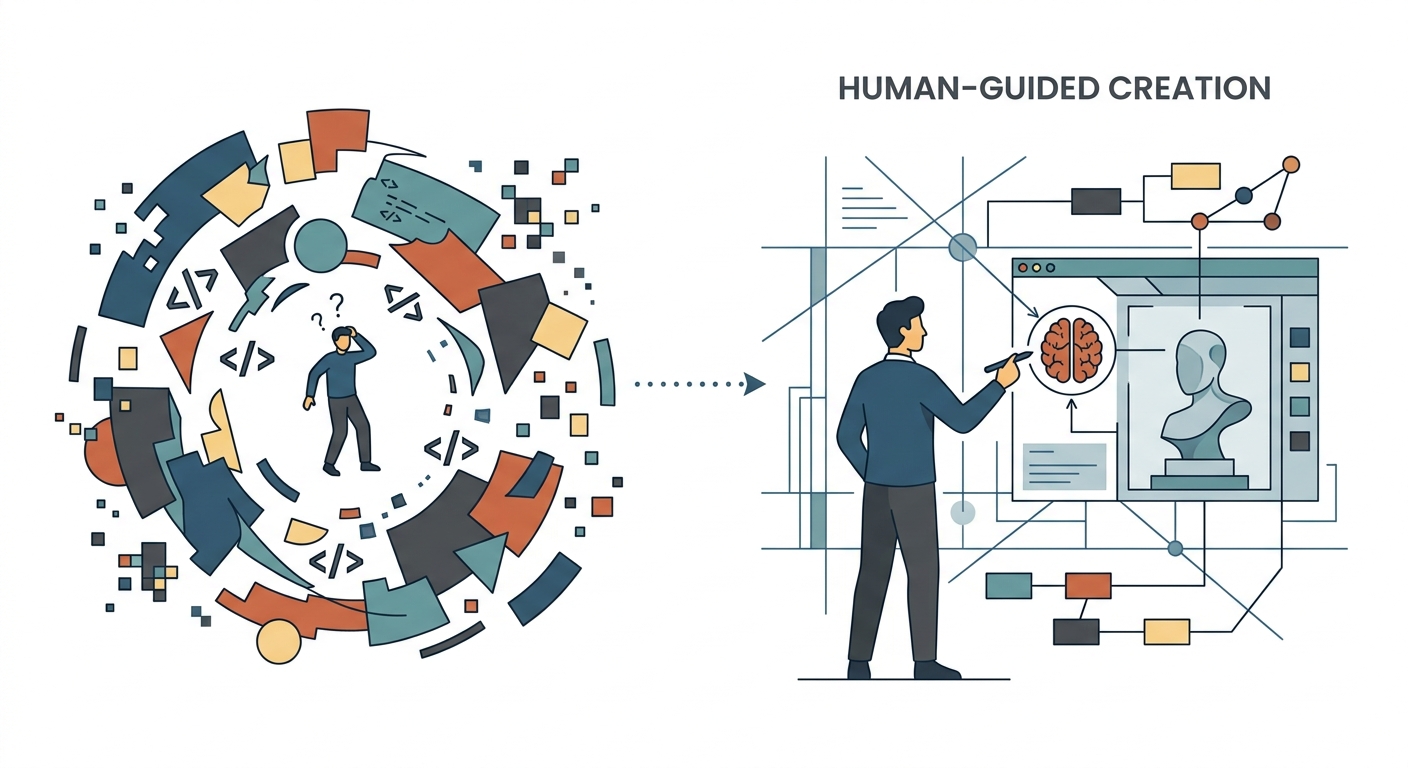
Most creators are making a fundamental mistake: they treat AI as a tool that replaces the doing. They want it to write the email, design the banner, and post the tweet while they sit back and sip coffee. That doesn't work. It makes you a spectator in your own business.
The most powerful systems treat AI as a subordinate staff member—a hyper-efficient intern that handles the drudgery of execution, while you act as the Director. An agentic workflow isn't just a chatbot that spits out a paragraph. It’s a system of interconnected agents capable of autonomous research, iterative drafting, and multi-platform distribution.
In this model, you provide the "Creative North Star." The agent doesn't decide what to say; it decides how to say it based on your strict guardrails. By offloading the heavy lifting of data synthesis and formatting, you are finally free to focus on the one thing AI cannot replicate: taste.
How Do You Build a Brand-Aligned AI Stack?
The biggest danger in the current landscape is "model homogenization"—the tendency for all AI content to sound, look, and feel like a bland, middle-of-the-road average of the entire internet. If your brand voice is bold and contrarian, but your AI stack is trained on generic web-scraped data, you’re just watering down your own equity.
Building a brand-aligned stack means moving away from off-the-shelf prompts and moving toward fine-tuning. You need to feed your models your own back-catalog, your white papers, and your historical assets. If the model doesn't know your history, it can’t represent your future. Understanding why brand voice matters in the AI age is the difference between being a voice in the crowd and an industry authority. When you curate your models to mirror your specific syntax, cadence, and visual aesthetic, the AI stops being a generator. It becomes an extension of your brand’s personality.
The Multimodal Toolbox: Which Tools Are Leading the Pack?
The most effective creators today aren't picking one tool; they’re building a "stack" that talks to itself across different media formats.
Writing & Strategy Agents (The Brains)
The "Brains" of your operation should be built on models that prioritize deep-context retrieval. Stop using standard chat interfaces for serious work. Look for tools that let you upload a "Knowledge Base"—your brand guidelines, past articles, and target audience personas. By integrating these into our AI-powered creative process, you ensure that every output is grounded in verifiable facts rather than hallucinations. Use AI to find the "connective tissue" between complex topics that human researchers might miss.
High-Fidelity Video & Visuals (The Eyes)
We have moved past the era of glitchy, six-fingered AI art. We’re in the age of cinematic realism. Tools like Google Veo are bridging the gap between static imagery and high-fidelity video production. You can now generate B-roll, motion graphics, and narrative sequences that feel intentional rather than randomly generated. The shift here is from "making an image" to "directing a scene," where the AI adheres to consistent lighting, character models, and environmental physics.
Voice Agents & Audio (The Ears)
Text-to-speech has evolved into adaptive voice agents that understand the emotional weight of a script. Modern platforms like ElevenLabs allow for granular control over cadence and inflection. A great voice agent doesn't just read; it performs. For podcasters and short-form creators, this means you can localize content into dozens of languages while keeping the exact timbre and personality of the original speaker. You can go global without losing your soul.
Video Editing Agents
Editing is the part of the stack that stayed manual the longest. You could generate a hundred shots in an afternoon and still lose a week assembling them in a timeline that knew nothing about the script they came from. The invideo editor is an agentic video editor built on the other side of that problem: its timeline already holds your script and approved takes, so you can ask for a lineup and get a rough cut in script order, then refine it by hand or simply say "give me three shorter versions." It won't replace Resolve on a heavy grade, but it gets you from a folder of clips to something watchable enough to judge.
The "Anti-Generic" Guide: How to Maintain Human Authenticity
To stay human in an automated world, you must embrace "Human-in-the-loop" (HITL) editing. Never publish the first draft. The "Anti-Generic" workflow requires three distinct layers of human intervention:
The Structural Edit: Did the AI follow the logic of your strategy, or did it wander into a generic summary? If it feels like a robot wrote it, it’s because it did. Cut the filler.
The Anecdotal Injection: AI can synthesize information, but it cannot have experiences. You must manually inject personal anecdotes, specific client wins, or "I-was-there" stories that the AI could never know. This is where your brand actually lives.
The Provenance Check: In a world of synthetic media, trust is a currency. Use watermarking and provenance metadata to verify that your content was human-directed. If you aren't proving your work is original, your audience will eventually assume it is just another piece of automated noise.
What Is the Real Cost of AI Creativity?
The "cost" of AI isn't just the monthly subscription fee—it’s the time spent managing the tools. For a solo creator, a "Lean Stack"—a high-end LLM for strategy, a voice clone service, and a video generation tool—usually runs between $100 and $300 a month. Think about that. That replaces a junior copywriter, an editor, and a freelance translator.
However, be careful. Moving to an "Enterprise Agent" tier often involves custom API integrations and private server hosting to protect your proprietary data. For agencies, this is a no-brainer: the ROI is found in the speed of iteration. If you can move from concept to final cut in four hours instead of four days, your margins grow fast. The trap is paying for enterprise tiers before you’ve standardized your workflow. Start lean. Validate your process. Only scale your tech stack when you have a bottleneck that automation can actually solve.
The Future of Creative Work: What’s Coming in the Next 6-12 Months?
We are approaching the age of "Personalized Media Feeds." Imagine a world where your newsletter or video content isn't a static file sent to 10,000 people, but a dynamic asset that adjusts its tone, examples, and length based on the specific audience segment consuming it.
In the next year, we will see the rise of agents that don't just create, but distribute based on real-time feedback loops. Your creative suite will tell you, "The audience in Segment A didn't respond to the video intro, so I’ve re-cut the hook for the next batch." This is the logical conclusion of the agentic workflow: a closed-loop system where the creative process is constantly learning from the audience's attention, not just guessing at what they want to see.
Frequently Asked Questions
Are these AI tools actually replacing human creatives?
No. They are replacing the "production-line" tasks that humans hate. Strategy, taste, and the ability to connect disparate ideas are uniquely human domains. AI is the brush; you are still the painter.
How do I prevent content from sounding like generic AI?
Stop prompting for "professional" or "engaging" content. Instead, feed the model your best-performing past work and explicitly tell it to avoid common AI tropes like "In the ever-evolving landscape" or "unlocking potential." Inject personal stories and specific data points that only you possess.
Which AI tools are best for small teams on a budget?
Focus on a "Lean Stack": a high-context LLM (like Claude or GPT-4o) for strategy, an audio tool like ElevenLabs for voice, and a video tool like Veo for visual assets. These three tools, when used in a refined, human-led workflow, can replicate the output of a five-person production team.
How do I ensure my AI-generated content is copyright-safe?
Always check the terms of service of your chosen tools to ensure they offer "commercial usage rights" and indemnity. Furthermore, ensure your agents are not pulling from restricted datasets. As of 2026, the best practice is to maintain a "chain of custody" for your assets—documenting the human directives used to create the final output.