TL;DR
- ✓ Eliminate long feature tours to prevent prospect drop-off and improve conversion rates.
- ✓ Focus on the result-first model to showcase transformation instead of technical product capabilities.
- ✓ Reach the Aha moment within 60 seconds to earn the viewer's continued attention.
- ✓ Use a surgical four-part script arc to ensure every syllable drives action.
On this page
A good 60-second product demo script shows the result first, then how the product gets there. Use 4 parts: a hook that names one problem, a quick look at the result, 2 or 3 workflow steps and a single call to action. Cut every feature that does not support that one result.
Last updated: October 6, 2026. We reviewed the framework, rewrote the template and removed unsourced statistics.
This guide is for SaaS founders, product marketers and sales teams who need a short demo video for a landing page, a sales email or social media. It covers the framework, a fill-in template, how to keep it under 60 seconds and how to voice it.
Key Takeaways
- Lead with the result, not the login screen. Show the finished outcome in the first 25 seconds.
- Use 4 parts: hook (0–10 s), result (10–25 s), workflow (25–50 s) and call to action (50–60 s).
- One problem, one result, one call to action. Every extra feature makes the product look harder to use.
- Design for mute. Captions and on-screen highlights should tell the story even with the sound off.
- Voice it with AI to update it easily. When the product changes, edit one line of the script and regenerate that section.
On this page: Why short demos · Result first · Framework · Template · Timing · Mute-first · Voiceover · FAQ
Why feature tours lose viewers
A feature tour walks through every screen, starting with login and settings. It assumes the viewer already cares about your product. Most viewers don't yet, so they leave before they see why it matters.
A short demo has a different job. It doesn't teach the product. It makes the viewer want the next step: a trial, a call or a longer demo. The same logic applies to explainer videos that don't convert and to in-app tutorials.
Result-first product demo
A result-first demo starts with the outcome the customer wants, then shows how your product delivers it. It answers "how does my day get better?" before "what does this button do?"
| Feature-tour demo | Result-first demo |
|---|---|
| Opens with a logo and "Today I'll show you our platform" | Opens with the customer's problem in one sentence |
| Shows setup and settings first | Shows the finished report, dashboard or file first |
| Covers many features | Covers the 2 or 3 steps behind one result |
| Ends with several links or options | Ends with one clear call to action |
The 60-second demo framework
Use this 4-part arc. The timings are targets, not strict rules, but the whole video should land at or under 60 seconds.
Pick a speaking pace and see how many words each part of a 60-second demo can hold.
| Part | Time | Words |
|---|---|---|
| Hook | 10 s | 25 |
| Result | 15 s | 38 |
| Workflow | 25 s | 63 |
| Call to action | 10 s | 25 |
At 150 words a minute. Leave a second of silence after each click on screen, so aim a little under these numbers. Check a finished draft with the words to minutes calculator.
- Hook (0–10 seconds). Name one specific problem as a fact, not a question. Example: "You spend Friday afternoons copying invoice data into spreadsheets."
- Result (10–25 seconds). Show the finished outcome on screen: the reconciled report, the clean dashboard, the sent email. This is the moment the viewer thinks "that's what I need".
- Workflow (25–50 seconds). Show 2 or 3 steps that produce the result. Use zooms and highlights so the viewer can follow without reading small text.
- Call to action (50–60 seconds). Give one path only: "Start your free trial" or "Book a demo". Don't offer a menu of options.
What to cut
Ask one question about every line: "Does this help the viewer see the result faster?" If not, cut it. Common cuts are logo intros, login screens, settings pages and "we also have" lists.
Demo script template
Copy this product demo script, fill in the brackets, then read it aloud with a timer.
| Time | Voiceover | On screen |
|---|---|---|
| 0–10 s | "[Role]s spend [time] every [period] on [manual task]." | The messy "before": spreadsheet, inbox or manual process |
| 10–25 s | "With [Product], that becomes [result] in [time you can prove]." | The finished result, full screen |
| 25–50 s | "Just [step 1]. Then [step 2]. [Product] does the rest." | The 2 or 3 steps, with zooms and highlights |
| 50–60 s | "[One call to action, such as Start your free trial]." | Logo, URL and button |
Only use time savings and numbers you can prove for your own product. If you're not sure, describe the result without a number.
Paste this into your notes or your script box, then replace each bracket.
Show me: a filled-in 60-second script (made-up invoice tool)
- Hook: "Finance teams spend Friday afternoons copying invoice data into spreadsheets."
- Result: "With this tool, that becomes a reconciled report you can open on Monday morning."
- Workflow: "Just forward your invoices. Then check the matches. The tool does the rest."
- Call to action: "Start your free trial."
The product here is invented to show the shape. Each part is one or two short sentences and the call to action is a single path.
Keeping a demo under 60 seconds
Most demo scripts run long on the first draft. Trim them in this order.
- Read the script aloud with a timer, or generate a quick AI voiceover and check its length.
- Cut adjectives and filler first: "really", "very", "easy-to-use", "powerful".
- Merge or remove a workflow step if the middle section runs past 25 seconds.
- Don't fix length by speeding up the voice. A rushed voice sounds like an ad disclaimer. Cut words instead.
- Sync audio and visuals. When the voice says "click", the cursor should click. When it says "report", the report should appear.
If you record the screen yourself, our screen recording tips for videos with voiceover help you capture clean footage that matches the script.
Designing for viewers on mute
Many people watch videos in feeds or offices with the sound off. Your demo should still make sense without audio.
- Add captions that state the value, not just the action. "Report ready in one click" beats "Click Export".
- Use visual cues such as circles, arrows and zooms to guide the eye.
- Put the key message on screen in the first few seconds, so it reads even before anyone unmutes.
Voicing your demo with AI
An AI voiceover makes a demo easy to update. When your interface or pricing changes, you change one line of the script and regenerate that section. You don't need to book a voice actor again.
- Paste the final script into an AI voice generator such as Kveeky.
- Choose a voice that fits your brand, from 700+ voices. A calm, confident voice suits most B2B demos.
- Set the delivery. Adjust the speed and volume, and choose an emotion such as Calm or Happy for the result line.
- Generate each part separately (hook, result, workflow, call to action) so you can replace one part later.
- Download the audio and place it on your timeline before you cut the screen recording.
Not sure which voice converts better? You can A/B test two voiceover styles on the same demo without re-recording. For general script techniques, see our guide to writing scripts for AI voiceover and the script structure templates.
Pick the line that sounds most like your situation.
How Kveeky helps
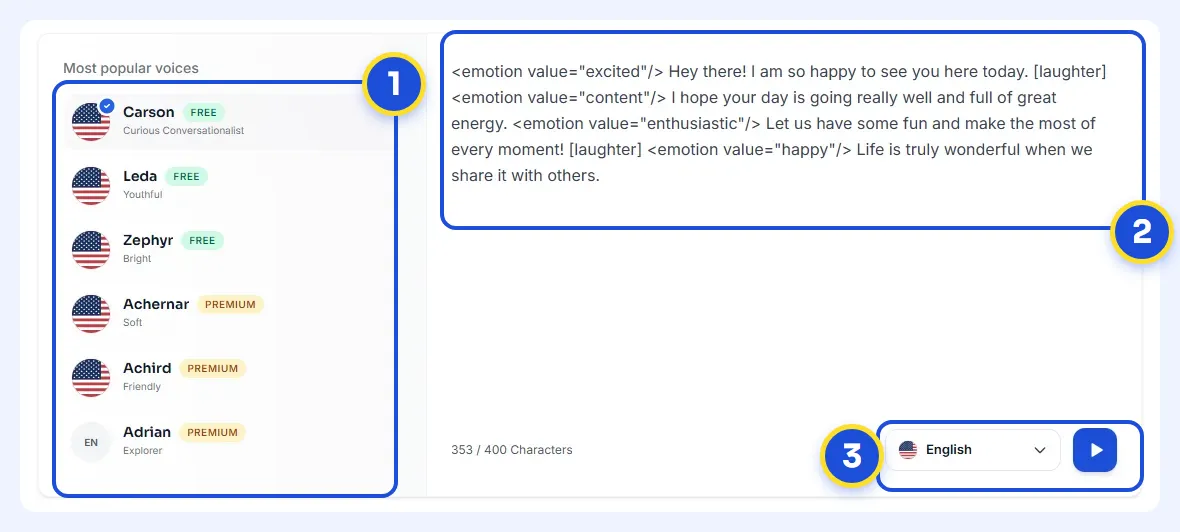
- 1Pick a voice. Voices are tagged Free or Premium.
- 2Type or paste a short line. Pick an emotion if you want one.
- 3Choose the language and press play to hear it.
Try it yourself in the free voice demo on Kveeky, no sign-up needed. For longer scripts and downloads, use the free plan.
Tick each one as you go.
Frequently asked questions
How long should a product demo script be?
For a 60-second demo, keep the script short enough to read aloud comfortably in under a minute. Time it with our words to minutes calculator or a quick AI voiceover, and cut words rather than speeding up the voice.
Is 60 seconds enough to explain a complex B2B product?
A 60-second demo isn't meant to explain everything. Its job is to sell the next step, such as a trial or a call. The deep dive happens in a longer demo or a sales conversation.
Should I include background music in a product demo?
Yes, but keep it quiet and simple. Music should support the energy without competing with the voiceover. Avoid tracks with vocals or busy rhythms.
Should I record the voiceover myself or use AI?
Use AI if you expect the product to change, because you can edit the script and regenerate one section. Record yourself, or hire a voice actor, if a specific founder's or brand voice is central to how you sell.
How do I update a demo video when the product changes?
Keep the script and the voiceover in separate sections. When a screen changes, re-record that clip, edit the matching script line and regenerate just that part of the voiceover.
- Why explainer videos aren't converting – how the voice changes what viewers do next.
- The perfect script structure for AI voiceovers – templates you can reuse.
- AI voiceovers in customer onboarding – turning the demo into an onboarding sequence.
- How much AI voiceover costs per video – real numbers before you commit.
- Voice providers – browse the providers behind the voices.
How we checked this guide
This guide is written by Hitesh Kumawat for the Kveeky team. Disclosure: Kveeky makes an AI voice generator.
- The framework and template are editorial recommendations, not results from a measured test.
- Kveeky features (700+ voices, speed and volume control, six emotions, audio download) come from kveeky.com, retrieved 2026-10-06.
- No Kveeky usage data is used in this guide.
Next step: fill in the template for your product, read it aloud with a timer, and cut until it fits in 60 seconds. Then pick a voice from our AI voiceover for product demos page and generate your first version.
Turn your script into a voiceover
Paste your text, pick a voice and download the audio. Free to start, no credit card.