TL;DR
- ✓ Use conversational scripts written for the ear to maintain listener engagement.
- ✓ Implement 90-minute recording sprints to prevent vocal strain and cognitive burnout.
- ✓ Treat your voice as a key asset for building student trust and rapport.
- ✓ Break content into 5-7 minute segments to keep your vocal delivery fresh.
On this page
These course narration tips will get you through a 10-hour course without straining your voice. Script for the ear, record in short blocks with real rest between them, and drink water all day. Treat your room before buying gear, mark your mic position, and use an AI voice for modules that don't need you.
Last updated: October 6, 2026. Voice-care advice was checked against the US National Institute on Deafness and Other Communication Disorders (NIDCD) on that date.
This guide is for creators, trainers and subject experts recording their own courses. They cover planning, scripting, protecting your voice, keeping a consistent sound over weeks, and deciding which parts to hand to an AI voice.
Plan a 10-hour course as many short sessions, not marathons. Write for the ear, record in blocks of about an hour or less with real rest in between, drink water all day, and stop when your voice turns hoarse or tired. Fix your room before you buy a mic, and hand procedures and updates to an AI voice. Time one test module first: it tells you how long the whole course really takes.
Key Takeaways
- Plan from a test module. Record and edit one module first, time it, and use that to plan the rest.
- Write for the ear. Short sentences, contractions and "you" language are easier to read aloud for hours.
- Rest is part of the schedule. NIDCD advises "vocal naps" through the day and not speaking when your voice is hoarse or tired.
- Consistency beats expensive gear. Same room, same mic distance, same settings and a reference clip keep 10 hours sounding like one course.
- Use AI voice where your personality isn't the point. Record intros and stories yourself; generate procedures, updates and reference modules.
On this page: Planning · Scripting · Sessions · Voice care · Room and mic · Consistency · Editing · AI voice · FAQ
Time to narrate a 10-hour course
Longer than 10 hours. Retakes, breaks, pickups and editing all add time, and the total depends on your script, your experience and your setup.
The honest way to plan is to measure:
- Pick one typical module of about 10 to 15 minutes of finished audio.
- Record and edit it fully, and note the time for each step.
- Divide the total time by the finished minutes. That gives you your own ratio.
- Multiply by the course length, then add a buffer for re-records and script fixes.
Run the 4-step test above, then enter your own numbers. The default of 4 is a placeholder, not a benchmark: replace it with the ratio you measured.
Planning arithmetic only. It does not predict your ratio; the test module does. Short blocks and rest days still apply.
This test also shows you where the script trips you up, before you've recorded 9 more hours of it.
To turn a script into minutes before you record, use the words to minutes calculator.
Script for the ear
Most narration problems start in the script. Text written for reading has long sentences, nested clauses and words that are hard to say.
- Keep sentences short. If you run out of breath reading a line, split it.
- Use contractions and "you". "You'll see" is easier to say and to hear than "The user will observe".
- Read it aloud before recording day. Mark tongue-twisters and rewrite them.
- Spell out numbers and acronyms the way you'll say them.
- Break the course into short lessons. Short files are easier to record, re-record and update.
Our guide to writing scripts for AI voiceovers applies to human narration too.
Plan short recording sessions
Long sessions make your voice tired and flatten your delivery. No single number is right for everyone, so plan short blocks and stop early when your voice changes.
A practical starting plan:
- Warm up gently before each session, for example humming and easy lip trills.
- Record in blocks of about an hour or less, then take a real break away from the mic.
- Rest your voice during breaks. Avoid long calls or loud conversations.
- Stop for the day if you feel hoarse, need to clear your throat often, or hear your pitch dropping.
- Spread the course over several days. A few focused sessions per day beat one marathon.
These are planning suggestions, not medical rules. If you use your voice heavily every day, a speech-language pathologist can give you advice that fits you.
Protecting your voice
The NIDCD, part of the US National Institutes of Health, lists simple habits that protect your voice.
- Drink plenty of water, and balance caffeine and alcohol with extra water.
- Take "vocal naps" and rest your voice through the day.
- Use a humidifier in dry weather. NIDCD recommends about 30% humidity at home.
- Don't speak when your voice is hoarse or tired. Push through, and you risk making it worse.
- Breathe from your chest, not your throat, and avoid whispering or shouting.
- Avoid alcohol-based mouthwash and medications that dry your throat, where you can.
NIDCD lists warning signs such as hoarseness, a rough or raw throat, and frequent throat clearing. If they don't go away, see a doctor.
Set up your room and mic
Room echo is harder to fix than a cheap mic. Fix the room first.
- Use soft surfaces. Curtains, rugs, a sofa or a closet full of clothes absorb reflections.
- Hang a heavy blanket behind you or around your desk if the room is bare.
- Turn off noise sources such as fans, fridges and notifications.
- Keep the same mic distance. Mark your position with tape so your sound doesn't change between sessions.
- Lock your settings. Write down your gain and software settings and use them every time.
Sounding consistent over weeks
A 10-hour course is usually recorded over weeks. Listeners notice when module 9 sounds different from module 1.
- Record a 30-second reference clip on day 1 at your target pace and energy.
- Play it before every session and match it.
- Record at the same time of day when you can, so your voice is as similar as possible between sessions.
- Use the same room, mic, position and settings every time.
- Keep a pronunciation list for names and terms, so you say them the same way all course long.
Paste it into your course document. Fill in one log per session so module 9 sounds like module 1, and so you can update a single lesson later.
Tips for faster editing
Editing can take as long as recording. These habits cut it down.
- Pause and restart the sentence when you make a mistake. The silence makes the retake easy to spot in the waveform.
- Don't fix every "um" live. Keep going and remove them in the edit.
- Record 10 seconds of room silence at the start of each session. Noise-reduction tools use it as a reference.
- Name files by module and lesson so you can replace a single file later.
- Normalize loudness across all lessons so learners don't have to change the volume.
When to use an AI voice
You don't have to narrate every minute yourself. Keep your voice for the parts where learners want you, and use AI voice for the rest.
| Course section | Your recorded voice | AI voice or voice clone |
|---|---|---|
| Welcome and course intro | Best fit: builds trust in you as the teacher | Possible, but less personal |
| Personal stories and case studies | Best fit: your experience is the point | Not recommended |
| Step-by-step procedures | Works, but tiring to record | Good fit: clear and consistent |
| Reference and glossary lessons | Works | Good fit: easy to extend later |
| Updates after launch | Hard to match your old recordings | Good fit: regenerate only the changed lines |
| Translated versions | Only if you speak the language | Good fit: voices in many languages |
Pick a lesson type. The answers come from the table above.
Tell learners which lessons use an AI voice. Research summarized in our post on what studies say about voice in learning found modern text-to-speech performed close to human voices, but quality still affected trust.
If you mix voices, keep each one to a clear role. Our guide on when to use different narrators covers how.
How Kveeky helps
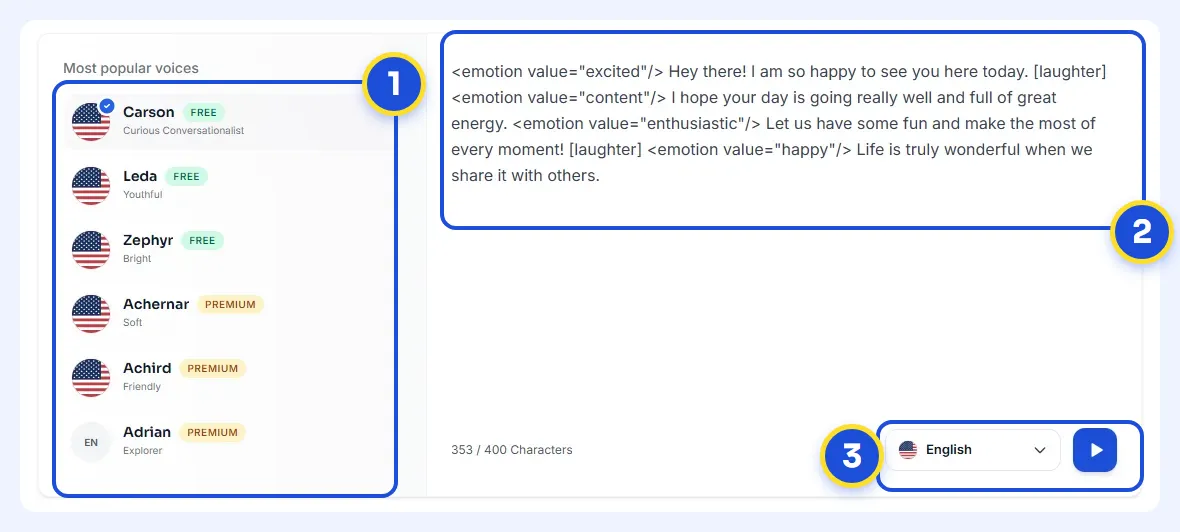
- 1Pick a voice. Voices are tagged Free or Premium.
- 2Type or paste a short line. Pick an emotion if you want one.
- 3Choose the language and press play to hear it.
Try it yourself in the free voice demo on Kveeky, no sign-up needed. For longer scripts and downloads, use the free plan.
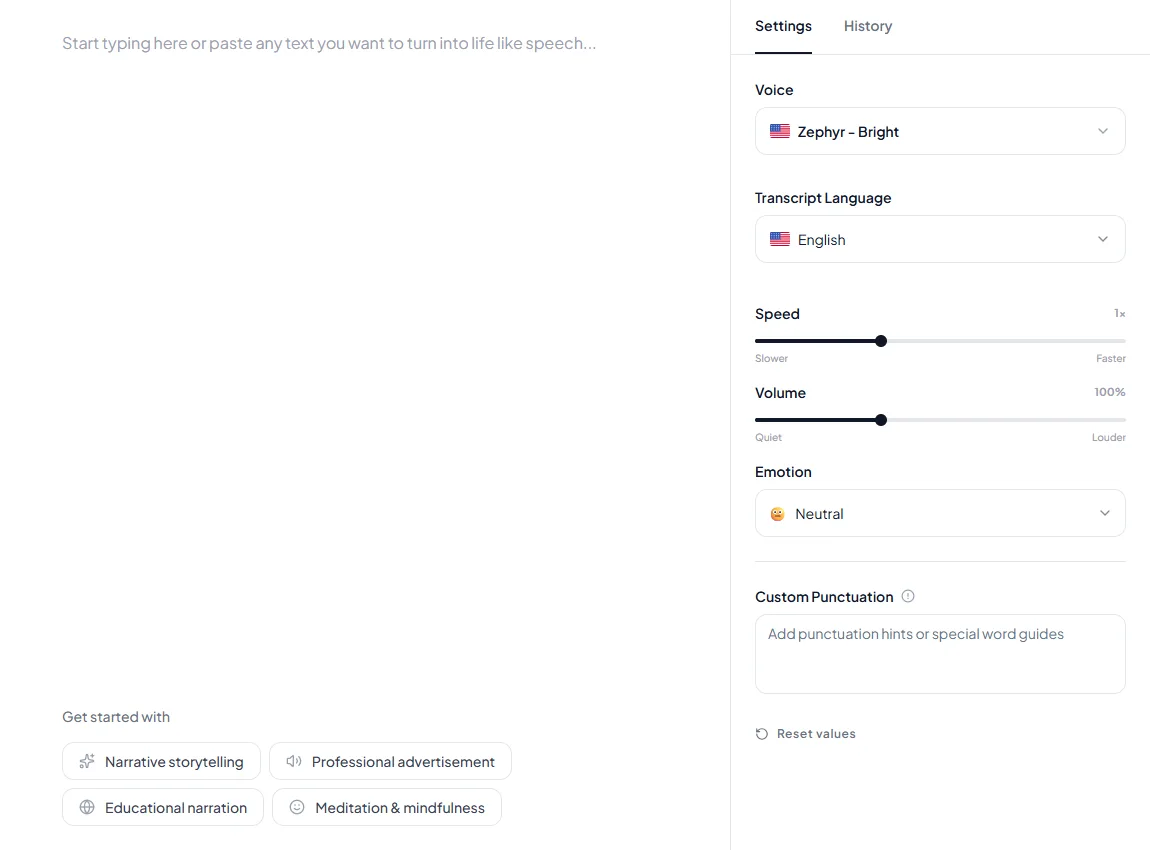
In Kveeky, you can paste a lesson script, choose from 700+ voices in 40+ languages, set emotion and speed, and download the audio for your editor. Cloning your own voice is covered on the pricing page; check which plan includes it. Our guide to cloning your own voice explains how it works.
Enter the course length and the share you would hand to an AI voice (procedures, reference, updates).
Estimate: 500 credits is about 40 seconds of audio on the free plan. Regenerating lines uses more credits. See the pricing page for plans.
Frequently asked questions
How long should a single recording session be?
There's no single safe number. Record in short blocks, about an hour or less, with real breaks, and stop when your voice feels tired or hoarse. NIDCD advises not speaking when your voice is hoarse or tired.
Does using AI voiceover make a course feel cheap?
Not if you use it for the right sections. Record intros and personal stories yourself, and use a clear AI voice or your own voice clone for procedures, reference lessons and updates.
What's the easiest way to handle mistakes while recording?
Pause, then restart the whole sentence. The gap is easy to find in the waveform, so you can cut the mistake quickly in the edit.
Should I buy a better mic or treat my room first?
Treat your room first. Soft furnishings and a quiet space reduce echo and noise, which a more expensive mic can't remove.
How do I keep a consistent tone across a course recorded over weeks?
Record a 30-second reference clip on day 1 and play it before each session. Use the same room, mic position and settings, and keep a pronunciation list.
- E-learning Voiceover Guide: AI Narration for Online Courses (2026)
- Why Students Drop Off Your Course (And What Your Narration Has to Do With It)
- Accessibility Isn't Optional: Making Your Courses Work for Everyone
- How to Write an AI Voiceover Script: Techniques and Templates
- Why Your YouTube Videos Sound Amateur (And It's Not Your Microphone)
- From Script to Upload in 30 Minutes: My AI Voiceover Workflow
- The Lazy Creator's Guide to Batch-Producing 30 Videos in a Weekend
- Multi-Voice Courses: When to Use Different Narrators (And When Not To)
- Words to minutes calculator
- Kveeky pricing
How we checked this guide
This guide is written by Deepak Gupta for the Kveeky team. Disclosure: Kveeky makes an AI voice generator. We rewrote an older version of this post and removed claims we could not source.
- Voice-care habits and warning signs: NIDCD, Taking Care of Your Voice, last updated June 11, 2025, retrieved October 6, 2026.
- Kveeky voices, languages and clone limits: kveeky.com/pricing, retrieved October 6, 2026.
- Session lengths and workflow steps are our practical suggestions, not medical guidance.
- No Kveeky usage data is used in this guide.
Before you book a single recording day, record and edit one module and time it. Then decide which lessons you'll narrate yourself and which you'll generate, using our AI voiceover for e-learning samples as a reference. For more ways teams use voice, see our text-to-speech for business guide.
Turn your script into a voiceover
Paste your text, pick a voice and download the audio. Free to start, no credit card.