How Businesses Utilize Text-to-Speech Tools for Marketing

TL;DR
- ✓ Text-to-speech technology transforms static blog content into immersive audio experiences for consumers.
- ✓ Audio-first marketing strategies help brands connect with audiences on the move.
- ✓ Repurposing blog posts into audio assets maximizes your content marketing ROI.
- ✓ Modern high-fidelity AI voices help maintain brand identity while scaling content production.
Businesses use text-to-speech tools for marketing to turn written scripts into voiceovers for video ads, social clips, product demos, audio versions of articles, onboarding videos and phone greetings. The main gain is control: you edit the text, regenerate one line and keep the same voice across every channel, without booking a studio for each change.
Last updated: October 7, 2026. Kveeky plan details were checked on kveeky.com/pricing on that date.
This guide is for marketers, founders and small teams who want to add voice to their content without hiring a voice actor for every edit. It covers the 8 most common uses, how to keep one brand voice, where voice-based marketing automation fits, and the rules to check before you publish.
Key Takeaways
- 8 common uses: ad voiceovers, social video, product demos and explainers, audio articles and newsletters, onboarding, in-app tutorials, phone greetings and localized campaigns.
- The real advantage is editing speed. Change a price or a product name in the script, regenerate the line, and the voice stays identical.
- Recorded voiceovers and live voice agents are different tools. In the US, the FCC confirmed in February 2024 that AI-generated voices count as "artificial" under the TCPA, so calls that use them need prior express consent.
- An audio version doesn't replace accessible text. WCAG 2.2 treats audio that is a clearly labeled alternative for text as an alternative, not as the main content.
- Kveeky has 700+ AI voices in 40+ languages. The free plan gives 500 credits a month (about 6.6 minutes), and paid plans start at $9/month, or $7.50/month billed yearly.
On this page: What they are · 8 uses · Audio articles · Brand voice · Voice-based automation · Choosing a tool · Make one in Kveeky · Rights and disclosure · Business voiceover answers · FAQ
What are text-to-speech tools for marketing?
They are AI voice generators that read a written script aloud and give you an audio file you can use in ads, videos, websites and phone systems.
Older text-to-speech stitched together recorded sound fragments, which is why it sounded flat. Modern neural voices are trained on recorded speech, so they handle rhythm, pauses and question intonation much better. That is why they now work for customer-facing marketing, not just accessibility read-outs.
Marketing teams use these tools for one practical reason: the script stays editable. A human recording is fixed once it's made. A text-to-speech voiceover can be changed line by line, in minutes, by anyone on the team.
8 ways businesses use text-to-speech in marketing
Here are the uses we see most often, with a deeper guide for each where we have one.
| Use | What text-to-speech does | Go deeper |
|---|---|---|
| 1. Video and audio ads | Voices the spot, and lets you test several reads of the same script | Advertising voiceover guide |
| 2. Social and LinkedIn video | Adds a voice to short videos that would otherwise be silent with captions | AI voiceovers for LinkedIn video ads |
| 3. Product demos and explainers | Narrates screen recordings and animated explainers, and updates them when the product changes | Why explainer videos underperform |
| 4. Audio articles and newsletters | Creates a listen-along version of written content | See the next section |
| 5. Customer onboarding | Voices welcome videos and setup walkthroughs | AI voiceovers in onboarding sequences |
| 6. In-app tutorials | Narrates short feature tours inside a SaaS product | Keep each clip to one task |
| 7. Phone greetings and IVR menus | Records every menu prompt in one consistent voice | Synthetic voices for phone systems |
| 8. Localized campaigns | Regenerates the same ad or demo in other languages | Translate first, then regenerate and re-time each version |
The common thread is reuse. One approved script can become an ad, a demo voiceover, a social clip and a phone greeting, all in the same voice.
How to turn articles and newsletters into audio
An audio version lets people listen to your article or newsletter while commuting or working. Treat it as an extra format, not a replacement for the text.
- Pick your best pages first. Start with articles that already get steady traffic, so you have enough listens to learn from.
- Clean the script. Remove "click here", tables and image captions that make no sense when spoken. Spell out abbreviations the voice might misread.
- Generate and listen once. Fix names and product terms before you publish.
- Place the player near the top. Put it under the headline and label it clearly, for example "Listen to this article (AI voice)".
- Link it from the newsletter. Add a short "Listen to this issue" link at the top of the email.
- Measure it. Track play, 25%, 50%, 75% and 100% progress events in your analytics tool, then compare listeners with readers.
Don't assume the audio lifts your numbers. Measure listen-through and conversions for a few weeks, then decide whether to extend it to more pages.
How to keep one brand voice across every channel
A brand voice is a small set of rules: which AI voice you use, how fast it speaks, how it says your product names, and when it changes tone.
- Choose 1 main voice and 1 backup. Use the main voice everywhere. Keep the backup for dialogue or a second language.
- Save your settings. Write down tone, pitch and speed so every teammate gets the same result.
- Keep a pronunciation list. Note how to spell product names and acronyms phonetically in scripts.
- Match tone to the moment. An ad hook can sound excited; a billing prompt should sound calm.
- Clone only voices you have rights to. A clone of your founder's voice can work well, with their written consent.
Our brand voice guide template for AI voiceovers gives you a ready-made document to fill in.
What is voice-based marketing automation?
Voice-based marketing automation uses AI voices inside automated customer conversations, such as outbound calls, inbound lead qualification and phone menus. It is a different job from making a recorded voiceover.
| Recorded voiceover (text-to-speech) | Live voice agent (voice automation) | |
|---|---|---|
| What it makes | An audio file you place in a video, ad, page or phone menu | A real-time conversation that listens and replies |
| Typical uses | Ads, demos, audio articles, IVR prompts | Lead qualification calls, appointment booking, support triage |
| Main risk | Off-brand or mispronounced audio | Wrong answers, missing consent, no route to a human |
| Kveeky fit | Yes. Paste a script, pick a voice, export MP3 or WAV | No. Kveeky makes recorded audio, not live agents |
If you do run live voice automation, 4 rules apply:
- Get consent before you call. The FCC's February 2024 Declaratory Ruling confirmed that TCPA limits on artificial voices cover current AI voices. Those calls need the called party's prior express consent, unless an exemption applies.
- Always offer a human. Give callers a clear way out of the bot, and pass the conversation summary to the person who picks up.
- Start small. Test on one simple task, such as booking a demo, before you put an agent in front of your best leads.
- Measure business outcomes. Track cost per interaction, time to resolution and lead-to-opportunity rate, not message counts.
For tools built for live calls, see our comparison of AI receptionist platforms with natural voices.
How to choose text-to-speech tools for marketing
Judge tools on the things that affect a published campaign, not on demo clips alone.
| What to check | Why it matters | Kveeky (checked October 6, 2026) |
|---|---|---|
| Voice range | You need voices that fit different audiences and campaigns | 700+ AI voices |
| Languages | Localized ads need native-sounding voices per market | 40+ languages with voices |
| Delivery control | Hooks, offers and calls to action need different energy | Tone, pitch and speed control, plus emotion tags |
| Export formats | Editors, ad platforms and phone systems expect standard files | MP3 and WAV |
| Commercial terms | Paid media and client work need clear usage terms | Pricing page lists commercial usage rights on every paid plan |
| Voice cloning | Lets you use an approved spokesperson voice | 5 clones on Free and Basic, 10 on Pro and Premium, 20 on Business |
| Cost per minute | Ads get regenerated many times during review | Free: 500 credits (about 6.6 min). Basic: 100 min for $9/month, or $7.50/month yearly |
Where Kveeky falls short: the free plan uses standard voices only, and every plan is credit-metered. If your team regenerates long scripts daily, check minutes per month before you choose a plan.
How to make a marketing voiceover in Kveeky
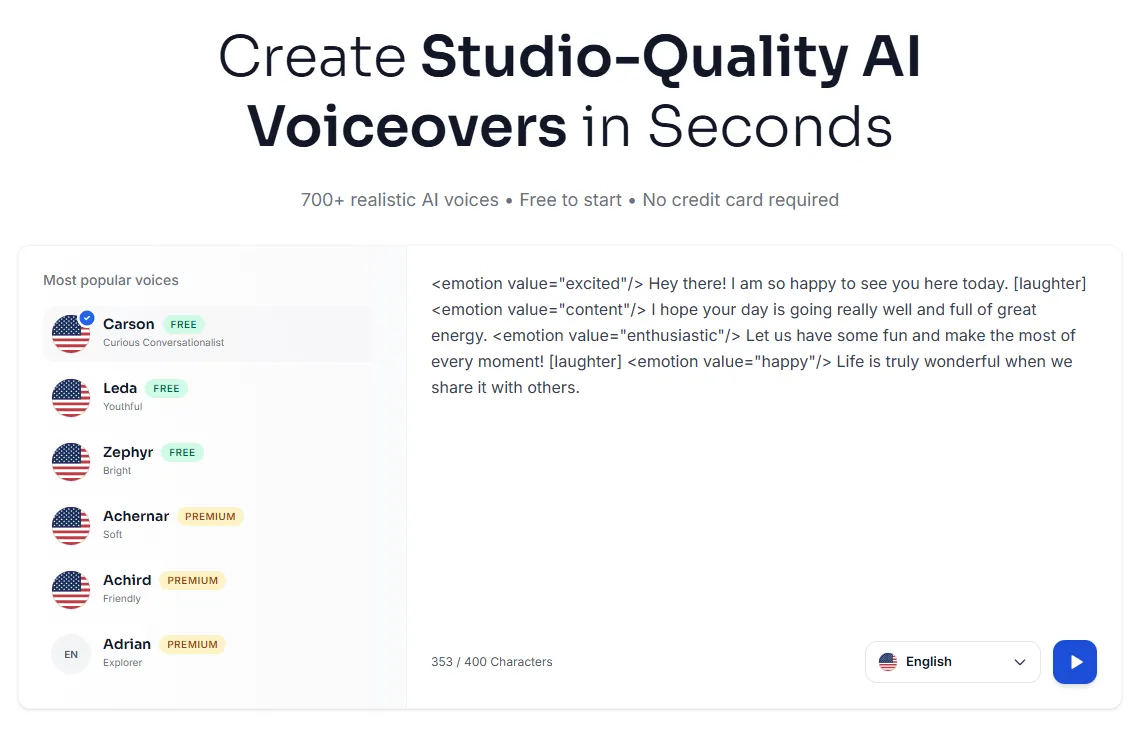
- Write for the ear. Use short sentences and put the main benefit in the first line.
- Paste the script and pick a voice. Filter by language and gender, and preview 2 or 3 options.
- Set the delivery. Adjust tone, pitch and speed. Add an emotion tag such as
<emotion value="excited"/>before a hook. - Listen once and fix problems. Re-spell tricky names, or add commas for pauses.
- Export MP3 or WAV and place it in your video editor, ad manager or website player.
- Save the script and settings in your brand voice document so the next edit sounds the same.
On Pro and higher plans, voice localization helps you produce the same voiceover for other markets. Have a native speaker review each translated script before you publish.
Rights, disclosure and consent
Check 3 things before a voiceover goes into paid media.
- Your plan's terms. Kveeky's pricing page lists commercial usage rights on every paid plan, and none on the free plan. Read the terms of any tool you use.
- Consent for cloned voices. Only clone a voice when the speaker has agreed in writing.
- Disclosure. Rules differ by country and platform. A short label such as "AI voice" in your description or credits keeps you honest with your audience.
We can't give legal advice. If a campaign runs in a regulated sector, such as finance, health or political ads, ask your legal team first.
Business voiceover: quick answers to common questions
These are the questions small teams ask most before they add a voice to their marketing, training and sales content.
What is a business voiceover, and what does it include?
A business voiceover is narration for a company's own content: ads, product demos, explainers, training, presentations and phone menus. A complete job includes the script, the chosen voice and its settings, a pronunciation list for product names, the final MP3 or WAV files and the right to use them where you publish. With AI, the voice is generated from the script, so an edit means regenerating one line instead of booking a new session.
What is B2B voiceover?
B2B voiceover is narration for content that sells to other businesses, such as product demos, explainers, webinars, sales clips, onboarding and LinkedIn ads. It needs a calm, credible delivery, a moderate pace and correct pronunciation of technical terms, because buyers are usually evaluating, not looking to be entertained. B2B scripts change whenever the product does, which is where AI voiceovers save the most re-recording. See our page on B2B explainer video voiceovers.
Are there free AI voiceover tools for business, and which is best for a small business?
Yes. Many AI voice generators have free plans, but they usually limit minutes, voices and commercial use, so read the plan terms before you publish. For a small business, the best tool has voices that fit your audience, clear commercial terms, MP3 or WAV export and enough minutes for your edits. Kveeky's free plan gives 500 credits a month (about 6.6 minutes) with standard voices and no credit card, and commercial usage rights start with paid plans from $9/month. Our comparison of free AI voice generators lists other options with their limits.
Is a free voiceover good enough for professional business videos and tutorials?
For internal tutorials, drafts and tests, often yes, as long as the script is written for the ear and someone listens before sharing. For customer-facing videos and ads, check 2 things first: whether the free plan allows commercial use, and whether its voices hold up on your full script. If either check fails, a low-cost paid plan is the safer choice.
How do I add a voiceover to a business presentation?
Generate one short narration file per slide, so a changed slide means regenerating one file. In PowerPoint for Windows, select Insert > Audio > Audio on My PC, choose the file and select Insert (Microsoft Support, Add or delete audio in your PowerPoint presentation, retrieved 2026-10-07). A voiceover matters most when people watch the deck without you, such as a recorded pitch or an investor update. Our page on AI voiceover for presentations has more.
How do I add a voiceover to business training videos?
Split each module into short scripts with one task each, generate them in one consistent voice and place the files in your video editor or course tool. Use a calm pace with pauses after each step, and keep a pronunciation list for product and policy terms. In training, the voice explains while the screen shows, so learners can watch the steps instead of reading long blocks of on-screen text. See our page on voiceovers for training videos.
What makes a voiceover effective for corporate videos?
A script written for the ear, one clear message per video and a voice that matches the audience. Add a steady pace with pauses after key points, and say every name correctly. The voiceover should support the visuals, not repeat every word on screen, and someone outside the project should listen to the full file before it goes live.
What are the main benefits of AI voiceovers for businesses, and how much time do they save?
The main benefits are editing speed, consistency and reach: you fix a line by editing text, every video uses the same voice, and one script can become other languages. The time saved comes from skipping recording sessions and re-takes, so it depends on how often your scripts change. We don't quote a percentage because we found no primary source that measures it; time one project before and after instead.
Can voiceovers boost customer engagement and brand messaging?
They can, when the voice fits the brand and the script is clear, but there's no universal uplift figure you can rely on. A consistent voice makes your messages recognizable across ads, demos and phone menus. Test it on your own audience: run the same video with 2 voices, or with and without narration, and compare watch time and clicks. Our guide to A/B testing voiceover styles explains the setup.
Which industries use AI voiceovers most?
Common users include e-learning and corporate training, SaaS and tech companies, e-commerce and retail advertisers, publishers with audio articles, service businesses with phone menus, and game and animation studios. What they share is a lot of scripted audio that changes often. Regulated sectors such as finance and health should have scripts and disclosures reviewed before they publish.
How do I make a free voiceover for an online ad?
Write a 15- to 30-second script with the offer in the first line, generate 2 or 3 reads and pick the one that fits your visuals. Before the ad runs, confirm your plan allows commercial use: Kveeky's free plan is fine for testing scripts, but commercial usage rights come with paid plans. Export MP3 or WAV, add it in your video editor or ad manager, and keep captions on. See our page on AI voiceovers for advertisements.
More guides on AI voiceovers for business
Every guide in this topic, in one place:
- Creating a Brand Voice Guide for AI Voiceovers (Free Template)
- 5 AI Receptionist Platforms With the Most Natural-Sounding Voices (2026)
- How SaaS Companies Are Using AI Voice for In-App Tutorials
- The Case for AI Voiceovers in Customer Onboarding Sequences
- AI Voiceovers for LinkedIn Video Ads: What's Working in 2026
- Why Students Drop Off Your Course (And What Your Narration Has to Do With It)
- Why Your Explainer Videos Aren't Converting (Hint: It's the Voice)
- Internal Training Videos Nobody Wants to Watch? Fix the Voice First
- Accessibility Isn't Optional: Making Your Courses Work for Everyone
- Multi-Voice Courses: When to Use Different Narrators (And When Not To)
- How to Narrate a 10-Hour Course Without Losing Your Voice (Or Your Mind)
- The Science of Voice in Learning: What Research Says About Retention
- How Synthetic Voices Enhance Brand Consistency in Business Phone Systems
- Voiceover for Advertisements: Your Key to Effective Ads
For plan-by-plan prices and commercial rights, see our comparison of the best AI voice generator for small business.
Frequently asked questions
What are text-to-speech tools used for in marketing?
The most common uses are voiceovers for ads, social videos, product demos, explainers, onboarding videos and phone menus. Teams also create audio versions of blog posts and newsletters, and localize one script into several languages.
Does adding an audio version of a blog post help SEO?
We know of no public evidence that an audio player is a ranking factor. Your text is still what search engines read. Add audio for your listeners, then measure plays and conversions to see if it's worth keeping.
Is voice-based marketing automation the same as text-to-speech?
No. Text-to-speech makes a recorded audio file from a script, while voice-based marketing automation runs live, two-way conversations such as qualification calls. In the US, AI-voice calls fall under the TCPA and need prior express consent.
Can I use AI voices in paid ads?
Yes, if your plan allows commercial use. Every paid Kveeky plan lists commercial usage rights; the free plan doesn't. Check platform rules on AI disclosure and get written consent for any cloned voice.
How much does text-to-speech for marketing cost?
Kveeky's free plan gives 500 credits a month, about 6.6 minutes, with no credit card. Paid plans start at $9/month, or $7.50/month billed yearly, for 100 minutes a month.
Do I need a transcript for an audio version of my article?
Usually not, if the audio reads the same article. WCAG 2.2 doesn't require a separate transcript for audio that is a media alternative for text, as long as it's clearly labeled as such.
How we checked this guide
This guide is written by Deepak Gupta for the Kveeky team. Disclosure: Kveeky makes an AI voice generator. It updates and replaces 3 older Kveeky posts on TTS in marketing, user engagement and voice marketing automation.
- Kveeky plans, voices and limits: kveeky.com/pricing, retrieved October 7, 2026.
- Adding audio to slides: Microsoft Support, Add or delete audio in your PowerPoint presentation, retrieved 2026-10-07.
- The industry list and the B2B, corporate and training guidance are editorial, based on common voiceover practice, not on a survey.
- FCC consent rule for AI voices: FCC Declaratory Ruling FCC 24-17, released February 8, 2024, retrieved October 6, 2026.
- Audio as an alternative for text: WCAG 2.2, Success Criterion 1.2.1, retrieved October 6, 2026.
- We removed market-size forecasts, engagement percentages and cost-saving figures from the older posts because we could not trace them to primary sources.
- No Kveeky usage data is used in this guide.
Want a first test? Take your best-performing product demo, rewrite the narration for the ear, and generate it with an AI voiceover for product demos. Compare it with the current version before you change anything else.