Creating a Brand Voice Guide for AI Voiceovers (Free Template)

TL;DR
- ✓ Learn why text-based brand guides fail to prevent AI instruction drift.
- ✓ Discover how to map brand values to technical prosody and emotional intensity.
- ✓ Transform your static brand guide into an executable audio-first prompt library.
- ✓ Download our free template to standardize your brand’s AI voice identity.
A brand voice guide for AI voiceovers is a short document that tells anyone on your team how your brand should sound. It names the voice, sets the pace, pitch and emotion, lists how to say tricky words and gives a brief for each project. The free template below fits on 1 page.
Last updated: October 7, 2026. Template and Kveeky settings checked against kveeky.com on that date.
This guide is for marketers, founders and content leads who make videos, ads, phone greetings or course audio with AI voices. Most text style guides cover words, not delivery. This one covers both, so your audio sounds like the same brand every time.
Key Takeaways
- Text guidelines aren't enough for audio. They cover word choice, not pace, pitch, pauses or pronunciation.
- Replace adjectives with settings. "Friendly" means little to an AI voice. "Mid pitch, slightly faster than default, short pauses" is something your team can repeat.
- Pick 1 master voice and allow small changes in speed or emotion per channel. Switching voices breaks recognition.
- A pronunciation list prevents most errors. Write how to say your brand name, product names and jargon.
- Brief every project with goal, audience, voice, emphasis words and a human listening check.
- Review the guide every quarter, and whenever you launch a product or change positioning.
On this page: What it is · Why text guides fall short · What goes in it · Traits to settings · Free template · Project brief · One voice or many · Keep it consistent · Set it up in Kveeky · What voice means in business · FAQ
What is a brand voice guide for AI voiceovers?
It's the audio version of your brand style guide. It turns "how we sound" into choices a person can repeat: which voice, how fast, how much emotion and how to say your product names.
A good guide is short. Your video editor, your support lead and a freelancer should all be able to read it in 5 minutes and get the same result.
Why text brand guidelines don't work for audio
Text guidelines describe vocabulary and grammar. They don't say how fast to speak, where to pause or which word to stress. Without those rules, every person on your team picks a different voice and setting.
That leads to voice drift. Your product video sounds calm and slow, your LinkedIn ad sounds rushed, and your phone menu uses a third voice. Listeners hear 3 different companies.
It also helps to separate 2 ideas:
- Brand voice is your personality. It stays the same everywhere.
- Brand tone is how that personality adjusts to the moment. A support message is softer than a launch ad, but it's still you.
Your guide should fix the voice and give clear limits for the tone.
What goes in an audio brand voice guide?
Keep it to these 8 sections. Each one answers a question your team would otherwise guess.
- Brand personality in 3 words, plus 1 sentence on what you're not (for example, "confident, not pushy").
- Master voice. The exact voice name, gender, accent and language. Add backup voices for other languages.
- Pace. Your default speed and when to go faster or slower.
- Pitch and energy. Where the voice sits, and how much it rises for excitement.
- Pauses. Where to pause: after the hook, between steps, before the call to action.
- Emotion range. Which emotions you allow per content type, and which you never use.
- Pronunciation list. Brand name, product names, acronyms and jargon, spelled the way they should sound.
- Quality check. Who listens before publishing, and what they check.
Do not guess a "correct" words-per-minute number from the internet. Measure it from a sample you already like: count the words and divide by the minutes. That number becomes your standard.
How to turn brand traits into voice settings
Adjectives become useful once you translate them into settings. Use this table as a starting point, then adjust by ear.
| Brand trait | What it sounds like when it's wrong | Voice choice | Speed and pitch | Pauses and emotion |
|---|---|---|---|---|
| Friendly | Flat, even speed, no warmth | Warm, conversational voice | Slightly faster than default, mid pitch | Short pauses; light "happy" emotion on the opening line |
| Authoritative | Rushed, high, nervous | Lower, steady voice | Slightly slower, lower pitch | Longer pauses after key points; neutral emotion |
| Innovative | Monotone, every word stressed the same | Crisp, clear voice | Default to slightly faster | Stress key nouns; "excited" only on the hook |
| Caring (health, finance, support) | Too cheerful for the topic | Calm, soft voice | Slower, mid to low pitch | Pauses before instructions; no excited tags |
| Playful (consumer, gaming) | Stiff, corporate | Bright, expressive voice | Faster, more pitch movement | Short pauses; occasional laughter or excited tags |
If you're unsure which tone fits your audience, our guide to matching AI voice tone to your niche shows examples for gaming, finance and self-help.
Free brand voice guide template (copy and paste)
Copy this into a doc and fill in the brackets. Keep it to 1 page.
BRAND VOICE GUIDE FOR AI VOICEOVERS — [Brand name] — v[1.0], [date]


PERSONALITY
We are: [word], [word], [word]
We are not: [e.g. pushy, sarcastic, overexcited]

MASTER VOICE
Voice: [voice name] | Language and accent: [e.g. English, US]
Other languages: [language → voice name]
Cloned voice? [yes/no — whose voice, written consent on file: yes/no]

PACE
Default: [your measured words per minute, or "default speed"]
Faster for: [social hooks, ads]  Slower for: [training, instructions]

PITCH AND ENERGY
Default: [low / mid / high]   Max energy: [where it's allowed]

PAUSES
Always pause: [after the hook] [between steps] [before the call to action]

EMOTION RANGE
Allowed: [e.g. neutral, happy, excited (hooks only)]
Never: [e.g. sad, whispering, laughter in support content]

PRONUNCIATION LIST
[Brand name] → say it as [phonetic spelling]
[Product / acronym] → [phonetic spelling or "spell out letters"]

QUALITY CHECK (before anything is published)
Listener: [name/role]
Check: right voice? right speed? names correct? pauses natural? matches visuals?


CHANNEL NOTES
   Ads/social: [faster, 1 hook emotion]
   Product/explainer video: [default]
   Training/onboarding: [slower, neutral]
   Phone greetings/IVR: [slow, clear, no emotion tags]
How to brief an AI voiceover project
Your guide sets the rules. A brief applies them to 1 script. Fill in these 6 fields for every project:
- Project and goal. For example, "Q3 product launch video, drive demo sign-ups."
- Audience. For example, "Operations managers, busy, prefer short and direct."
- Voice settings. Master voice, plus any change from the guide (for example, "slightly faster for social").
- Emphasis words. The 2 or 3 words that must land, usually the benefit.
- Pronunciation. Any new names in this script.
- Listening check. Who signs off, and by when.
A weak brief vs a strong brief
Weak: "Make this ad sound professional, trustworthy and exciting. American male voice."
That gives the voice tool nothing to work with. You'll get a generic read that doesn't match your visuals.
Strong: "Use our master voice. Slightly faster than default. Pause after the hook for the logo reveal. Stress the word 'simple' in line 2. Say the brand name with a hard K. Conversational, not theatrical."
Every line in the strong brief is something a person can check by listening.
Should you use one AI voice or different voices per channel?
Use 1 master voice for most content. Recognition comes from repetition, and a new voice in every video resets it.
You can still adapt per channel. Keep the same voice and change only speed, emotion or pauses. For example, speed it up for social ads and slow it down for training.
Use a second voice only when the format needs it, such as a dialogue, a customer quote or a different language. Keep the second voice in your guide too, so it's the same every time.
Match the audio to your visuals too. A clean, minimal brand needs a calm, uncluttered read. A fast, bold brand can take more energy.
How to keep your AI brand voice consistent
A guide only works if people use it. These habits keep it alive:
- Audit what you already have. Collect your last 10 to 20 audio pieces and note every voice and speed used.
- Store the guide where work happens. Put it next to your scripts, not in a forgotten shared drive.
- Keep approved samples. Save 2 or 3 "golden" audio files that everyone can compare against.
- Make listening mandatory. No audio goes live until a named person has heard the whole file.
- Test before you change. If you want a new voice or speed, run a quick test first. Our guide on how to A/B test voiceover styles shows how.
- Review quarterly. Also review after a product launch or a positioning change.
Protect your voice. If you clone a real person's voice, such as a founder, get their written consent first. Record who may use the clone and for what. Our guide on whether voice cloning is legal covers the main questions. It isn't legal advice, so check your own situation with a lawyer.
How to set up your brand voice in Kveeky
Here's how the template maps to Kveeky's settings.
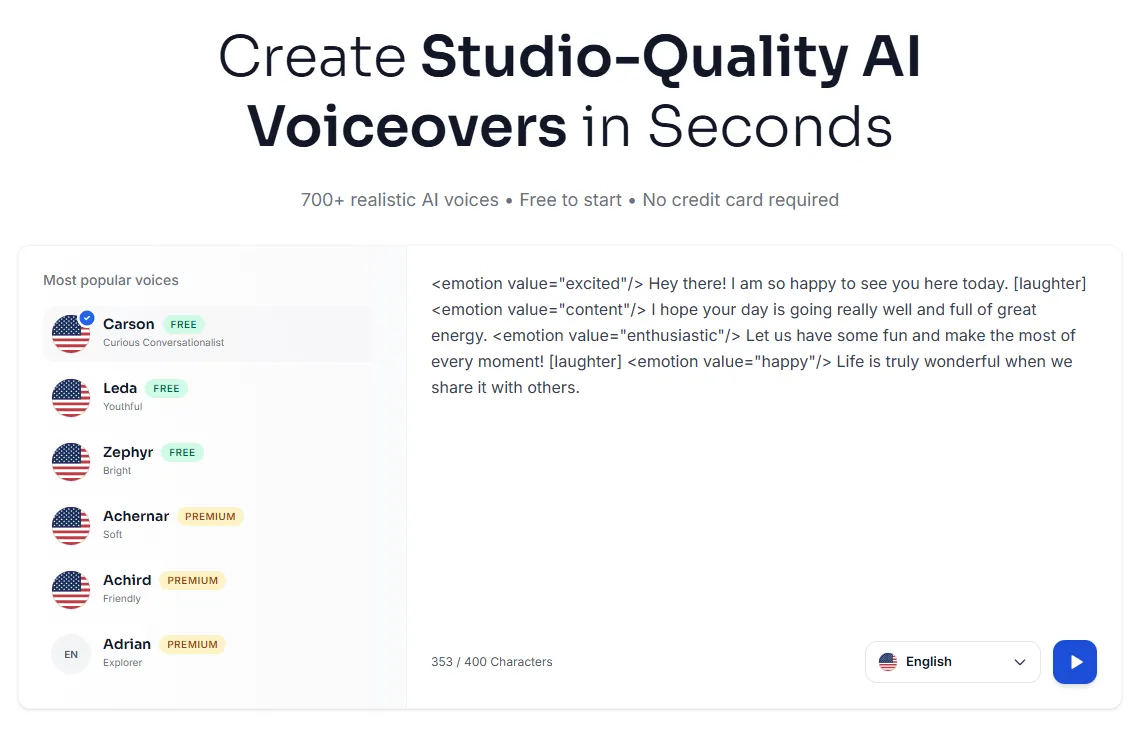
- Choose your master voice. Browse 700+ AI voices and filter by language. Kveeky has voices in 40+ languages.
- Or clone a voice. Every plan includes voice clones: 5 on Free and Basic, 10 on Pro and Premium, 20 on Business.
- Set tone, pitch and speed to match sections 3 and 4 of your guide.
- Add emotion tags where your guide allows them, such as
<emotion value="excited"/>on a hook or[laughter]in playful content. - Fix pronunciation by re-spelling words the way they should sound, as listed in your guide.
- Export MP3 or WAV, and save the settings with your approved samples.
Every paid plan includes commercial usage rights for the audio you generate. Plans start at $9/month, or $7.50/month billed yearly, on the Kveeky pricing page.
For more business uses of one consistent voice, see our hub on text-to-speech for marketing teams and our guide to keeping one brand voice across phone systems.
Brand voice vs spoken voice: what voice means in business
People use the word "voice" in 2 ways at work. Your guide needs both, so here is the short version.
What does voice mean in business?
In business, "voice" usually means brand voice: the steady personality a company shows in everything it writes and says, such as plain and friendly or formal and precise. For audio, it also means spoken voice, the actual sound of your brand: the voice, accent, pace and emotion in your videos, ads and phone greetings. Brand voice decides what you say and how it feels, while spoken voice decides how it sounds, and the template above links the two. Phone companies also sell "business voice" plans, but that means calling services, not branding.
Related guides on AI voiceovers for business
Keep going with these related guides:
- How SaaS Companies Are Using AI Voice for In-App Tutorials
- The Case for AI Voiceovers in Customer Onboarding Sequences
Frequently asked questions
Does a text brand voice guide work for AI voiceovers?
Only partly. A text guide covers words and grammar. AI voiceovers also need rules for voice choice, speed, pitch, pauses, emotion and pronunciation, which text guides don't include.
What is the difference between brand voice and brand tone?
Brand voice is your personality, and it stays the same everywhere. Brand tone is how that personality adjusts to the moment, such as softer in support and more energetic in ads.
How do I stop my AI voiceover from sounding robotic?
Add pauses after key points, vary speed by content type and use emotion only where it fits. Fix mispronounced names with phonetic spelling, and always listen to the full file before publishing.
Should I use one AI voice for all my content?
Yes, for most brands. Use 1 master voice and change only speed, emotion or pauses per channel. Add a second voice only for dialogue, quotes or other languages.
How often should I update my AI brand voice guide?
Review it every quarter. Also update it when you launch a product, change positioning or add a new language.
What should an AI voiceover brief include?
Include the project goal, the audience, the voice and any setting changes. Add 2 or 3 emphasis words, new pronunciations and the person who will listen and approve.
How we checked this guide
This guide is written by Govind Kumar for the Kveeky team. Disclosure: Kveeky makes an AI voice generator.
- Kveeky features, voice counts, clone limits and prices come from kveeky.com/pricing, retrieved on October 7, 2026.
- The trait-to-settings table is a starting point based on common voiceover practice, not a measured study. Adjust it by listening.
- No Kveeky usage data is used in this guide. We removed statistics from earlier versions that we could not trace to a primary source.
Ready to try your guide? Fill in the template, then test your master voice on a real script with AI voiceovers for advertisements.