How SaaS Companies Are Using AI Voice for In-App Tutorials

TL;DR
- ✓ Static product tours are being replaced by conversational AI voice agents.
- ✓ AI agents guide users through complex workflows to reduce onboarding churn.
- ✓ Agentic voice models can actively execute UI actions for the user.
- ✓ Personalized voice interaction significantly slashes product Time-to-Value.
SaaS companies use AI voice for in-app tutorials in 2 ways. Most add short recorded narration to product tours, help videos and feature announcements, because it's fast to update when the UI changes. A smaller group builds real-time voice agents that listen and answer, which takes engineering work and careful design.
Last updated: October 6, 2026. Accessibility rules checked against the W3C WCAG 2.2 Understanding pages on that date.
This guide is for product managers, product marketers and customer education teams at SaaS companies. It covers where voice helps inside an app, where it annoys users, and how to add narration without slowing your releases.
Key Takeaways
- Recorded AI narration is the common choice. It suits tours, help clips and release videos where the steps are fixed.
- Real-time voice agents suit open questions, but they need speech recognition, a language model and engineering time.
- Never autoplay sound without a stop control. WCAG 1.4.2 (Level A) requires one for audio that plays automatically for more than 3 seconds.
- Caption every narrated video. WCAG 1.2.2 (Level A) requires captions for prerecorded audio in synchronized media.
- Write 1 short clip per step. When a button moves, you regenerate 1 clip, not the whole tour.
- Track activation, tour completion and how-to tickets to see if narration helps.
On this page: How SaaS teams use it · Recorded vs real-time · Where voice helps · How to add it · Script template · Accessibility · Keep it current · Measure it · FAQ
How are SaaS companies using AI voice for in-app tutorials?
The most common uses are small and practical. Voice is added where a user is already looking for help, not on every screen.
- Narrated product tours. A short voice line plays with each step of a guided tour.
- Empty-state help clips. A 30- to 60-second video sits on a blank dashboard and shows the first action.
- Feature announcements. A narrated clip in a "What's new" panel explains a release.
- Contextual help videos. A help icon opens a short narrated walkthrough of that screen.
- Localized tutorials. The same tour is narrated in each language your customers use.
- Conversational help. A few teams add a voice agent that answers spoken questions in real time.
The first 5 use recorded audio. That's why AI text-to-speech fits: you write the script, generate the audio and replace it whenever the product changes.
Recorded AI narration vs real-time voice agents
These are different products with different costs. Pick based on whether your tutorial steps are fixed or open-ended.
| Question | Recorded AI narration | Real-time voice agent |
|---|---|---|
| What it does | Plays a prepared voice track with a tour step or video | Listens to the user and replies out loud |
| Best for | Fixed, linear steps: tours, help clips, release videos | Open questions and non-linear workflows |
| What you need | A script, a text-to-speech tool and your tour or video tool | Speech-to-text, a language model, text-to-speech and engineering time |
| Update effort | Edit the script and regenerate 1 clip | Update prompts, test answers and monitor quality |
| Main risks | Outdated clips if nobody owns updates | Wrong answers, slow replies, privacy questions about microphone use |
| Where Kveeky fits | Yes: generate MP3 or WAV narration | No: Kveeky does not run live voice agents |
Most teams should start with recorded narration. It's cheaper to test, and it shows you which steps users actually need help with before you build anything conversational.
Where voice helps in a product tour, and where it gets in the way
Voice helps when the user's eyes are busy. It lets them watch the screen while hearing what to do, instead of reading a tooltip and looking back.
Voice helps when:
- The step involves several clicks in a row, such as connecting an integration.
- The concept is new, such as how permissions or workflows work.
- The user opened help on purpose, by clicking a help icon or "Show me".
Voice gets in the way when:
- It starts talking the moment someone logs in.
- It talks over a user who is already clicking ahead.
- It reads out text that's already on screen word for word.
- There's no obvious way to mute it.
The rule is simple: voice is opt-in. Play it when the user asks, stop it when they act, and remember their mute choice.
How to add AI voice to in-app tutorials
Here's a workflow that works with most product tour and video tools.
- Pick the 3 to 5 moments that matter. Use support tickets and product analytics to find where new users get stuck.
- Write 1 short script per step. Keep each clip to 1 action and 1 or 2 sentences.
- Choose 1 voice for the whole product. Use the same voice across tours, help clips and release videos. Our brand voice guide template for AI voiceovers helps you set it once.
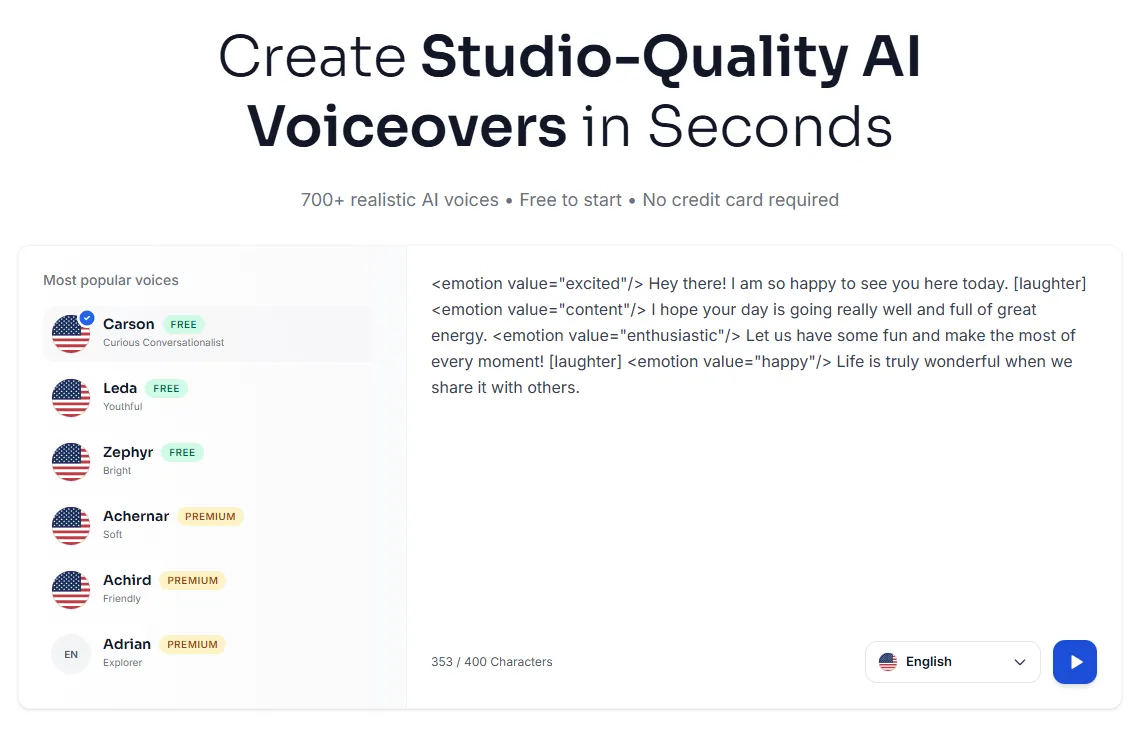
- Generate the audio. In Kveeky, paste each script, pick from 700+ voices, adjust tone, pitch and speed, then download MP3 or WAV.
- Add it to your tour or video. Attach the clip to the tour step, or lay it over a screen recording. These screen recording tips for voiceover videos help the visuals match the narration.
- Add captions and a mute button. See the accessibility rules below.
- Name files by step and version, such as
connect-crm_step2_v3.mp3, so updates are easy to find.
A script template for one tutorial step
Short, specific scripts sound more natural than long ones. Use this pattern for each step:
- Where: "In the top right, you'll see the Integrations button."
- Action: "Click it, then choose your CRM."
- Result: "Your contacts will start syncing in the background."
- Next: "When you're ready, click Next to set up your first report."
Name buttons exactly as they appear in the UI. If a label changes, search your scripts for it and regenerate only the clips that mention it.
Accessibility rules for narrated tutorials
Voice can make tutorials easier for many users, but only if it's optional and backed by text. 2 Level A rules in WCAG 2.2 apply directly:
- Audio Control (1.4.2). If audio plays automatically for more than 3 seconds, users need a way to pause or stop it, or to control its volume separately.
- Captions, Prerecorded (1.2.2). Prerecorded audio in synchronized media, such as a narrated video, needs captions.
In practice, that means:
- Don't autoplay narration. If you must, add a visible stop button.
- Caption every narrated video, and offer a text version of each tour step.
- Make the play and mute controls reachable by keyboard.
- Use a clear, steady voice at a moderate speed for instructions.
Our guide to accessible course design covers captions and transcripts in more detail.
How to keep tutorials current when your UI changes
Outdated tutorials hurt more than missing ones. A tour that points to a button that moved teaches users not to trust your help.
- Store scripts next to your release notes, not inside a finished video file.
- Assign an owner for each tour, usually product marketing or customer education.
- Check tutorials in your release checklist. Any UI change to a toured screen triggers a script review.
- Regenerate only what changed. With 1 clip per step, a renamed button means 1 new file.
- Reuse the same voice and settings so new clips match old ones.
For multi-language products, translate the updated script and regenerate it in each language. Kveeky has voices in 40+ languages. Our guide to localizing product videos on a budget covers the workflow.
How to measure whether narrated tutorials work
Compare users who play the narration with users who don't, or run the tour with and without voice for 2 to 4 weeks.
| Metric | What it tells you |
|---|---|
| Activation rate | Do more new users reach the first key action? |
| Tour completion | Do users finish the tour, or skip it at a certain step? |
| Mute rate per step | Which clips are unwanted or too long? |
| "How do I" tickets | Do fewer users ask support about the toured feature? |
| Feature adoption | Do users try the feature the tutorial explains? |
Look at mute rate first. A clip that most people mute is either badly timed or not needed.
Frequently asked questions
Does AI voice in tutorials help or distract users?
It helps when users ask for it and the voice explains actions they're doing on screen. It distracts when it autoplays, repeats on-screen text or talks over users who are already clicking ahead.
Should I use recorded AI narration or a real-time voice agent?
Use recorded narration for fixed steps such as tours, help clips and release videos. Consider a real-time voice agent only for open-ended questions, and budget for engineering, testing and monitoring.
How do I update narrated tutorials when the UI changes?
Keep 1 short script per step, stored next to your release notes. When a label or button changes, edit that script and regenerate only that clip with the same voice and settings.
Do narrated tutorials need captions?
Yes. WCAG 2.2 success criterion 1.2.2 (Level A) requires captions for prerecorded audio in synchronized media, such as a narrated video. Also offer a text version of each tour step.
Should I tell users the voice is AI-generated?
Yes, a short label such as "AI-generated narration" is good practice. It sets expectations and builds trust, especially if you also use human-voiced content.
Can I narrate tutorials in several languages?
Yes. Translate each script, then generate it with a voice in that language. Kveeky has voices in 40+ languages, so you can keep the same tour in each market.
How we checked this guide
This guide is written by Ankit Agarwal for the Kveeky team. Disclosure: Kveeky makes an AI voice generator.
- Accessibility rules are quoted from the W3C's Understanding SC 1.4.2 Audio Control and Understanding SC 1.2.2 Captions (Prerecorded), retrieved on October 6, 2026.
- Kveeky features come from kveeky.com/pricing, retrieved on October 6, 2026.
- No Kveeky usage data is used in this guide. We removed earlier claims about latency targets and market reports that we could not trace to a primary source.
Want to try narration on your next release? Write scripts for your 3 most-used tour steps, then generate them with AI voiceovers for product demos. For the wider onboarding picture, see our case for AI voiceovers in customer onboarding and our hub on how businesses use text-to-speech.