The Case for AI Voiceovers in Customer Onboarding Sequences

TL;DR
- ✓ Static tutorials create friction by failing to match your current product interface.
- ✓ AI voiceovers allow you to update onboarding content instantly whenever your codebase changes.
- ✓ Achieve a high-touch onboarding experience at scale without massive production budgets.
- ✓ Modern neural engines provide natural, emotive speech that builds genuine customer loyalty.
- ✓ Treat your audio scripts like code for an agile and perpetually relevant walkthrough.
An onboarding voiceover is the narration on the welcome, setup and feature videos new customers watch in their first weeks. AI voiceovers suit these sequences because the product changes often. You edit a script and regenerate the audio in minutes, in 40+ languages, with the same voice every time.
Last updated: October 6, 2026. Kveeky plan details checked on kveeky.com/pricing on that date.
This guide is for customer success, customer education and product marketing teams. It explains when AI narration beats a human voice actor, how to plan an onboarding video sequence and how to keep it current.
Key Takeaways
- Onboarding videos go out of date fast. Every UI change can make a walkthrough wrong. AI narration lets you fix 1 line instead of booking a new session.
- Use AI for the "how," a human for the "why." Walkthroughs and feature videos suit AI. A founder's welcome or brand story often suits a real person.
- Plan a sequence, not 1 long video. Short videos tied to each onboarding step are easier to watch and to update.
- Keep 1 voice across the whole sequence. It makes the videos feel like one guided path.
- Localize the same sequence for each market by translating scripts and regenerating them with a voice in that language.
On this page: What it is · Why AI fits · AI vs human · Sequence plan · How to make them · Tone by product · Keep them current · Employee onboarding · FAQ
What is an onboarding voiceover?
It's the spoken track on your onboarding videos. It explains what the customer sees on screen and what to do next.
Most onboarding sequences include a welcome video, a few setup walkthroughs and short feature videos. They're often sent by email, shown in the app or stored in a help center. The voice is what ties them together.
Why AI voiceovers suit customer onboarding sequences
Onboarding content has 3 problems that AI narration solves well.
1. It changes constantly. Your team ships updates every few weeks. A walkthrough recorded last quarter may point to a button that moved. With AI, you edit the script line and regenerate the audio. The rest of the video stays the same.
2. It needs many languages. If you sell in several markets, every video needs a version per language. Coordinating voice actors for each one takes weeks. With AI, you translate the script and generate it with a voice in that language. Kveeky has voices in 40+ languages.
3. It needs 1 consistent voice. When different team members record different videos, the sequence sounds like it came from different companies. A single AI voice, with saved settings, sounds the same in video 1 and video 12.
There's also a cost point. AI narration is a predictable monthly subscription instead of a per-session fee. For a detailed comparison, see our breakdown of what hiring a voice actor really costs.
AI voice vs a human voice actor for onboarding videos
Neither is better everywhere. Use the table to decide per video, not for the whole program.
| Factor | AI voiceover | Human voice actor |
|---|---|---|
| Updating 1 line after a UI change | Edit the script and regenerate in minutes | Book a pickup session, then wait for delivery |
| New languages | Translate and regenerate with a voice in that language | Hire and direct a new actor per language |
| Consistency across 10+ videos | Same voice and settings every time | Depends on the actor's availability |
| Emotional weight and brand story | Good with emotion and pacing controls | Usually stronger for personal, high-stakes messages |
| Cost model | Monthly subscription (Kveeky from $9/month) | Per project, per hour or per finished minute |
A common hybrid: a real person records a short welcome, and AI narrates every walkthrough after that.
What videos belong in a customer onboarding sequence?
Short videos tied to each step work better than 1 long tour. Here's an example sequence for a SaaS product. Adjust the timing to your own activation steps.
| When | Video | Goal | Voice tone |
|---|---|---|---|
| Day 0 | Welcome | Set expectations and show the first step | Warm, friendly |
| Day 1 | Setup walkthrough | Connect data or invite the team | Calm, clear, step by step |
| Day 3 | First win | Help the customer finish 1 real task | Encouraging |
| Day 7 | Key feature | Show the feature most tied to retention | Confident, brisk |
| Day 14 | Next level | Introduce advanced features or integrations | Neutral, efficient |
Keep each video short and focused on 1 outcome. Use your product analytics to see where new customers stall, and put a video there first.
How to produce an onboarding voiceover with AI
This workflow keeps scripts easy to update later.
- Write the script first. Use short sentences and name buttons exactly as they appear in your UI.
- Choose 1 voice for the sequence. Write down the voice name and settings in your brand voice guide template so anyone can reproduce it.
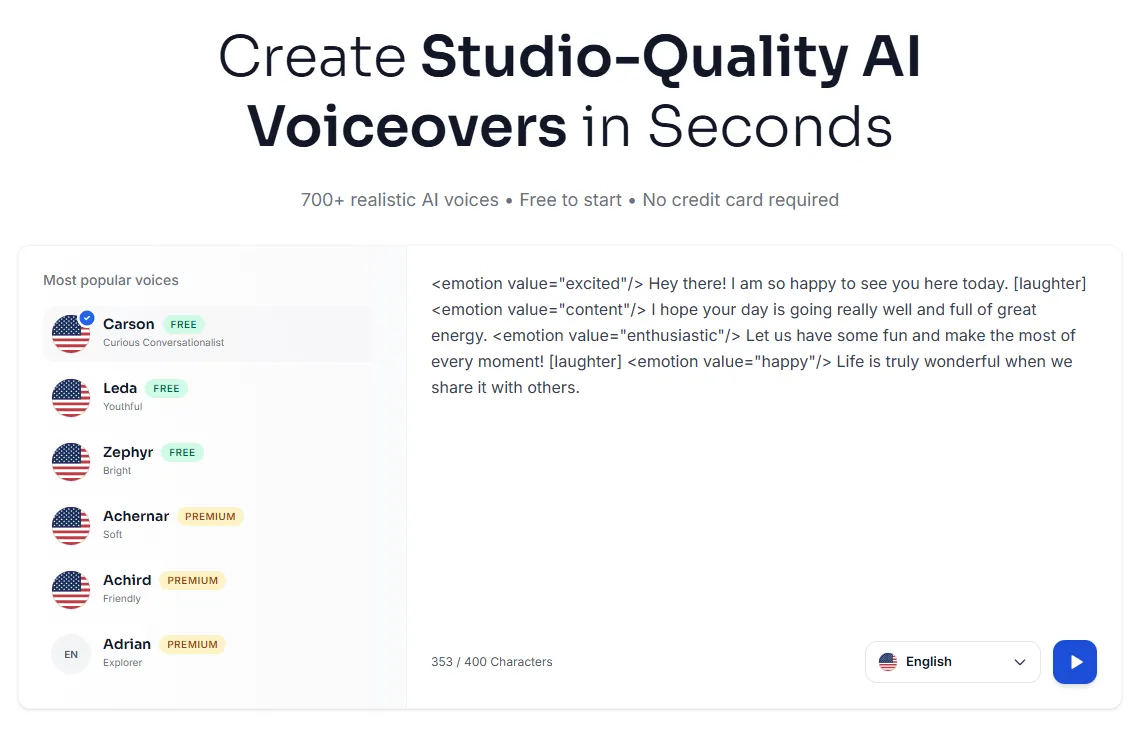
- Generate the audio. In Kveeky, paste the script, pick from 700+ AI voices and adjust tone, pitch and speed.
- Add emphasis where it helps. An emotion tag such as
<emotion value="excited"/>can lift a "first win" moment. Keep setup steps neutral. - Export MP3 or WAV and lay it over your screen recording.
- Add captions so customers can follow with the sound off.
- Save the script with the video, with a version number, so updates take minutes.
Every paid Kveeky plan includes commercial usage rights, so you can use the audio in customer-facing videos. See the Kveeky plans and minutes for details.
Which voice tone fits your product?
Match the voice to what your customers need to feel during setup.
- Fintech and finance: steady, measured and clear. Trust matters more than energy.
- B2B SaaS: brisk and helpful. Your users are busy and want the next step.
- Consumer and lifestyle apps: warmer and more playful. It can sound like a friend showing you around.
- Health and support-heavy products: calm and slower, with pauses before each instruction.
If your onboarding also uses in-product tours, keep the same voice there. Our guide to AI voice for in-app tutorials covers tours and help clips.
How to keep onboarding videos up to date
Outdated onboarding is worse than none. A walkthrough that shows the old UI makes new customers doubt the product.
- Give each video an owner, usually customer education or product marketing.
- Add a video check to your release checklist. Any change to an onboarding screen triggers a script review.
- Re-record only the changed lines. Keep the same voice and settings so the new audio matches.
- Review the full sequence every quarter. Check that the order still matches your activation steps.
Can you use AI voice for employee onboarding too?
Yes. The same logic applies to new-hire onboarding: policies, tool setup and process videos change often and need a consistent voice. Our guide to fixing the voice in corporate training videos covers internal training in detail.
Frequently asked questions
Does AI voiceover sound robotic in onboarding videos?
Not if you choose the voice and settings with care. Use short sentences, add pauses between steps and adjust speed. Listen to the full video before you send it, and fix mispronounced product names.
How do I update an onboarding video when the product changes?
Edit the script line that changed, regenerate that audio with the same voice and settings, and replace it in your video editor. Keeping 1 short video per step makes this faster.
Is a human voice or AI better for customer onboarding?
Use a human voice for personal, high-stakes moments such as a founder's welcome. Use AI for walkthroughs, feature videos and translations, where speed of updates and consistency matter most.
Can I make onboarding voiceovers in several languages?
Yes. Translate each script, then generate it with a voice in that language. Kveeky has voices in 40+ languages, so each market can get the same sequence.
Can I use AI voiceovers in customer-facing videos?
Yes, on a paid Kveeky plan. Every paid plan includes commercial usage rights for the audio you generate. Check the plan page for current terms.
How we checked this guide
This guide is written by Govind Kumar for the Kveeky team. Disclosure: Kveeky makes an AI voice generator.
- Kveeky features, prices and rights come from kveeky.com/pricing, retrieved on October 6, 2026.
- The onboarding sequence is an example structure, not a benchmark. Adjust it to your own activation data.
- No Kveeky usage data is used in this guide. We removed statistics from earlier versions that we could not trace to a primary source.
Ready to narrate your first onboarding video? Script your Day 0 welcome or Day 1 setup video, then generate it with AI voiceovers for explainer videos. For more business uses, see our hub on text-to-speech tools for marketing.