TL;DR
- ✓ High dropout rates are often caused by poor narration rather than student life.
- ✓ Dry or robotic audio increases cognitive load and creates unnecessary learning friction.
- ✓ Natural prosody and vocal clarity help students absorb complex information more efficiently.
- ✓ A strong emotional connection through your voice keeps students committed to your course.
On this page
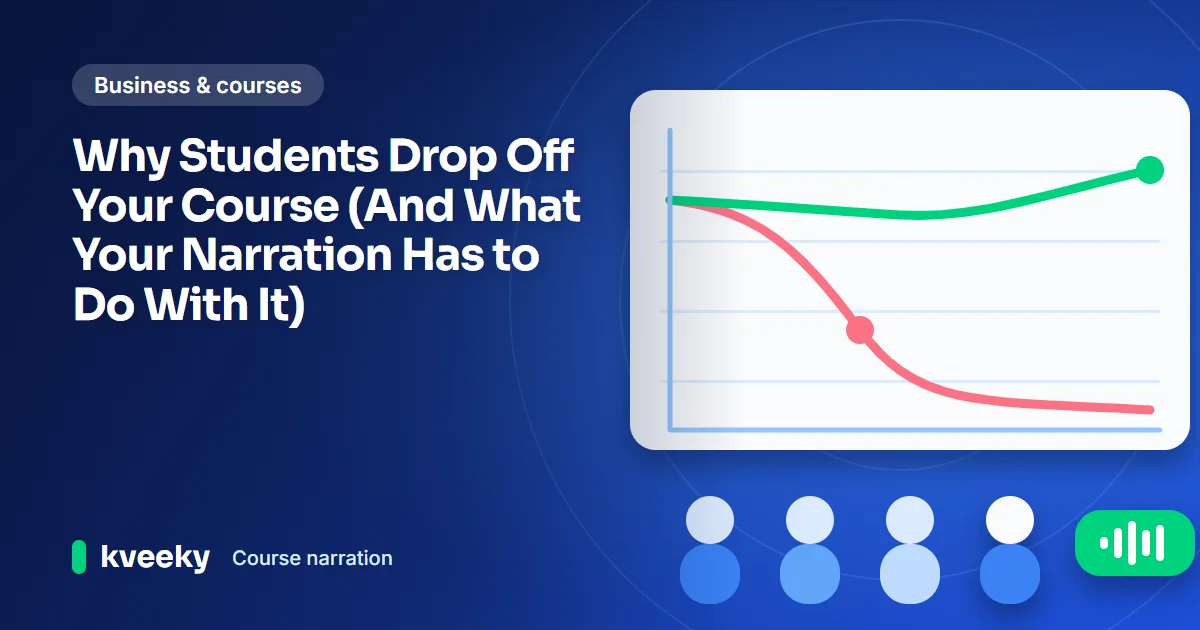
Students drop off online courses for many reasons, mostly time, motivation and unclear value. Course narration matters because it adds or removes friction in every lesson. Muffled audio, a flat monotone, rushed pacing or a reading-from-a-script tone make each lesson harder to finish. Clear, conversational narration makes the next lesson easier to start.
Last updated: October 6, 2026.
This guide is for course creators, instructional designers and L&D teams who see learners stall partway through a course. It shows how to tell whether narration is part of the problem, how to audit it and when an AI voice helps or hurts.
Key Takeaways
- Narration is rarely the only reason students leave, but it's one you control fully and can fix quickly.
- Look at where students stop. Drop-off at the start of lessons, or after dense sections, often points to delivery.
- Talk like a mentor, not a lecturer. Use "you," name the hard parts and vary your pace.
- Fix audio basics first: clear sound, steady volume, no long accidental pauses.
- AI voice works for updates, translations and consistency. Your own voice, or a clone of it, keeps the personal connection.
On this page: Why students leave · How narration affects completion · Warning signs · Audit · Script rewrite · Re-engagement script · AI or your voice · In Kveeky · FAQ
Why students drop off
Most students don't quit in one moment. They drift. A busy week turns into a missed lesson, and the next lesson feels harder to start.
The common causes fall into 2 groups:
- Life factors you can't control: work, family, health and changing priorities.
- Course factors you can control: unclear value, lessons that are too long, confusing navigation and delivery that's hard to follow.
Narration sits in the second group. It won't fix a course nobody needs, but it decides how much effort each lesson takes.
Narration and completion
Every lesson asks for attention. Narration either makes that attention easier to give, or harder.
Clarity. If learners have to strain to hear words or decode a muffled recording, they have less attention left for the ideas. That makes lessons feel longer than they are.
Pacing. A rushed read overwhelms. A slow, flat read bores. Good narration slows down for hard ideas and moves faster through simple ones.
Presence. Learners respond to a voice that sounds like someone is talking to them. A conversational tone that names the hard parts makes the course feel like guidance, not a lecture.
For the research on how voice affects learning, see our summary of what studies say about voice and retention.
Signs of narration drop-off
Check your course platform's analytics and student feedback for these patterns.
| Signal | What it may mean | What to check |
|---|---|---|
| Learners leave in the first minute of a lesson | The opening doesn't hook them | Do you start with what they'll be able to do? |
| Drop-off right after dense sections | Pacing is too fast, or there's no check-in | Do you slow down and recap? |
| Many learners watch at high speed | Narration feels slow or padded | Cut filler and long pauses |
| Rewinds on the same few seconds | A word or idea is unclear | Re-record or rephrase that line |
| Comments about sound or the voice | Audio quality is distracting | Microphone, room echo, volume changes |
One signal alone proves little. Two or three together, on the same lessons, are worth acting on.
Look at one lesson where students stall and tick every signal you see. This uses the same five signals as the table above.
Auditing narration in 5 steps
Pick 1 lesson where students stall. Listen to it as a tired learner at the end of a workday, not as its author.
- Check the sound. Listen on cheap earbuds and on a laptop speaker. Is every word clear? Does the volume stay steady?
- Find dead air. Note any pause that isn't there on purpose. Tighten them.
- Mark the monotone. Highlight every stretch where speed and pitch don't change for 30 seconds or more.
- Count the "you." Lecture-style scripts say "the learner" or "one." Conversational scripts say "you."
- Check the hard parts. Before each difficult idea, do you slow down and tell the student it's tricky? After it, do you recap?
Fix the worst lesson first, then re-check your analytics after a few weeks.
Tick each step as you finish it. Your progress stays in this browser, so you can come back to it.
0 of 5 done
Rewriting a lecture script
Small changes in wording change how the voice sounds, human or AI.
Lecture version: "In this lesson, we will cover the fundamental principles of data analysis. Data analysis is important because it allows for better decision-making."
Conversational version: "Ever stared at a spreadsheet and felt it staring back? You're not alone. In this lesson, you'll turn that data into a clear plan for your next project."
The second version uses "you," names a real feeling and promises a result. It's also easier to read aloud with natural rhythm.
Paste one lesson script. Nothing leaves your browser. The counts are a rough aid for step 4 of the audit, not a score.
A 30-second re-engagement script
Place a short check-in halfway through a long module. It acknowledges effort and resets focus. Adapt this:
"Let's pause for a second. You've made it halfway through this module, and that's real progress. If the last section felt heavy, that's normal. It's the hardest part. From here, we'll put it into practice, one step at a time."
Keep it short, honest and specific to the module. Don't overpraise.
Paste it into your lesson script, then adapt it to the module.
Keep it short, honest and specific to the module.
AI or your own voice
Each option has a place. Choose based on the course, not on habit.
Which lesson are you about to narrate?
| Option | Strengths | Weaknesses | Best for |
|---|---|---|---|
| Your own recorded voice | Personal connection; students know it's you | Slow to update; hard on your voice over many hours | Welcome videos, personal stories, live-style lessons |
| A stock AI voice | Fast to produce and update; steady quality; many languages | Less personal; needs careful pacing to avoid sounding flat | Compliance, software training, reference lessons, translations |
| An AI clone of your own voice | Sounds like you; updates without re-recording | Needs a good voice sample; tell students it's AI-generated | Long courses you update often |
Many creators mix them. They record the welcome and key stories themselves, and use AI for lesson updates and other languages. If you're recording many hours, our guide on how to narrate a long course without vocal strain helps either way. If you're deciding whether to add a second voice, see when to use different narrators in a course.
Tell students when narration is AI-generated. It's honest, and it avoids a sense of being misled later.
Course narration in Kveeky
If you choose AI narration for some lessons, here's the workflow.
- Write the script conversationally, using the rewrite tips above.
- Pick a voice from 700+ AI voices in the voice library, filtered by language and gender. For cloning your own voice, see the pricing page.
- Set the speed for a calm, clear teaching pace. Slow down slightly for dense lessons.
- Add pauses with punctuation before key ideas and after recaps.
- Use emotion lightly. Choose from 6 emotions in the settings. A warm one suits a course intro, not a technical walkthrough.
- Download the audio and add it to your lesson video, with captions.
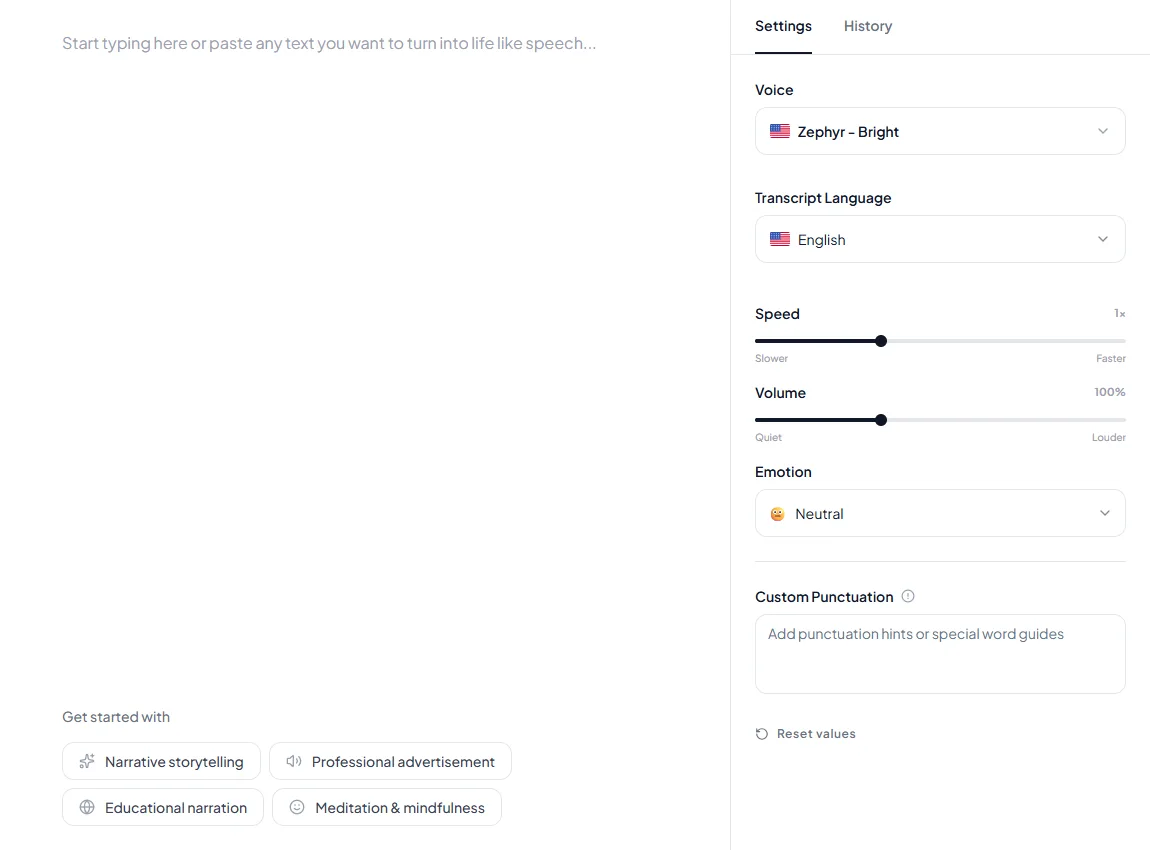
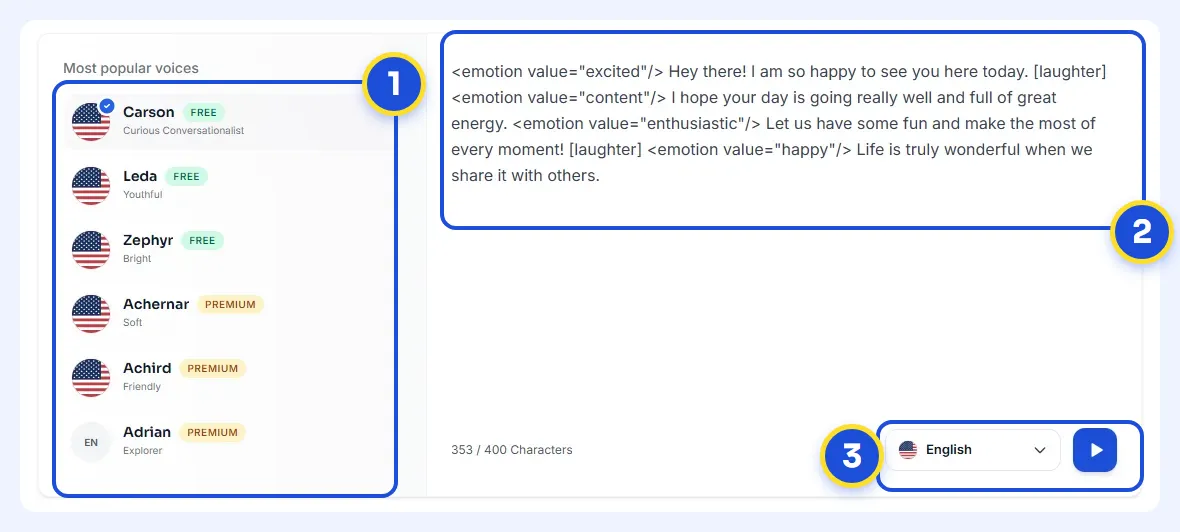
- 1Pick a voice. Voices are tagged Free or Premium.
- 2Type or paste a short line.
- 3Choose the language and press play to hear it.
Try it yourself in the free voice demo on Kveeky, no sign-up needed. For longer scripts and downloads, use the free plan.
Every paid plan includes commercial usage rights, so you can use the audio in a paid course. Check the Kveeky pricing page for minutes per plan. Captions and transcripts also help learners who can't use audio; our course accessibility guide covers both.
Frequently asked questions
Does narration really matter if my course content is good?
Yes. Good content still has to be heard and followed. Unclear audio, a flat tone or rushed pacing make each lesson harder, which makes it easier for students to put the course down.
How can I tell if my narration is causing students to drop off?
Look for drop-off in the first minute of lessons, exits right after dense sections, frequent rewinds on the same spot and comments about the sound. Two or more signals on the same lesson are worth acting on.
Should I use AI voiceovers for my online course?
Use AI where speed and consistency matter: updates, software walkthroughs, compliance lessons and translations. Keep your own voice, or a clone of it, for welcome videos and personal stories. Tell students when narration is AI-generated.
What is the biggest course narration mistake?
Reading the script like a textbook. Write the way you'd explain it to one person, use "you," slow down for hard ideas and recap after them.
How long should each narrated lesson be?
Keep each lesson focused on 1 outcome. If a lesson covers several ideas, split it. Shorter lessons are easier to start, finish and update.
- E-learning voiceover guide - AI narration for online courses
- The science of voice in learning - what research says about retention
- Making your courses accessible - captions, transcripts and audio
- Narrate a 10-hour course without losing your voice - for recording yourself
- Multi-voice courses - when to use different narrators
- Pacing AI voiceovers for complex topics - slower is not always better
- How to write an AI voiceover script - techniques and templates
- Words-to-minutes calculator - how long will the lesson run
How we checked this guide
This guide is written by Deepak Gupta for the Kveeky team. Disclosure: Kveeky makes an AI voice generator.
- Kveeky features and plan details come from kveeky.com/pricing, retrieved on October 6, 2026.
- An earlier version quoted a 70–90% MOOC dropout range. We couldn't confirm that figure in the linked source on October 6, 2026, so we removed it.
- No Kveeky usage data is used in this guide. The audit steps and warning signs are practical guidance, not results from a study.
Want to test AI narration on one lesson? Rewrite your weakest lesson's script and generate it with AI voiceovers for e-learning, then compare drop-off against the original. For more business uses of AI voice, see our hub on text-to-speech for business and marketing.
Turn your script into a voiceover
Paste your text, pick a voice and download the audio. Free to start, no credit card.