TL;DR
- E-learning voiceover guide for course teams: script length at 150 wpm, WCAG 2.2 and Section 508 rules, Storyline audio specs and real cost per course hour.
On this page
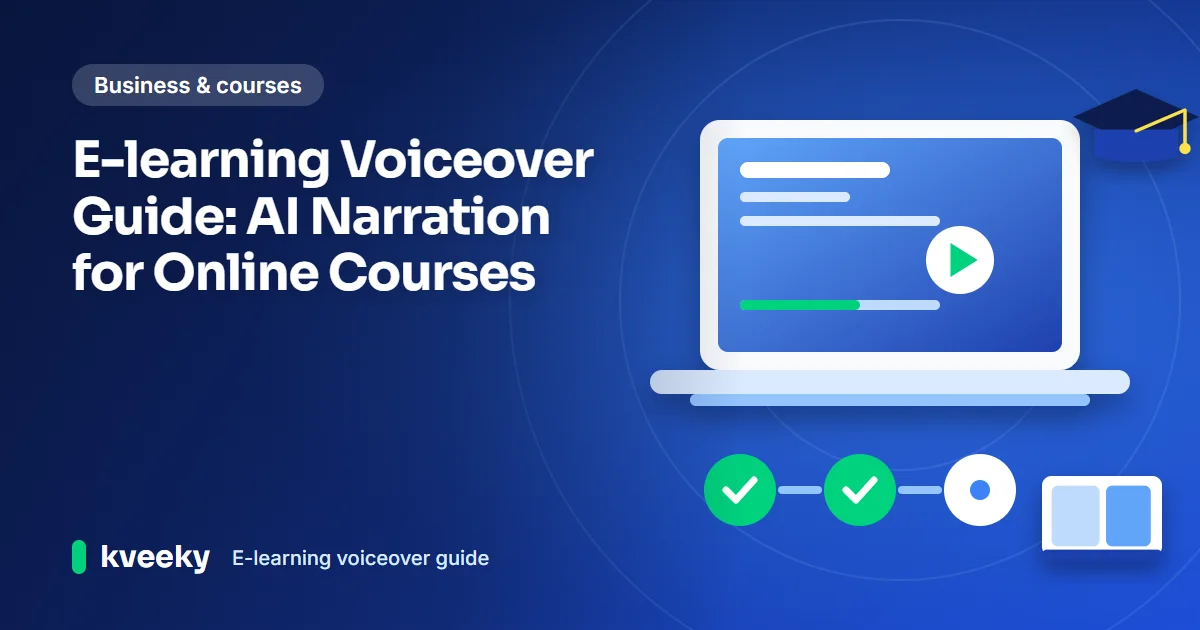
This e-learning voiceover guide shows how to narrate an online course with AI in 7 steps: write a script at about 150 words per minute, pick one consistent voice, generate and review each slide, export the audio, add captions, and check accessibility. For most US and UK course teams, AI narration costs under $50 per finished course hour.
Last updated: October 15, 2026. Prices, file formats and accessibility rules below were checked on the vendors' and regulators' own pages on that date.
Plan about 150 words per narrated minute (130 for technical content), generate slide by slide, and listen to every file at normal speed. AI narration fits compliance, software and process courses; keep a human voice for role-plays and courses sold on your name. Use the calculator below for your own course.
It's written for instructional designers, L&D teams and independent course creators who need clear narration without booking a studio for every update. You'll get a script template, word budgets, authoring-tool audio specs, a WCAG checklist and a worked cost example.
- Plan scripts at about 150 words per minute. A 5-minute module needs about 750 words; slow to about 130 wpm for new or technical ideas.
- Captions aren't optional. WCAG 2.2 success criterion 1.2.2 (Level A) requires captions for prerecorded audio in video, and Section 508 and UK public sector rules both point to WCAG.
- Storyline 360 imports MP3 and WAV, and Articulate recommends 16-bit 44 kHz PCM WAV if a file won't import.
- AI narration is cheap per hour. One finished course hour, with 50% extra for retakes, fits a $9 Kveeky Basic month, a $22 ElevenLabs Creator month or a $49 WellSaid Pro month (prices retrieved 2026-10-15).
- Use a human narrator for emotional storytelling, role-plays and flagship brand courses; use AI for compliance, software training and content that changes often.
What is an e-learning voiceover?
An e-learning voiceover is the spoken narration in an online course, training video or interactive module. It explains what's on screen, so learners can watch a diagram or software demo instead of reading long text blocks.
Narration does the most work where the screen is busy: process diagrams, software walkthroughs and scenarios. It does the least where learners need to scan, such as reference tables or policy text they'll come back to.
For the research on how voice affects retention, see our summary of what studies say about voice in learning. For drop-off patterns in real courses, read why students drop off your course.
Should you use AI or a human narrator for your course?
Use AI narration when content changes often, ships in several languages or must stay consistent across many modules. Use a human narrator when the course depends on emotion, acting or a recognizable brand voice.
| Course type | Best choice | Why |
|---|---|---|
| Compliance and policy training | AI | Rules change yearly; you regenerate one paragraph instead of rebooking a session |
| Software and product training | AI | UI changes break narration often; fast fixes matter more than performance |
| Onboarding for new staff | AI or human | AI for the process modules, a real leader's recorded welcome for the first video |
| Multilingual rollouts | AI | The same voice style across languages, without casting 5 narrators |
| Soft skills and role-plays | Human | Acting, timing and emotion still sound better from a person |
| Flagship paid courses sold on your name | Human (your own voice) | Learners buy the instructor; a synthetic voice can feel like a bait-and-switch |
Click your course type. The answers are the rows of the table above.
A mixed approach is common. Record the instructor for the course welcome and wrap-up, and use AI for the 20 or 30 how-to modules in between. Our guide to when to use different narrators in one course covers how to keep that from sounding disjointed.
How do you write an e-learning voiceover script?
Write for the ear: short sentences, one idea per sentence, and words learners would say out loud. Plan the length at about 150 words per minute, the average US English speaking rate, and slow down for new concepts.
Word budget by module length
These budgets come from the same math as our words to minutes calculator: words = minutes × words per minute.
| Narration length | Slow and clear (130 wpm) | Average (150 wpm) |
|---|---|---|
| 1 slide, 30 seconds | 65 words | 75 words |
| Micro-lesson, 2 minutes | 260 words | 300 words |
| Module, 5 minutes | 650 words | 750 words |
| Lesson, 10 minutes | 1,300 words | 1,500 words |
| Course hour, 60 minutes | 7,800 words | 9,000 words |
Use 130 wpm for technical, safety or second-language audiences. Use 150 wpm for refreshers and software demos where learners already know the terms.
Enter your finished course length, speaking pace, seconds per slide and retake allowance (the guide plans 50%). Kveeky plan allowances: Free 500 credits (396 seconds), Basic 100 minutes at $9, Pro 133 minutes at $19.99, Premium 200 minutes at $29, Business 1,000 minutes at $99, all on monthly billing.
Slide-by-slide script template
Copy this into a spreadsheet or document, with one row per slide. It keeps narration, on-screen text and pronunciation notes together, which makes reviews and later updates much faster.
| Column | What goes in it | Example |
|---|---|---|
| Slide ID | Module and slide number, matching the authoring file | M2-S04 |
| On-screen text | Only the words learners see | 3 steps to report an incident |
| Narration | What the voice says; don't repeat the on-screen text word for word | "When something goes wrong, you've got 24 hours to report it. Here's how." |
| Say it as | Phonetic respelling for names, acronyms and jargon | OSHA = "OH-shuh"; SQL = "sequel" |
| Pace and tone | Slow, neutral or warm, plus pauses | Slow; pause after "24 hours" |
| Words / seconds | Word count and estimated time at your chosen wpm | 15 words / 6 seconds |
| Status | Draft, SME approved, generated, QA passed | SME approved |
The example incident deadline is a placeholder; use your own policy. For more on writing lines that sound natural, see our guide to AI voiceover scripts.
Paste it into your script spreadsheet, one row per slide. Fill each field before you generate audio.
On-screen text: ____
Narration: ____ (do not repeat the on-screen text word for word)
Say it as: ____ (names, acronyms, jargon)
Pace and tone: ____ (slow, neutral or warm; pauses)
Words / seconds: ____ words / ____ seconds
Status: Draft / SME approved / Generated / QA passed
E-learning voiceover guide: the 7-step AI workflow
Here's the full process from approved script to published module. Each step has an expected result, so you know when to move on.
- Lock the script with your subject matter expert. Expected result: every slide row is marked "SME approved". Changing text after you generate audio costs credits and time.
- Build a pronunciation list. Expected result: every product name, acronym and person's name has a "say it as" spelling. Respelling in the script works in any tool.
- Pick 1 voice and test it on your hardest slide. Expected result: a 30-second sample with jargon, numbers and a list that you'd be happy to hear 50 times. Keep the same voice, speed and settings for the whole course.
- Generate slide by slide, not the whole module at once. Expected result: 1 audio file per slide, named with the slide ID (for example
M2-S04). Short files sync to slides and are cheap to fix. - Listen to every file at 1× speed. Expected result: no mispronounced terms, no odd stress on numbers, and pauses where the script marks them. Fix the text, regenerate that line only.
- Export the audio and import it into your authoring tool. Expected result: each file is attached to its slide and the timeline matches the narration.
- Add captions and run the QA checklist below. Expected result: captions match the audio, auto-playing audio can be paused, and the module passes a full play-through.
Tick each step when its expected result is true for your module.
Ticked: 0 of 7
How Kveeky helps
Kveeky covers steps 3 to 6 in the browser: paste a slide's narration, pick 1 of 700+ AI voices, adjust speed, volume and emotion, and download the audio. Every paid plan includes commercial usage rights for generated audio.
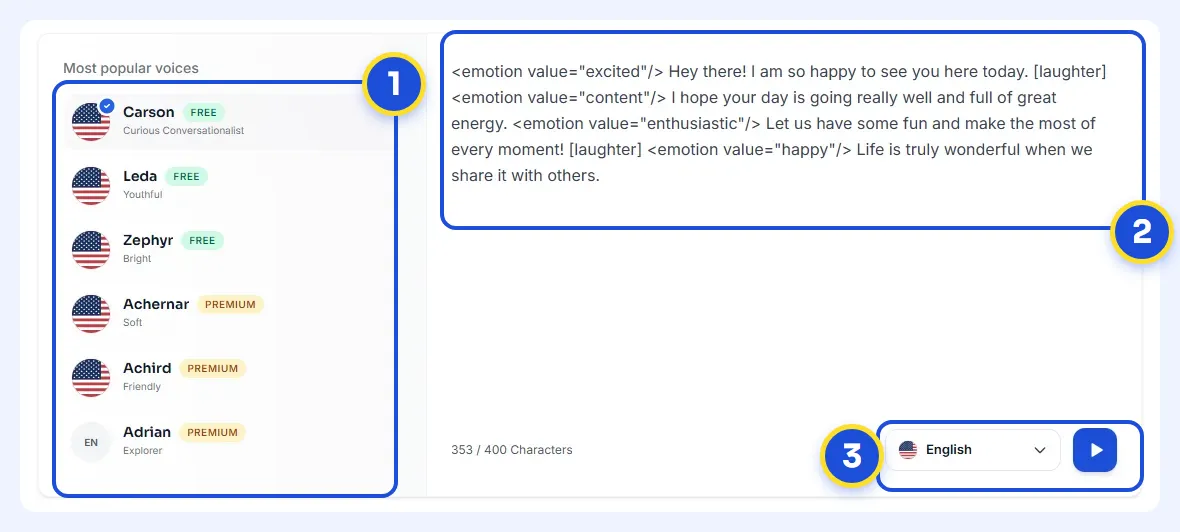
- 1Pick a voice. Voices are tagged Free or Premium.
- 2Type or paste a short line. Pick an emotion if you want one.
- 3Choose the language and press play to hear it.
Try it yourself in the free voice demo on Kveeky, no sign-up needed. For longer scripts and downloads, use the free plan.
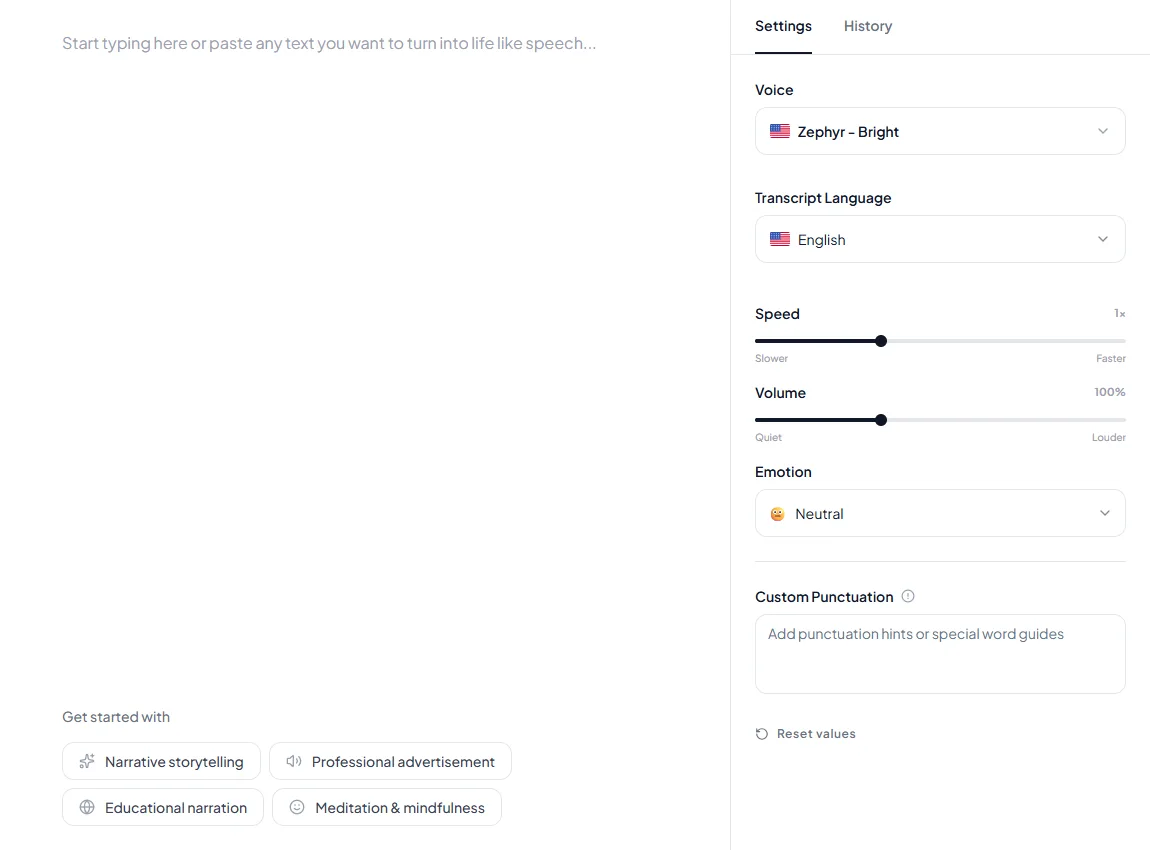
Try it now with step 3: paste your hardest 75-word slide into the free plan, which gives 500 credits a month (about 6.6 minutes) with no credit card. If the voice handles your jargon, you've found your course narrator. The Kveeky e-learning voiceover page has more course-specific examples.
What audio settings do Storyline, Rise and other authoring tools need?
Use WAV for the cleanest import if your voice tool offers it, or MP3 if file size matters. Articulate Storyline 360 accepts both, and Articulate recommends 16-bit 44 kHz PCM WAV when a file gives an "Unsupported audio file or bitrate" error.
| Tool | Accepted audio | Built-in text to speech | Notes |
|---|---|---|---|
| Articulate Storyline 360 | AAC, AIF, AIFF, M4A, MP3, OGG, WAV, WMA | Yes, up to 10,000 characters per conversion | If an import fails, convert to 16-bit 44 kHz PCM WAV |
| Articulate Rise 360 | "All major audio file formats", up to 5 GB per file | Not covered in the media article | Rise optimizes uploaded audio for streaming |
| Any LMS video player | Audio baked into an MP4 video | No | Mix narration into the video before upload; add a caption file |
Sources: Articulate's own support articles, retrieved October 15, 2026 (listed at the end). Storyline's built-in text to speech is handy for drafts; a separate voice tool helps when you want the same voice across Storyline, Rise and video.
A practical file naming rule saves hours later: use the slide ID as the file name. When a policy changes, you regenerate M2-S04 and replace one file instead of hunting through a timeline.
What accessibility rules apply to course narration?
Narrated video needs captions, audio-only content needs a transcript, and auto-playing audio longer than 3 seconds needs a pause or stop control. These come from WCAG 2.2, the W3C standard that US and UK public sector rules point to.
| WCAG 2.2 criterion | Level | What it means for your course |
|---|---|---|
| 1.2.1 Audio-only and Video-only | A | Narration with no video (a podcast-style lesson) needs a text transcript |
| 1.2.2 Captions (Prerecorded) | A | Every narrated video or slide with synced audio needs captions |
| 1.2.3 Audio Description or Media Alternative | A | If visuals carry meaning the narration doesn't say, add description or a full text alternative |
| 1.2.5 Audio Description (Prerecorded) | AA | At AA, provide audio description for prerecorded video |
| 1.4.2 Audio Control | A | Audio that auto-plays for more than 3 seconds needs pause, stop or its own volume control |
In the US, the Revised Section 508 Standards require federal electronic content to meet WCAG 2.0 Level A and AA. In the UK, public sector websites and apps must meet WCAG 2.2 AA under the 2018 accessibility regulations. Private companies often adopt the same targets in procurement.
Good narration helps 1.2.3 for free: if the voice says what the diagram shows ("the red line is last year's sales"), learners who can't see the screen still follow. For a wider checklist, read our guide to making courses work for everyone.
How much does AI voiceover for an online course cost?
One finished course hour costs $9 to $49 a month on the entry plans below, with monthly billing. That assumes 90 minutes of generation per finished hour, because you'll regenerate some lines.
Cost per finished course hour
Prices are in USD, monthly billing, from each vendor's pricing page on October 15, 2026. Minutes are the vendors' own stated allowances.
| Tool | Cheapest plan covering 90 min in a month | Monthly price | Commercial use |
|---|---|---|---|
| Kveeky | Basic, 100 min/month | $9 | Yes, every paid plan |
| ElevenLabs | Creator, about 121 min/month | $22 | Yes, from Starter |
| WellSaid | Pro, 180 downloaded min/month (Starter's 20 min is too small) | $49 | Yes, on paid plans |
ElevenLabs showed launch discounts on October 15, 2026 (Starter $1 and Creator $11 for the first month); the table uses the regular prices. WellSaid counts only the minutes you download, so retakes don't use its allowance. Its Starter and Pro plans list English voices, and Starter lists caption files.
Worked example: a 6-hour compliance course
Say you're narrating a 6-hour course: 360 finished minutes. With 50% extra for retakes, you'll generate about 540 minutes on tools that count generated audio. WellSaid counts downloads, so it needs 360.
| Tool | Finish in 1 month | Cheapest if spread out |
|---|---|---|
| Kveeky | Business, 1,000 min: $99 | Basic for 6 months (600 min): $54 |
| ElevenLabs | Pro, about 600 min: $99 | Creator for 5 months (about 605 min): $110 |
| WellSaid | No monthly self-serve plan covers 360 min | Pro for 2 months (360 min): $98 |
If you need the whole course in one month, Kveeky Business and ElevenLabs Pro cost the same $99. Kveeky's yearly billing drops Business to $82.50 a month. For your own numbers, try the voiceover cost calculator or compare all plans on the Kveeky pricing page.
Do you have to tell learners the voice is AI?
Usually it isn't a legal requirement for a generic narrator voice, but it's good practice. Add one line to the course intro, such as "This course is narrated with an AI voice."
The EU AI Act's transparency rules in Article 50 apply from August 2, 2026. They require disclosure when audio is a deep fake, such as a cloned voice of a real person. If you clone your instructor or CEO, get written consent and label it. Our AI voice disclosure generator writes a short notice you can paste in.
This is general information, not legal advice. Check with your legal team if your course is sold in the EU or uses a real person's voice.
E-learning voiceover QA checklist
Run this checklist on every module before you publish. It takes about 10 minutes per 10-minute module and catches most learner complaints.
- Every product name, acronym and number sounds right at 1× speed.
- The same voice, speed and settings are used in every module.
- Narration doesn't read the on-screen text word for word.
- Each slide's audio ends before the slide advances, with no clipped words.
- Volume is consistent between slides; no file is noticeably louder.
- Captions match the audio and are timed to it (WCAG 1.2.2).
- Audio-only lessons have a transcript (WCAG 1.2.1).
- Auto-playing audio can be paused or stopped (WCAG 1.4.2).
- The course intro says the narration is AI-generated.
- File names match slide IDs, and the script spreadsheet is saved with the course for future updates.
For long courses, our guide on narrating a 10-hour course covers pacing a big project. If narration already sounds flat, see how to fix the voice in training videos and how to make an AI voiceover sound less robotic.
Open what you need.
How do I get a slide to the right length?
What do I do when an audio file will not import?
How do I handle a name the voice gets wrong?
Can I use the free plan for a real course?
Keep reading: AI voiceovers for customer onboarding · AI voice in app tutorials · Multilingual voiceover with AI · Localize product videos on a budget · AI voiceover cost per video · AI voice commercial use rights · Voice cloning legality and consent · Kveeky language pages
Frequently asked questions
How long should an e-learning voiceover script be?
Plan about 150 words per narrated minute, or 130 for technical content. A 5-minute module needs 650 to 750 words, and a 30-second slide about 65 to 75 words.
Is AI voiceover good enough for e-learning?
For compliance, software and process training, usually yes, and it's much faster to update. For role-plays, emotional stories or courses sold on an instructor's name, a human voice is still the better choice.
What audio format is best for Articulate Storyline?
Storyline 360 imports MP3, WAV and 6 other formats. If an import fails, Articulate recommends converting to 16-bit 44 kHz PCM WAV.
Do e-learning voiceovers need captions?
Yes, if you follow WCAG. Success criterion 1.2.2 (Level A) requires captions for prerecorded audio in synchronized media, and audio-only lessons need a transcript under 1.2.1.
How much does it cost to voice a 1-hour course with AI?
About $9 to $49 for a month on entry plans, assuming 90 minutes of generation for 60 finished minutes. Kveeky Basic is $9, ElevenLabs Creator $22 and WellSaid Pro $49 per month (retrieved October 15, 2026).
How many slides fit in a 10-minute module?
At 150 words per minute a 10-minute module is about 1,500 words. With 30 seconds per slide that is 20 slides of about 75 words each.
How fast should e-learning narration be?
Use about 130 words per minute for technical, safety or second-language audiences, and about 150 for refreshers and software demos where learners know the terms.
Can I use the free plan to voice a course I sell?
Use the free plan (500 credits a month, about 6.6 minutes, no card) to test voices. Commercial rights come with every paid plan, so generate the final audio on one.
Should I generate the whole module at once?
No. Generate slide by slide, with one file per slide named with the slide ID. Short files sync to slides, and fixing one line means regenerating one file.
Do I need to say the narration is AI?
For a generic narrator voice it is usually good practice rather than a legal requirement. Add one line to the course intro. If you clone a real person, get written consent and label it.
How we checked this guide
This guide is written by Govind Kumar for the Kveeky team. Disclosure: Kveeky makes an AI voice generator. No Kveeky usage data is used in this guide. Every figure above is external and linked, or from kveeky.com/pricing. We didn't run listening tests, so we make no claims about voice quality.
- WCAG 2.2 success criteria 1.2.1, 1.2.2, 1.2.3, 1.2.5 and 1.4.2: W3C, WCAG 2.2, retrieved 2026-10-15.
- Section 508, E205.4: U.S. Access Board, ICT standards, retrieved 2026-10-15.
- UK public sector requirement (WCAG 2.2 AA): GOV.UK accessibility requirements, retrieved 2026-10-15.
- Storyline 360 audio formats: Articulate, Adding Audio; 16-bit 44 kHz WAV: Issues with Imported Audio; text to speech limit: Converting Text to Speech; Rise 360: Manage Course Media. All retrieved 2026-10-15.
- EU AI Act Article 50 and its August 2, 2026 start date: Regulation (EU) 2024/1689, read via artificialintelligenceact.eu, retrieved 2026-10-15.
- ElevenLabs plans: elevenlabs.io/pricing, retrieved 2026-10-15. WellSaid plans: wellsaid.io/pricing, retrieved 2026-10-15.
- 150 wpm average speaking rate: National Center for Voice and Speech, as cited on our words to minutes calculator. Kveeky plans and rights: kveeky.com/pricing.md, retrieved 2026-10-15.
The 50% retake allowance and the 130 wpm "slow" pace are our planning assumptions. Prices change, so confirm on each vendor's page before you budget.
Your next step: take one approved module, count its words, and paste the hardest slide into the Kveeky AI voice generator for training videos to hear it before you commit the whole course.
Turn your script into a voiceover
Paste your text, pick a voice and download the audio. Free to start, no credit card.