Free vs Paid Text to Speech: What You Actually Get in 2026

TL;DR
- Free vs paid text to speech in 2026: minutes, commercial rights, attribution and cost per minute, checked on each vendor's own pricing page.
Free vs paid text to speech comes down to 3 things: how many minutes you get, whether you may use the audio commercially, and how many voices you can reach. Free plans give roughly 3 to 7 minutes of audio. Paid plans start around $5 to $9 a month.
Last updated: October 9, 2026. Every plan detail below was read on the vendor's own pricing page on that date.
Most people searching this are deciding one thing: can I finish my project on a free plan, or will I hit a wall? This guide shows what free plans really include, where the walls are, and what a paid plan costs per minute.
Key Takeaways
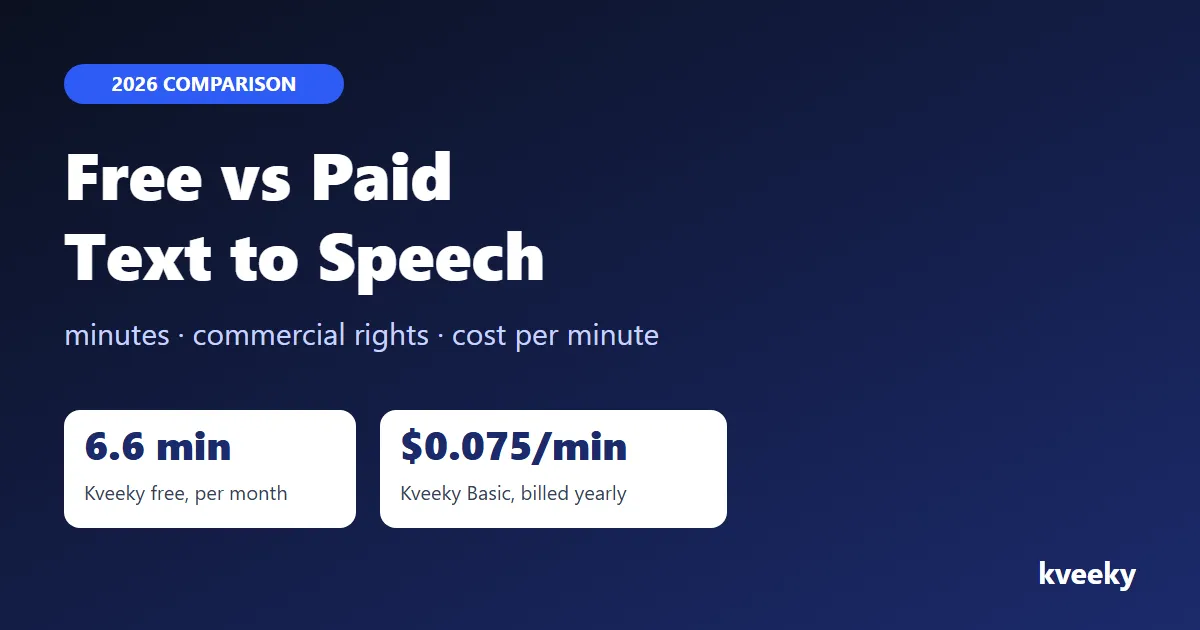
- Free plans are for testing. Kveeky Free gives 500 credits a month (about 6.6 minutes) with standard voices. WellSaid Free gives 3 download minutes a month. Typecast Free gives about 5 minutes in total, once.
- Commercial rights are the biggest gap. WellSaid's free allowance carries "no commercial rights", Typecast Free requires attribution, and Kveeky lists commercial rights on every paid plan.
- Cloud text to speech from Amazon and Microsoft has larger free tiers, but it is a developer service: you write code and get no editor.
- Paid text to speech starts at $5 to $9 a month. On Kveeky, Basic is $7.50 a month billed yearly for 100 minutes, or $0.075 per minute.
- Stay free if you need under 5 finished minutes a month for personal use. Pay once you publish for a business or need more than that.
On this page: Free vs paid: the real difference · What free plans include · Commercial use · Cloud free tiers · Cost per minute · Worked example · When to pay · Test checklist · FAQ
Free vs paid text to speech: what is the real difference?
Paid plans give you more minutes, more voices, commercial rights and fewer restrictions. The audio engine is often the same one you hear on the free plan. You are paying for volume and permission, not always for a better-sounding voice.
Here is how the two tiers usually differ:
| What you get | Typical free plan | Typical paid plan |
|---|---|---|
| Audio per month | 3 to 7 minutes | 20 to 100+ minutes |
| Voices | A limited set (Kveeky Free: standard voices only) | The full library (Kveeky paid: all 700+ voices) |
| Commercial use | Not included, or attribution required | Included |
| Downloads | Capped or limited formats (WellSaid Free: MP3 only) | Higher caps, more formats |
| Extras | Basic playback and download | Voice cloning, localization, priority support, depending on plan |
What do free text to speech plans include in 2026?
Free plans give a small allowance meant to let you test a voice. We read the free tier of 3 tools on October 9, 2026.
| Tool | Free allowance | Commercial use on Free | Other limits |
|---|---|---|---|
| Kveeky | 500 credits/month (about 6.6 minutes), no credit card | Not listed. Commercial rights are listed on paid plans | Standard voices only; 5 voice clones |
| WellSaid | 3 download minutes/month, no credit card | No ("no commercial rights") | MP3 only |
| Typecast | 3,000 credits (about 5 minutes) of lifetime download credit | Not listed; attribution required for all downloads | No watermark-free video export |
Two details matter. Typecast's free credits are a one-time pool, not a monthly refill. WellSaid counts only downloaded minutes, so you can generate more than you can save.
Kveeky's free plan is the largest monthly allowance of the 3 here. It is still about 6.6 minutes: enough for a short test video, not a weekly channel. You can try it with no card on the Kveeky voice generator for social videos.
Can you use free text to speech commercially?
Usually not without conditions. A free plan that doesn't list commercial rights should be treated as personal use only. Check the pricing page or the terms before you publish anything a client or an ad budget depends on.
What we found on October 9, 2026:
- WellSaid: the free allowance carries "no commercial rights"; Starter lists "full commercial rights".
- Typecast: "Attribution is required for all content downloaded on the Free plan." Basic includes a commercial license, and attribution is optional.
- Kveeky: the pricing page says every paid plan includes commercial usage rights for generated audio. It doesn't list commercial rights for Free, so we treat Free as testing only.
This isn't legal advice. For a tool-by-tool table, see our guide to commercial use of AI voiceovers by plan.
Are the free cloud TTS tiers from Amazon and Microsoft really free?
Yes, within limits, and they are larger than any voice-generator free plan. They are built for developers: you call an API, you pay per character after the free tier, and there is no timeline editor.
| Service | Free tier | Price after the free tier |
|---|---|---|
| Amazon Polly, Standard voices | 5 million characters/month, no stated time limit | $4.00 per 1 million characters |
| Amazon Polly, Neural voices | 1 million characters/month for the first 12 months | $16.00 per 1 million characters |
| Amazon Polly, Generative voices | 100 thousand characters/month for the first 12 months | $30 per 1 million characters |
| Microsoft Azure AI Speech, Neural voices | 0.5 million characters/month (Free F0 tier) | Not shown on the page we could read |
At about 900 characters per minute of speech (150 words a minute at 6 characters a word, our estimate), 1 million characters is roughly 1,100 minutes. That is far more audio than any consumer free plan.
The catch is the work around it. You need an account, code that calls the API, and your own way to edit, preview and download audio. If you want to paste a script, pick a voice and download, a voice generator is faster. For Google's own offering, see our Google text to speech guide.
How much does paid text to speech cost per minute?
Entry-level paid plans cost about $0.075 to $0.95 per minute of included audio. Divide the plan price by the minutes it includes.
| Plan | Monthly billing | Yearly billing | Included audio |
|---|---|---|---|
| Kveeky Basic | $9 | $7.50/month ($90/year) | 100 minutes/month |
| Kveeky Pro | $19.99 | $12.50/month ($149.99/year) | 133 minutes/month |
| Typecast Basic | $5 | $54/year | About 35 minutes/month |
| WellSaid Starter | $19 | $10/month ($120/year) | 20 minutes/month (240 per year) |
| Plan | Cost per included minute, monthly | Cost per included minute, yearly |
|---|---|---|
| Kveeky Basic | $0.090 | $0.075 |
| Kveeky Pro | $0.150 | $0.094 |
| Typecast Basic | $0.143 | $0.129 |
| WellSaid Starter | $0.950 | $0.500 |
These are our calculations: plan price divided by the vendor's stated allowance. Typecast states "~35 mins", so its figure is approximate. For a wider comparison of paid plans, see our best AI voice generator for small business guide, and for per-video costs, what an AI voiceover costs per video.
Where cloud services win: Amazon Polly Neural at $16 per million characters works out to about $0.014 per minute on our estimate. That is cheaper than any plan above, if you can build the workflow yourself.
Worked example: 30 finished minutes a month
Say you publish 30 minutes of narration a month, such as 6 five-minute training videos. Plan for about 1.5× generation to cover retakes: 45 minutes of audio.
| Option | Covers 45 minutes a month? | Monthly cost |
|---|---|---|
| Kveeky Free (about 6.6 minutes) | No. About 4 finished minutes | $0 |
| WellSaid Free (3 download minutes) | No. 3 minutes, no commercial rights | $0 |
| Typecast Free (about 5 minutes, once) | No. Runs out in the first month | $0 |
| Kveeky Basic (100 minutes) | Yes, with 55 minutes spare | $7.50 yearly or $9 monthly |
| Typecast Basic (about 35 minutes) | No. Short by about 10 minutes | $54 a year |
| WellSaid Starter (20 minutes) | No. Short by 25 minutes | $10 yearly or $19 monthly |
The free plans cover under 15% of this workload. The cheapest plan that covers it is Kveeky Basic at $0.25 per finished minute billed yearly ($7.50 ÷ 30). That is our calculation.
When is a free plan enough, and when should you pay?
A free plan is enough when you need under 5 finished minutes a month and the audio is personal or a test. Pay when any row below applies.
| Your situation | Free enough? | What to do |
|---|---|---|
| Testing voices before you commit | Yes | Use the free plan with your own script |
| One short personal video a month | Usually | Stay free; check attribution rules |
| Client, ad or business audio | No | Pay for a plan that lists commercial rights |
| A weekly channel or course | No | Pay; size the plan at 1.5× finished minutes |
| Apps and automation | Maybe | Cloud TTS free tier, if you can code |
| Premium voices or a larger library | No | Pay (Kveeky unlocks all 700+ voices on any paid plan) |
How to test a free plan before you pay
Spend 10 minutes on a real script and you will know. Use this checklist:
- Paste a 60-second slice of your actual script, not the sample text.
- Try 2 or 3 voices and listen on headphones and a phone speaker.
- Check whether the voice you liked is in the free library or locked to paid plans.
- Download the file and confirm it is the format you need (MP3 or WAV).
- Read the free plan's commercial-use and attribution line before you publish.
- Note how many credits one minute used, then multiply by your monthly volume.
Kveeky's free plan needs no credit card, so you can run all 6 steps first. For more options, see our list of the best free AI voice generators and the guide to free online text to speech with realistic AI voices.
Frequently asked questions
Is free text to speech good enough?
For testing and short personal clips, yes. Free plans often use a limited set of voices. The real limits are minutes, commercial rights and voice choice.
Can I use free text to speech for YouTube or business videos?
Only if the plan allows it. WellSaid's free allowance has no commercial rights and Typecast's free plan requires attribution. Kveeky lists commercial rights on paid plans, so use one for monetized or client work.
How much does paid text to speech cost?
Entry plans start around $5 to $9 a month. Kveeky Basic is $9 a month, or $7.50 billed yearly, for 100 minutes. Typecast Basic is $5 a month, and WellSaid Starter is $19 a month.
What is the best free text to speech with no limits?
No free plan is without limits. Cloud services such as Amazon Polly give 5 million Standard-voice characters a month but need technical setup. Kveeky's free plan gives about 6.6 minutes a month with no credit card.
Are credits the same as minutes?
No. Credits are consumed per character of generated speech. Kveeky's 500 free credits are about 6.6 minutes, and 75,000 credits are about 100 minutes.
How we checked this guide
This guide is written by Ankit Agarwal for the Kveeky team. Disclosure: Kveeky makes an AI voice generator. We list Kveeky first in each table for ease of comparison, state where cloud services cost less, and use no Kveeky usage data. Some vendors were left out because their pricing pages could not be read reliably on the date of this check.
- Kveeky plans and rights: kveeky.com/pricing.md, retrieved 2026-10-09.
- WellSaid: wellsaid.io/pricing, retrieved 2026-10-09.
- Typecast: typecast.ai/pricing, retrieved 2026-10-09.
- Amazon Polly: aws.amazon.com/polly/pricing, retrieved 2026-10-09.
- Microsoft Azure AI Speech: Azure Speech pricing, retrieved 2026-10-09.
Cost per minute is our calculation: plan price ÷ the vendor's stated minutes. The 900 characters per minute figure is our estimate at 150 words a minute.
Your next step: take a 60-second slice of your script, run the checklist above on a free plan, then compare it with your monthly finished minutes. If you need commercial rights, start with the Kveeky voice generator for training videos and review the plans on the pricing page.