Voiceover for Advertisements: Your Key to Effective Ads

An advertising voiceover is the spoken track that carries the message in a TV, radio, streaming audio, podcast or social video ad. A good one matches the voice to the audience, puts the hook in the first seconds and fits the slot exactly. You can hire a voice actor or generate the read with an AI voice generator.
Last updated: October 6, 2026. Kveeky plan details were checked on kveeky.com/pricing on that date.
This guide is for marketers, small businesses and agencies making voice over ads for the first time, or trying to make them faster. It covers ad formats, how to choose a voice, how to write the script, and when an AI voice is the better choice.
Key Takeaways
- Voice is a casting decision. Pick the voice for the audience and the offer, not for how impressive it sounds on its own.
- Write to the slot. Read the script aloud with a timer before you record or generate anything. Most problems are scripts that are too long.
- Human voice actors still win on complex acting, celebrity recognition and broadcast campaigns where one read runs for months.
- AI voices win on revisions and versions. You can test several reads, fix one word or localize the ad without a new session.
- Kveeky has 700+ AI voices in 40+ languages, MP3 and WAV export, and lists commercial usage rights on every paid plan, from $9/month.
On this page: What it is · Ad formats · Choosing a voice · Writing the script · Human vs AI · Make one in Kveeky · AI dubbing · Mistakes · FAQ
What is an advertising voiceover?
An advertising voiceover is narration recorded or generated for an ad, where the speaker is heard but usually not seen. It tells the viewer or listener what the product is, why it matters and what to do next.
In audio-only ads, such as radio, streaming and podcast spots, the voice carries the whole message. In video ads, it guides attention and keeps the story clear when the visuals move fast.
An AI voiceover for ads works the same way. You write the script, choose a synthetic voice, set the delivery and export an audio file for your editor or ad platform.
Types of voice over ads
The format sets the length, the pace and how much the voice has to do.
| Format | What the voice does | Watch out for |
|---|---|---|
| Radio and streaming audio ads | Carries the whole message with no visuals | Say the brand name early and repeat it at the end |
| TV and connected TV commercials | Supports the visuals and delivers the offer | Leave room for music, sound effects and any legal line |
| Social video ads | Hooks the viewer in the first line | Many people watch muted, so add captions too |
| Podcast ads | Sounds closer to a personal recommendation | Keep it conversational, not announcer-style |
| Infomercials and long product ads | Explains features step by step | Vary the energy so a long read doesn't go flat |
| Explainer and demo ads | Walks through how the product works | Match each sentence to what is on screen |
For audio-first platforms, see our page on AI voiceovers for Spotify ads. For B2B video, our guide to AI voiceovers in LinkedIn video ads covers what works on that platform.
How to choose the best voice for your ad
Choose the voice your buyer trusts for this kind of offer. Then check that it fits your brand and the platform.
| Ad goal | Voice style that usually fits | Delivery |
|---|---|---|
| Limited-time sale or launch | Bright, energetic | Faster pace, clear stress on the offer |
| Finance, health or insurance | Calm, steady, mature | Even pace, no hype |
| Software and B2B products | Friendly and knowledgeable | Conversational, plain words |
| Luxury and premium brands | Low, warm, unhurried | Slow pace, longer pauses |
| Kids, games and entertainment | Playful or character voice | Wide pitch range, more emotion |
| Local businesses | Neighborly, natural accent for the area | Relaxed, direct call to action |
3 checks before you commit:
- Audience test. Would your buyer take advice from someone who sounds like this?
- Brand test. Does the voice match your other ads, videos and phone greetings? A brand voice guide for AI voiceovers keeps this consistent.
- Platform test. Play it on a phone speaker. Thin or overly breathy voices lose clarity there.
How to write a voice over script for an ad
A strong ad script makes one promise and gives one action. Use this order.
- Hook. Open with the problem, a question or a surprising fact your buyer recognizes.
- Unique point. Say what makes you different: price, quality, convenience or service. Show it, don't just claim "the best".
- Benefit. Turn features into outcomes the listener cares about.
- Offer. Give a reason to act now, such as a trial, a discount or free delivery. Create urgency without pressure.
- Call to action. Say exactly what to do: visit, call or tap. Repeat the brand name.
- Time it. Read the script aloud with a timer at a natural pace. If it runs long, cut words, not pauses.
Write for the ear. Use short sentences, everyday words and numbers people can remember. If you need help with pacing and emphasis, these pacing, pauses and emphasis techniques apply to ads too.
Voice actor or AI voice for commercials?
Both have a place. The right choice depends on how much acting the ad needs and how often you will change it.
| Professional voice actor | AI voice generator | |
|---|---|---|
| Cost | Quoted per project; length, market and usage period change the fee | Plan-based; Kveeky Basic is $9/month for 100 minutes |
| Revisions | Often a new session | Edit the line and regenerate |
| Testing versions | Each read costs time and money | Make several reads of the same script quickly |
| Acting range | Stronger for subtle emotion, comedy and character work | Good for clear, direct reads; emotion tags help |
| Recognition | Stronger when a known voice is part of the brand | No celebrity value |
| Languages | One actor per language | Kveeky has voices in 40+ languages |
| Usage terms | Set in the actor's contract | Set by the plan; Kveeky lists commercial usage rights on every paid plan |
A common split: use AI voices to draft, test and run performance ads, then hire an actor for a long-running broadcast campaign. Our guide on how to A/B test voiceover styles without re-recording shows how to run that test.
How to make an AI advertising voiceover in Kveeky
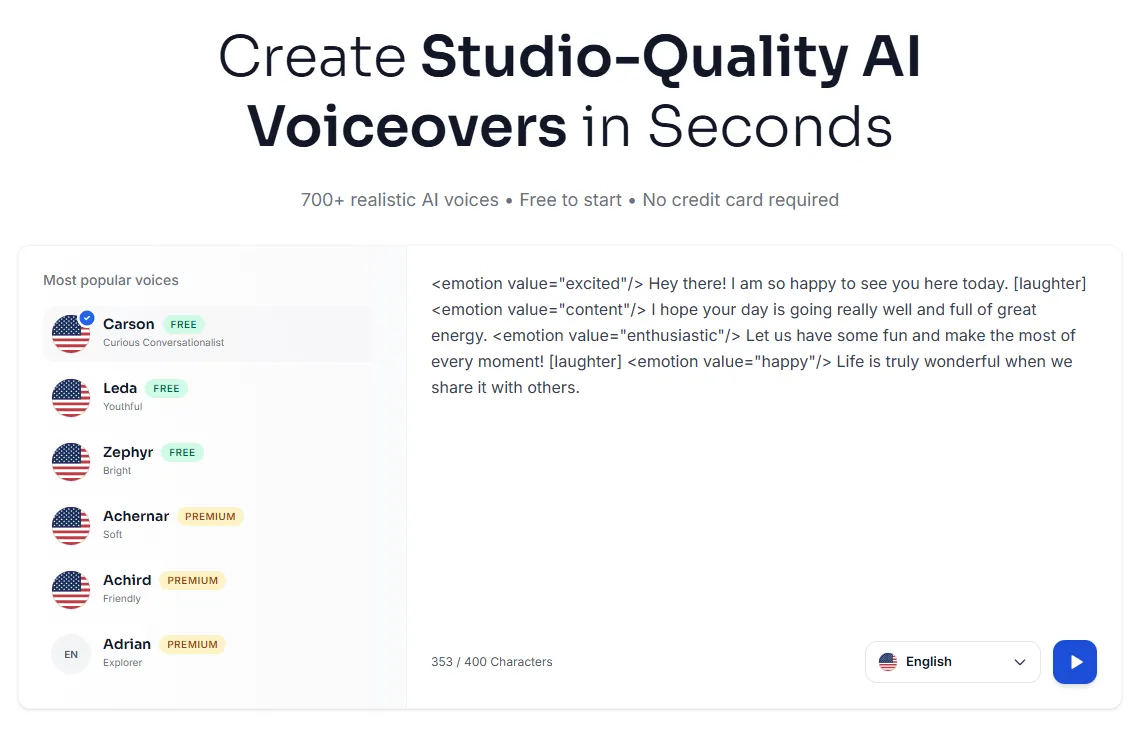
- Paste your timed script into the Kveeky voice generator.
- Shortlist 3 voices that fit your ad goal, and preview the hook line with each.
- Set the delivery. Adjust tone, pitch and speed. Add
<emotion value="excited"/>before an offer, or keep it neutral for trust-led ads. - Fix pronunciation. Re-spell your brand name phonetically if the voice misreads it, and add commas for breathing room.
- Export WAV for video and broadcast editing, or MP3 for quick drafts.
- Mix it. Place music under the voice, lower the music during speech, and check the ad on phone speakers and headphones.
The free plan gives 500 credits a month (about 6.6 minutes) with standard voices, which is enough to test a few ad scripts. Paid plans unlock all 700+ voices; see our AI voiceover for advertisements page for examples.
AI dubbing for commercials in other languages
To run the same ad in another market, translate the script, have a native speaker check it, then regenerate it in a voice for that language.
- Re-time every version. Translations often run longer, so trim the script to fit the slot.
- Localize the offer. Prices, dates and legal lines change by market.
- Keep the voice style consistent across languages, even when the voice itself changes.
On Kveeky's Pro plan and above, voice localization helps here. Our guide to AI dubbing and video localization covers the full workflow.
Common advertising voiceover mistakes
- Too many words. A rushed read sounds like a disclaimer. Cut until it breathes.
- Wrong energy. A hyped voice on a serious offer erodes trust.
- Brand name said once. Say it early and again at the end, especially in audio-only ads.
- Music fighting the voice. Lower the bed under speech so every word is clear.
- No phone test. Most ads are heard on small speakers. Check there before you publish.
- No rights check. Confirm usage terms with your actor or your AI voice plan before paid media.
Frequently asked questions
How much does a voice over for an ad cost?
A professional voice actor quotes per project, and the fee depends on length, market and how long the ad runs. With an AI voice generator you pay for a plan instead; Kveeky starts at $9/month, or $7.50/month billed yearly, for 100 minutes.
What makes a good advertising voice?
A good advertising voice suits the audience, sounds clear on phone speakers and matches the brand's other ads. Energy should fit the offer: bright for a sale, calm for finance or health.
Can I use an AI voice in commercials?
Yes, if your plan includes commercial use. Kveeky lists commercial usage rights on every paid plan, but not on the free plan. Check each ad platform's rules on AI-generated content before you publish.
How long should an ad voiceover be?
It should fit the slot with a little room for music and the logo. Common slots are 15, 30 and 60 seconds, so read the script aloud with a timer before you produce it.
How do I make a voice over for an ad?
Write a timed script, choose a voice that fits the audience, then record it with a voice actor or generate it with an AI voice generator. Mix it under music and test it on a phone speaker.
How we checked this guide
This guide is written by Ankit Agarwal for the Kveeky team. Disclosure: Kveeky makes an AI voice generator. We rewrote an older version of this post and removed outdated product numbers.
- Kveeky plans, voices and limits come from kveeky.com/pricing, retrieved October 6, 2026.
- We did not quote voice actor rates because published rates vary widely by market and usage, and we could not verify a single reliable figure.
- No Kveeky usage data is used in this guide.
Ready to hear your script? Paste your next ad into Kveeky and generate the hook with 3 different voices. Then use our hub guide to text-to-speech tools for marketing to plan where else that voice can run.