Emotionally Intelligent Text-to-Speech Synthesis Techniques

TL;DR
- Traditional monotone TTS is obsolete in the modern agentic voice era.
- Neural prosody mapping allows AI to convey intent, rhythm, and emotion.
- Modern systems use deep learning to map text directly to acoustic features.
- Emotional intelligence in audio reduces cognitive friction and improves user engagement.
- AI-driven voice systems are shifting from simple narration to authentic acting.
The era of the "monotone bot" is officially dead.
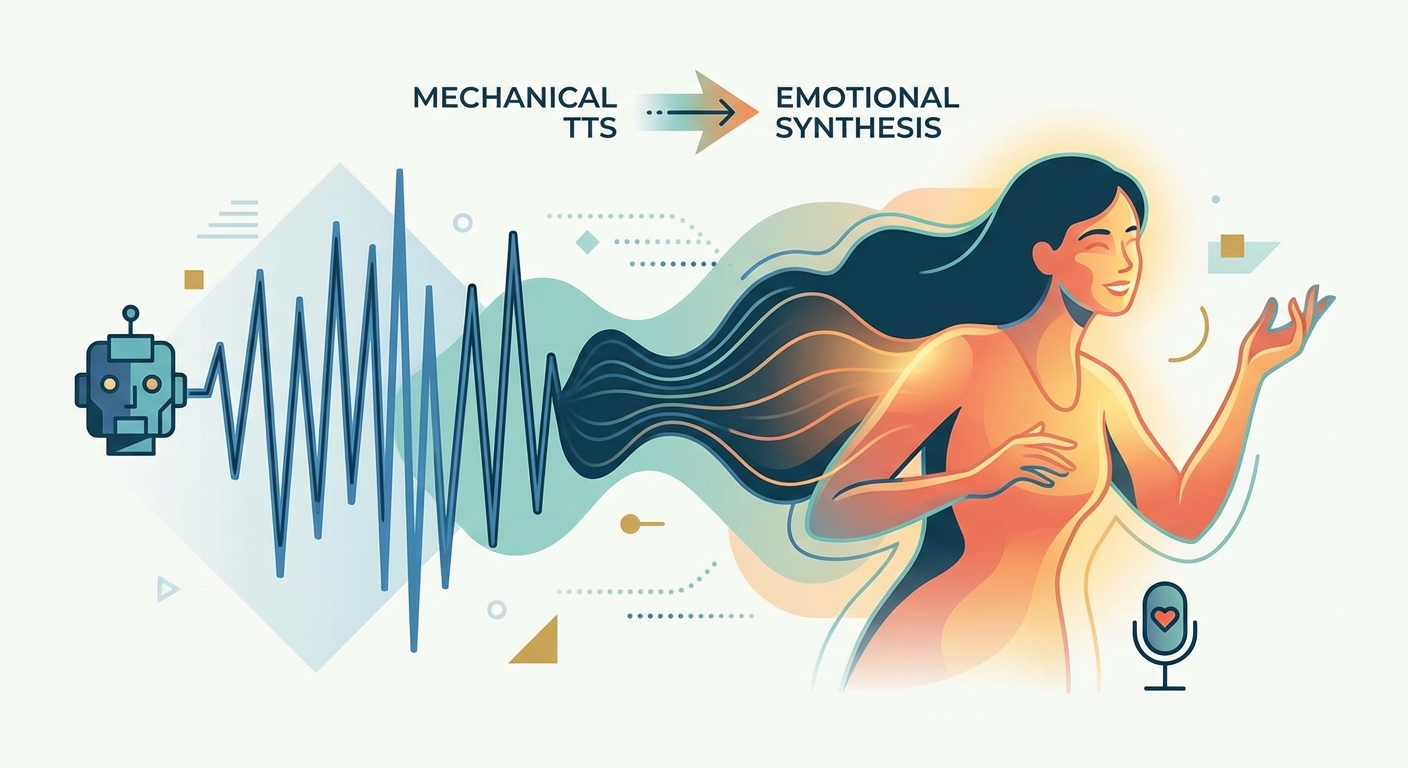
For years, we’ve been stuck in the trenches of utility-based text-to-speech (TTS). It was a simple, soul-crushing exchange: you fed a machine a string of text, and it spat back a digitized waveform. It got the job done, sure, but it sounded like a calculator trying to read poetry.
Those days are over. We’ve moved into the age of agentic voice systems—tech that doesn’t just read words, but decodes the subtext. Emotionally intelligent TTS isn't some sci-fi fantasy anymore. It’s the baseline for any creator who realizes that communication is 7% words and 93% delivery. By using neural prosody mapping, modern systems can now replicate the stutter of hesitation, the breathless pace of urgency, and the razor-sharp sting of sarcasm. It’s changing everything.
Why Is Traditional TTS Falling Behind in 2026?
Let’s be honest: the "uncanny valley" of synthetic audio has always been a rough place to hang out. Old-school TTS relied on static concatenation—basically stitching together phonemes like some digital Frankenstein’s monster. Even as we shifted to early neural TTS, the output stayed flat. It lacked the variable intent that makes human speech actually human.
As noted in recent Voice AI trends 2026, the market has moved on. Users don’t want a narrator; they want an actor. Think about it: if you hear a medical alert delivered with the chipper, upbeat tone of a weather report, your brain immediately screams, "Fake!" That disconnect creates cognitive friction. Your audience doesn't just notice it—they bounce. In an economy where attention is the only currency that matters, if your voice system can't carry the weight of the message, you’ve already lost the room.
How Does Emotionally Intelligent TTS Actually Work?
Modern emotional TTS has ditched the rigid, developer-heavy nightmares of SSML tags. Instead, it relies on deep learning architectures that map text directly to acoustic features. The system runs the input through an NLP engine to figure out the "vibe"—the semantic intent—which then informs the prosody controller. This is the secret sauce: it’s the part of the AI that handles rhythm, stress, and intonation.
By decoupling the text from the delivery, the engine can tweak the pitch and the timing in real-time. It’s not just about slapping a "happy" filter on a voice. It’s about the system realizing that a comma isn't just a pause—it’s a breath. It’s knowing that an exclamation point should trigger a subtle spike in breath intensity. It’s acting, not just speaking.
What Are the Key Methods for Controlling Emotion?
The evolution here has been lightning-fast. We’ve gone from wrestling with complex sliders for "energy" and "pitch" to using natural language as a director’s tool.
Prompt-Based Control
Think of prompting as the director’s chair. You aren't a coder anymore; you’re a casting director. Instead of adjusting technical parameters, you just tell the AI what you want. "Read this with a shaky, nervous tone, like the speaker is hiding a secret." The model interprets that instruction and alters its acoustic output to perform the script. This is backed by research into controlling emotion in TTS with natural language prompts, which shows how semantic descriptors can steer the latent space of a model toward specific emotional clusters.
Zero-Shot Synthesis
This is the real game-changer. These models are trained on massive, diverse datasets, allowing them to apply emotional nuance to any voice profile—including your own—without needing hundreds of hours of tagged recordings. As documented in the Zero-Shot Emotion TTS Model research, these systems can generalize "anger" or "joy" across different speakers. Suddenly, expressive AI isn't just for the big studios; it’s for everyone.
How Can You Master Prompt Engineering for Emotional Output?
If you’re still messing with sliders, you’re working in the dark. The future of voice direction lies in your ability to describe the "vibe." Treat your AI like a voice actor. They need direction, not just coordinates.
The Prompt Cheat Sheet:
- For Tension: "Add a slight hesitation before the final word; increase breathiness."
- For Excitement: "Increase pitch variance; use a faster speaking rate with sharp, crisp consonants."
- For Empathy: "Slightly lower the base pitch; lengthen the duration of vowels; prioritize a soft, rounded tone."
- For Authority: "Reduce pitch variance; maintain a steady, measured tempo; emphasize the final word of each phrase."
Focusing on these descriptors moves you away from the robotic, "uncanny" feel of legacy tools. If your current stack is still struggling to get this right, you might need to check out AI Voice Solutions to find a more robust foundation for your audio.
Which Use Cases Demand Emotional Synthesis?
Emotional intelligence isn't just a "nice to have." In high-stakes environments, it’s the difference between success and failure.
- Gaming: An NPC in an open-world RPG that speaks with a static, flat tone is an immersion killer. Dynamic emotional synthesis lets characters react to the player—shifting from frustration to genuine fear based on what the player does.
- E-Learning: Retention rates spike when the material is delivered with a tone of actual encouragement. Empathetic AI tutors can sense when a student is hitting a wall and soften their tone, providing a supportive, human-like presence.
- Marketing/Advertising: The difference between a generic ad and one that actually converts is the "hook." Using an urgent, enthusiastic tone in a landing page video can move the needle on your conversion rates in ways a flat voice never could.
What Is the "Human-in-the-Loop" Workflow?
Even with the best models on the planet, the "last mile" of production usually needs a human hand. This is the "Human-in-the-Loop" (HITL) workflow. You let the AI do the heavy lifting—the phrasing, the tone, the rhythmic baseline—and then a human editor steps in. They refine the pacing. They tweak that one inflection point that feels slightly off. For enterprise-grade projects where perfection isn't optional, integrating Professional Voice-Over Services ensures that your synthetic base meets the high standards required for broadcast or major commercial release.
How Do We Solve for Ethics and Disclosure?
As the line between human and synthetic voices blurs, the industry is moving toward mandatory transparency. We’re seeing a shift toward mandatory watermarking—inaudible, machine-readable signatures that identify audio as AI-generated.
But look: disclosure isn't just a legal hurdle. It’s a trust-building exercise. Whether it’s a quick disclaimer in a podcast or a metadata tag on a video, transparency is the only way to ensure the long-term viability of synthetic media. If you aren't being honest with your audience, they’ll find out—and they won't be happy about it.
Frequently Asked Questions
How do AI systems add emotion to text-to-speech?
Modern systems use neural networks to predict acoustic features like pitch, duration, and energy based on the input text. Unlike static models that use fixed rules, these networks learn how humans vary their tone in response to different contexts, allowing for dynamic, expressive output.
Can I make AI voice sound truly angry or sad?
Yes, using modern zero-shot models and precise prompt engineering. By describing the emotional state in your prompt—such as "frustrated, clipped, and sharp" for anger—the model adjusts its prosody to mimic those specific human characteristics.
What is the difference between standard TTS and emotionally intelligent TTS?
Standard TTS focuses on legibility—getting the words right. Emotionally intelligent TTS focuses on intent—understanding why the words are being said and adjusting the delivery to match that underlying meaning.
Is emotional AI voice-over copyright-safe?
The legal landscape is evolving. Generally, the output is safe if you use licensed, ethical models that respect the rights of the original voice talent (if a voice clone is used). Always check the Terms of Service for the platform you are using to ensure you have the rights to the synthesized audio.
Does emotional synthesis require specialized hardware?
No. Most state-of-the-art emotional TTS models are delivered via cloud-based APIs. This means the heavy computational lifting happens on the provider’s servers, allowing you to generate professional-grade, emotional audio from any standard computer or device.