
New Industry Report Reveals Escalating Economic Efficiency of AI Voice Impersonation and Fraud Attacks


TL;DR
- AI voice impersonation attacks have surged by 1,300% over the last year.
- Global financial losses from synthetic fraud reached $16.6 billion in 2024.
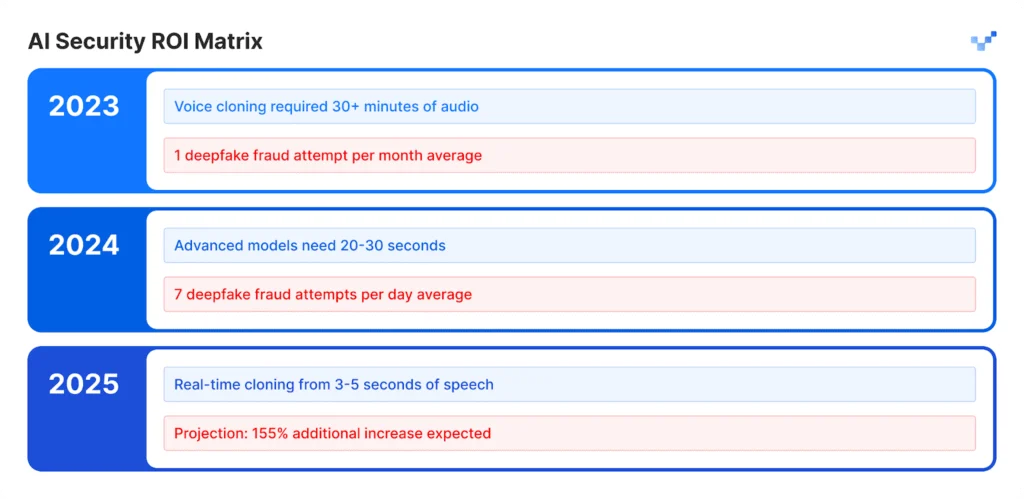
- Just three seconds of audio is enough to create an 85% accurate voice clone.
- Banking and insurance sectors face the highest risk from voice-based authentication threats.
- Experts project $40 billion in annual U.S. fraud losses by 2027.
The AI Fraud Gold Rush: Why Your Voice is No Longer Your Own
The rules of financial crime just got rewritten, and the pen is held by a machine. We aren’t talking about the occasional phishing email anymore; we’re looking at a 1,300% explosion in voice impersonation attacks over the last year. It’s a full-blown industrialization of deception. In 2024 alone, global financial losses from these synthetic schemes hit $16.6 billion—a brutal 33% jump that should have every C-suite executive losing sleep.
The barrier to entry for criminals has effectively vanished. What used to require a sophisticated operation now takes a few cheap tools and a bit of patience. As organizations scramble to hold onto some semblance of digital trust, the sheer "economic efficiency" of these attacks has become the primary engine of a global security crisis. If the current trajectory holds, experts are looking at a terrifying $40 billion in annual fraud losses in the U.S. by 2027.
The Industrialization of Synthetic Fraud
Speed is the new currency of the criminal underworld. A few years ago, a phishing campaign was a labor-intensive, manual grind. Today? Generative models can churn out hyper-targeted, high-quality phishing emails in about five minutes—a job that once ate up 16 hours of human labor. The results are as predictable as they are depressing: these AI-generated lures are seeing a 54% click-through rate, leaving the old 12% standard of traditional phishing in the dust.
Then there’s the voice cloning. This is the real game-changer. You only need three seconds of someone’s audio to generate an 85% accurate vocal match. That’s enough to fuel everything from the classic "grandparent scam" to high-stakes corporate impersonation. These aren't just random shots in the dark, either. Over 25% of executive systems handling sensitive financial operations are already staring down the barrel of direct deepfake threats.
Sector-Specific Impact and Geographic Hotspots
If you work in insurance or banking, you’re in the crosshairs. According to the latest voice intelligence security report, the insurance world saw a 475% surge in synthetic voice incidents, while banks dealt with a 149% spike. Any institution that relies on "voice-based authentication" is essentially leaving the front door unlocked.
Geographically, the map is shifting. The Asia-Pacific region has become the epicenter of this mess, recording a 194% increase in AI-driven fraud throughout 2024. It’s a clear sign that this isn't a localized problem—it’s a decentralized, tech-enabled wildfire.
| Metric | 2024/2025 Data |
|---|---|
| Global Fraud Losses (2024) | $16.6 Billion |
| AI-Related Scam Losses (2025) | $893 Million |
| Projected Annual Fraud (2027) | $40 Billion |
| Voice Attack Frequency | ~7 per day |
Who’s Accountable?
Legislators are finally waking up to the fire. Senator Maggie Hassan (D-NH) has launched a formal inquiry into the heavy hitters of the voice-cloning world—ElevenLabs, LOVO, Speechify, and VEED. The demand is simple: show us your safeguards. The underlying question, however, is much harder to answer: how do you keep a powerful tool accessible for legitimate creators without handing a loaded weapon to every scammer on the internet? It’s a delicate balance, and right now, the scammers are winning the generative AI social engineering game.
The Crisis of Digital Trust
We are facing a fundamental collapse in how we verify identity. When 73% of organizations report being hit by cyber-enabled fraud in 2025, you have to ask: can we trust anything we hear over the phone? The international AI safety report 2026 points out that this erosion of trust is a compounding problem. Every successful deepfake makes the next one easier to pull off because the baseline for "normal" interaction is being dragged into the mud.
As the 1,300% surge in AI impersonation continues to reshape the landscape, the focus has to shift toward a few key survival strategies:
- Platform Safeguards: AI developers need to stop treating "non-bypassable verification" as an optional feature and start treating it as a core requirement.
- Authentication Evolution: We need to move away from voice-only verification immediately. If your security relies on a voiceprint, it’s already obsolete.
- Regulatory Oversight: Expect federal mandates to start dictating how voice-cloning software is distributed and tracked.
- Operational Resilience: Companies need to audit their financial systems for synthetic communication patterns before the money leaves the account.
The 2024 IC3 Report from the FBI confirms what we’ve all suspected: cybercrime is scaling in perfect lockstep with the tech meant to stop it. As the economic efficiency of AI-driven fraud continues to climb, the gap between our defenses and their offense is becoming a massive, gaping hole in global economic stability. We aren't just fighting criminals anymore; we're fighting the very tools that define the modern internet.