
Sprinklr Expands AI Voice Integration Capabilities to Automate Enterprise Customer Service Workflows

TL;DR
- Sprinklr’s Summer '26 release introduces agentic AI to automate complex service workflows.
- Sprinklr Copilot enables conversational data analysis via natural language queries.
- New voice AI features convert real-time feedback into structured, actionable data.
- Strategic integrations with Adobe and Microsoft bridge marketing and service outcomes.
Sprinklr’s Summer '26 Release: Can Agentic AI Finally Kill the "CX Action Gap"?
For years, enterprise software has been a graveyard of good intentions. Companies spend millions on "Unified CX" platforms, only to find themselves drowning in fragmented data—a phenomenon the industry calls the "CX action gap." You have the insights, but you can’t act on them fast enough.
Sprinklr is taking another swing at this problem with their Summer '26 Release. Unveiled at CXUnifiers 2025, the update is a heavy pivot toward "agentic AI." The goal? To stop treating customer service as a reactive game of whack-a-mole and start turning raw signals into automated, real-time resolutions.
The Shift to Agentic AI
The tech world is currently obsessed with "agents," and Sprinklr is leaning in hard. They’ve introduced "Sprinklr Copilot," an always-on assistant that lets your team talk to their dashboards like they’re chatting with a colleague. Instead of digging through menus, you ask the system what’s happening, and it answers.
But the real muscle here is the new "Sprinklr AI Agents." These aren’t just chatbots. They are autonomous entities built to handle the grunt work—the repetitive, soul-crushing tasks that keep support teams stuck in the weeds. By handing these off to AI, the idea is to free up human employees to actually handle the complex, high-empathy work that machines still can’t touch.
Making Voice Matter
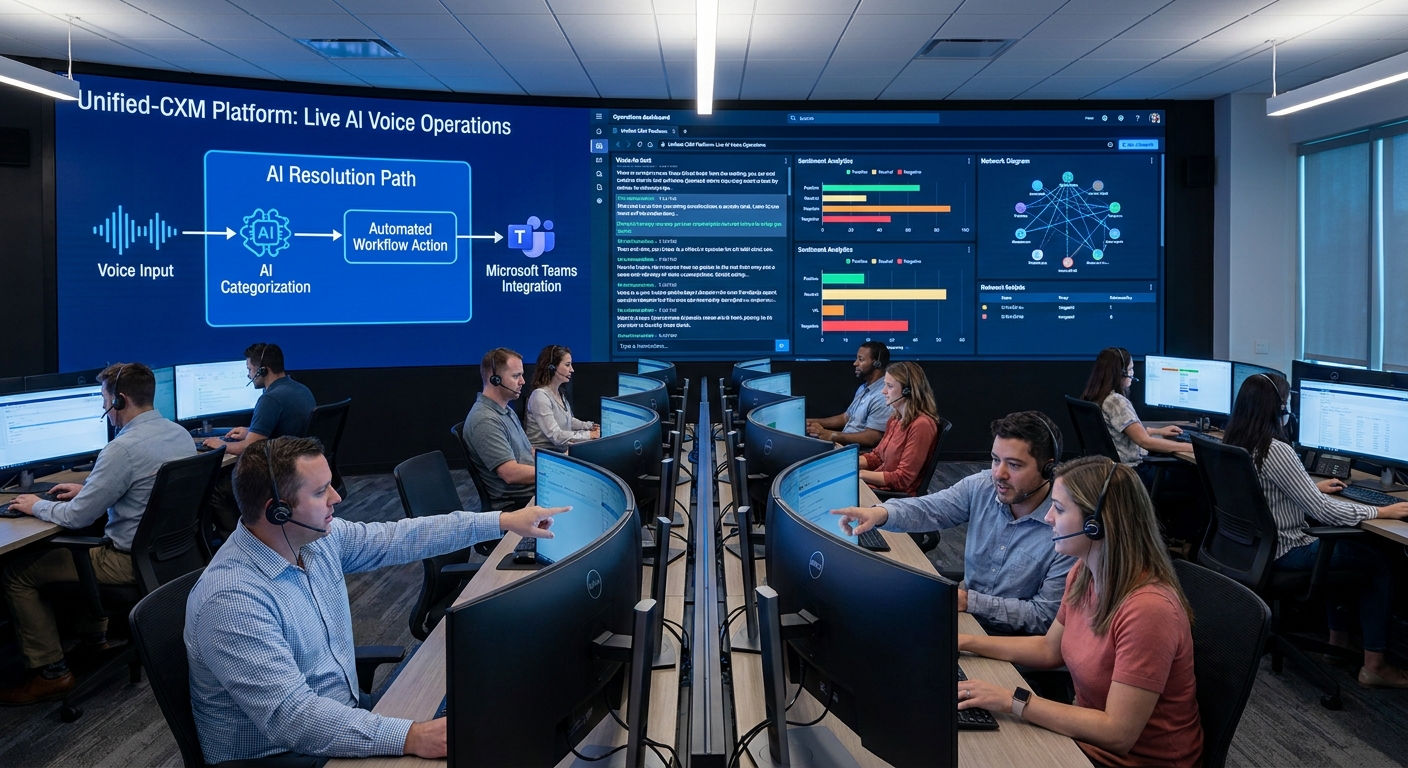
Voice has always been the "dark data" of the customer experience world. It’s messy, hard to transcribe, and even harder to analyze at scale. With this release, Sprinklr is pushing deeper into Voice AI, specifically with voice-enabled in-channel surveys.
The logic is simple: catch the feedback while the conversation is still warm. By automating the conversion of voice interactions into structured data points, they’re trying to remove the manual bottleneck that usually turns voice feedback into a post-mortem report that nobody reads.
They’re also playing nice with the rest of the enterprise stack. By syncing up with Microsoft Teams and Adobe Customer Journey Analytics, the platform is attempting to bridge the gap between your marketing spend and your actual service outcomes. It’s a necessary move; if your influencer campaign is driving thousands of confused customers to your support line, you want to know about it before the end of the quarter.
The Toolkit: A Quick Breakdown
| Feature Category | Primary Functionality |
|---|---|
| Agentic AI | Autonomous handling of repetitive tasks and personalized engagement. |
| Sprinklr Copilot | Conversational dashboard interaction and real-time system monitoring. |
| Voice AI | Voice-enabled in-channel surveys and real-time feedback analysis. |
| Analytics | LLM Insights for AI-powered search results and video analytics. |
| Integrations | Connectivity with Microsoft Teams, Adobe, and CreatorIQ. |
The CreatorIQ integration is worth a mention for any brand deep in the influencer space. Being able to tie an influencer’s reach directly to customer sentiment and service inquiries gives you a 360-degree view that’s usually impossible to stitch together without a small army of data analysts.
Searching for Visibility in the AI Era
We’re living through a massive shift in how people find information. Search isn't just about blue links anymore; it’s about LLM-generated answers. Sprinklr’s new "LLM Insights" feature is a direct response to this. It helps brands track how they appear—or don't appear—in AI-powered search results. If your brand is invisible to the AI, you’re effectively invisible to the consumer.
They’ve also integrated tech from their acquisition of ViralMoment to get a better handle on video. Since video is now the primary language of the internet, being able to process it at scale—rather than just reading text—is a massive upgrade for spotting trends before they become PR nightmares.
Democratizing the Data
Perhaps the most practical change is the overhaul of their Customer Feedback Management (CFM) module. They’ve moved to a no-code interface, which is a subtle but important win. When you make it easy for non-technical teams to set up feedback loops and automated responses, you stop siloing data in IT or data science departments.
As noted in Sprinklr's official announcements, the ultimate goal is to strip away the friction that makes enterprise software so painful to use.
The Bottom Line
The Summer '26 Release isn't just about adding new buttons to a dashboard. It’s an admission that the old way of managing customer experience—manual monitoring, siloed data, and reactive responses—is dead.
By leaning into agent-based architectures, Sprinklr is betting that the future belongs to companies that can automate the "boring" parts of service without losing the human context. Whether it’s connecting Adobe’s journey data or tracking influencer sentiment, the platform is clearly trying to become the central nervous system for the modern enterprise.
As CXM Today has pointed out, the real test will be how well these autonomous agents perform in the wild. But for a company like Sprinklr, the path forward is clear: if you can’t turn insights into action instantly, you’re already behind.