Polygraf AI Launches Meeting Guard to Provide Real-time Deepfake Detection for Enterprise Voice Environments

TL;DR
- Polygraf AI introduces Meeting Guard for real-time enterprise deepfake detection.
- The tool monitors Zoom, Google Meet, and Teams for synthetic audio and video.
- It utilizes three proprietary engines to identify AI-generated threats during live calls.
- Meeting Guard also prevents accidental PII leaks during sensitive corporate sessions.
- The system provides CISOs with real-time threat scores to stop fraud instantly.
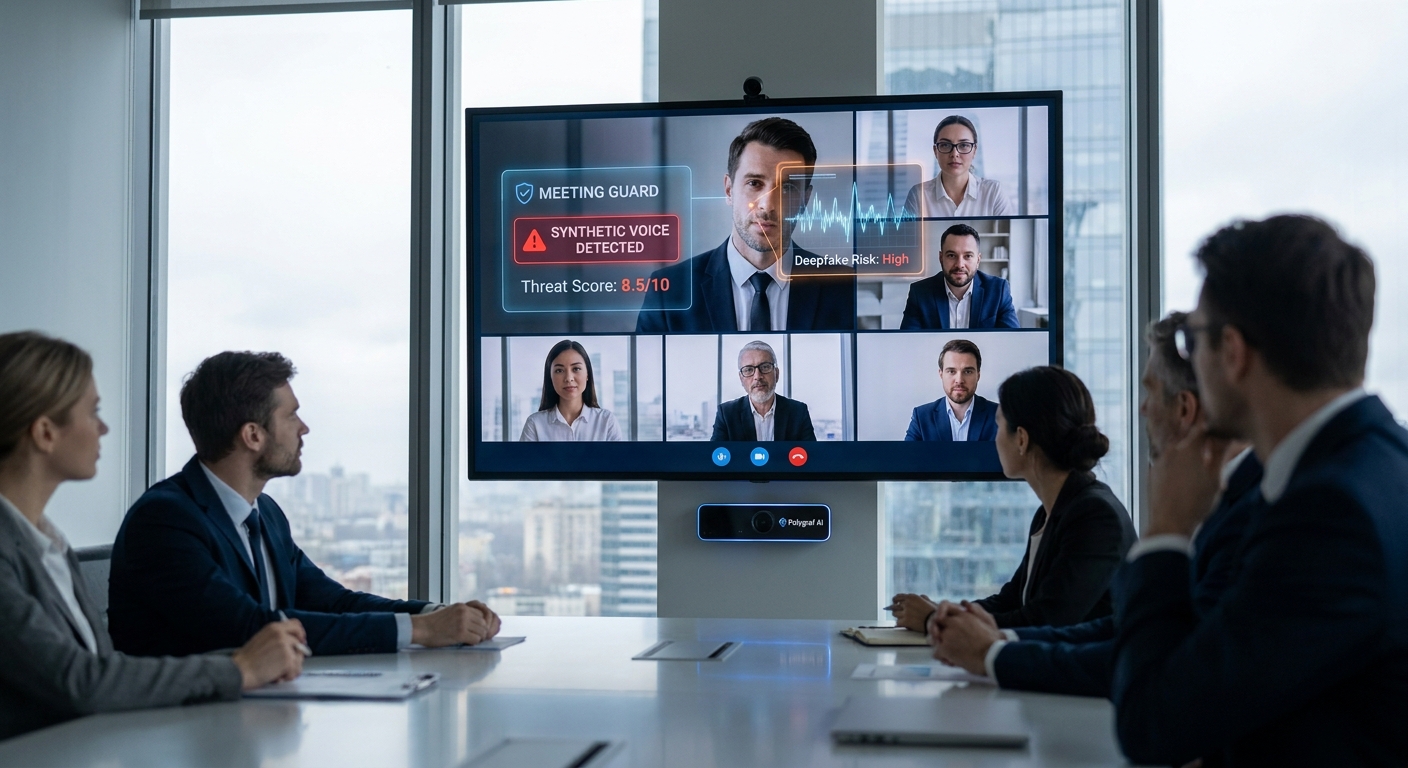
The virtual meeting room has become the new front line of corporate security. On July 14, 2026, Polygraf AI pulled the curtain back on Meeting Guard, a tool built to do one thing: spot the fakes before they cause real-world damage. Whether it’s a deepfake CEO asking for a wire transfer or an AI-generated imposter sitting in on a sensitive strategy session, the threat is no longer theoretical. It’s here, and it’s happening on Zoom, Google Meet, and Microsoft Teams.
For years, we’ve treated remote work as a convenience. Now, it’s a vulnerability. As remote and hybrid setups become the bedrock of global business, the barrier to entry for cybercriminals has plummeted. Why break into a server when you can just impersonate the CFO during a quarterly sync? Meeting Guard acts as a digital bouncer, sitting in on calls to flag synthetic audio, video artifacts, and unauthorized data leaks that traditional firewalls simply can’t see.
The Watcher in the Room
How does it actually work? Instead of forcing IT teams to wrestle with complex API integrations that break every time a platform updates, Meeting Guard takes a simpler approach: it joins the call. It functions as a silent, visible participant, keeping a constant eye—and ear—on the data stream.
The system relies on three proprietary engines to sniff out deception:
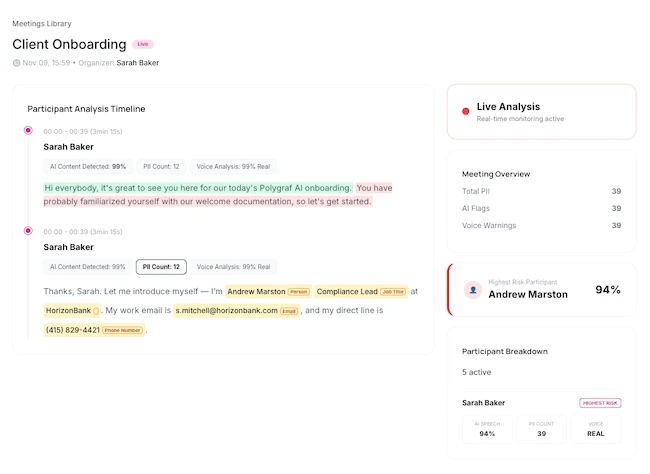
- Deepfake Voice Identification: It listens for the subtle, unnatural cadence and vocal patterns that give away synthetic audio.
- AI-Generated Content Scanning: It hunts for the visual glitches and "uncanny valley" artifacts that define most deepfake video.
- PII Leak Prevention: It monitors for the accidental—or intentional—verbal disclosure of sensitive corporate data or personal information.
This is the new reality of the CISO AI fraud war. Manual verification is dead; you can’t trust your eyes or ears anymore. By providing real-time threat scores, Meeting Guard gives security teams the heads-up they need to shut down a breach while it’s still in progress, rather than cleaning up the mess after the money has left the bank.
Privacy Without Compromise
If you’re a CISO, your first question is likely: "Where does my meeting data go?" It’s a valid concern. Plugging a third-party tool into your most sensitive internal conversations sounds like a privacy nightmare. Polygraf has tried to sidestep this by offering local deployment options. The data stays in your house, and it doesn't get shipped off to some external server for processing.
They’ve also implemented a strict "No-Training" policy. Your company’s confidential discussions aren't being used to feed the next generation of their AI models. With SOC 2 Type II and ISO 27001 certifications under their belt, they’re aiming to prove that security doesn't have to come at the cost of confidentiality. As Channel Insider pointed out, this positioning is critical. If businesses are going to use these tools for high-stakes financial transactions, they need to know the guardrail isn't a backdoor.
The Landscape of Deception
The urgency here isn't just marketing hype. The numbers tell a grimmer story. Research suggests that 62% of organizations have already dealt with a deepfake-related incident. It’s not just a "what if" scenario; it’s a "when."
| Attack Vector | Percentage of Reported Incidents |
|---|---|
| Video Calls | 37% |
| Audio Calls | 43% |
| Other Methods | 20% |
Data from Gartner confirms what many security professionals have suspected: audio is the weakest link. It’s cheaper to produce, easier to mask, and incredibly effective at fooling people who are used to hearing a familiar voice. When an attacker can perfectly mimic an executive’s tone and inflection, the human brain is hardwired to trust it. That’s exactly what these criminals are banking on.
A Shift in Strategy
We’ve spent decades securing the network perimeter and the software stack. But the rise of generative AI has shifted the battlefield to the content itself. It doesn't matter how secure your VPN is if the person on the other end of the screen is an AI-powered imposter.
As noted by Yahoo Finance, the goal of Polygraf AI’s Meeting Guard is to take the burden of "truth" off the human participant. We are no longer reliable judges of authenticity. By automating the detection of synthetic media, companies are finally adding a layer of verification that doesn't rely on a gut feeling.
As AI continues to improve, the quality of these fakes will only get better. We are entering an era where verifying the identity of a meeting participant is as fundamental as checking a password. Meeting Guard is a technical answer to a social engineering problem, and in the current climate, it’s a necessary evolution for any enterprise that values its reputation and its bottom line.