Innovation News Network Report Confirms Industry-Wide Shift from Passwords to Biometric Authentication Standards in 2026

TL;DR
- 2026 marks the official industry-wide shift from passwords to biometric authentication.
- Global passwordless authentication market projected to reach $35.6 billion by 2030.
- Security is evolving to combine physiological, behavioral, and device-bound identification methods.
- Financial services lead adoption, prioritizing seamless, invisible identity verification.
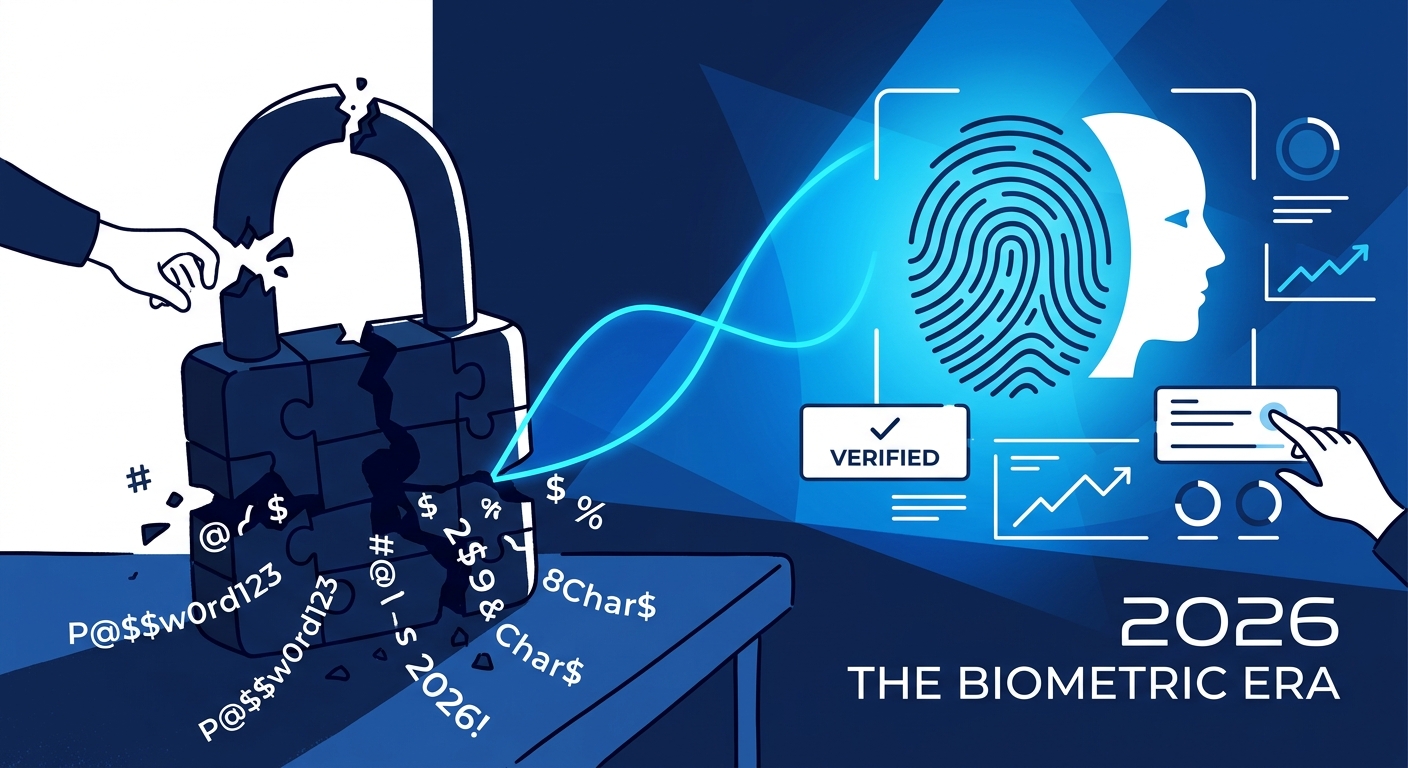
The Password is Dead: Why 2026 is the Year Biometrics Took Over
The password—that clunky, forgotten, and easily stolen string of characters—is finally hitting the exit sign. If you’ve felt like logging into your accounts has become a different experience lately, you aren’t imagining it. The Innovation News Network has confirmed what many of us suspected: 2026 is the year the world officially ditched the password in favor of biometric authentication.
For decades, we’ve relied on "what we know" to prove who we are. But in an era where AI-driven phishing and credential stuffing can crack a legacy password in seconds, that model is a liability. We’re moving toward "who you are." Whether it’s a thumbprint, a facial scan, or the way you type, the industry is betting its future on the fact that your physical self is much harder to forge than a string of letters and numbers.
This isn't just about unlocking your iPhone anymore. This is the new bedrock for global finance, government portals, and enterprise security. The passwordless authentication market is exploding, projected to balloon from a $9.1 billion valuation in 2024 to a staggering $35.6 billion by 2030. That’s a 22.5% growth rate, fueled by a desperate, industry-wide need for security that actually works.
How We’re Actually Authenticating Now
We’re moving away from the "one-and-done" login. Modern security is layering up. It’s no longer enough to just scan a face; systems are increasingly multimodal, demanding a combination of markers—like a voiceprint paired with iris recognition—to make sure the person behind the screen is actually you.
The tech driving this shift falls into three main buckets:
- Physiological Biometrics: The classics. Your fingerprint, facial geometry, iris patterns, and voice. These are your biological signatures.
- Behavioral Biometrics: This is the "stealth" layer. It tracks how you move your mouse, your cadence when typing, and how you interact with your device. It verifies you continuously, not just at the start of a session.
- Device-Bound Authentication: This anchors your identity to a specific piece of hardware—a secure token or your smartphone—turning that device into a physical key that only you can activate.
As biometric security replaces the password, the goal is "invisible" security. We want identity verification to happen in the background, without the friction of captchas or password resets. In high-traffic zones like airports or banking halls, this is a game-changer. It turns a bottleneck into a seamless flow.
Who’s Leading the Charge?
Not everyone is moving at the same speed. Financial services are currently the biggest adopters, holding 30% of the market share. When you’re dealing with billions in assets, you don't mess around with weak passwords.
| Segment | Market Share | Primary Driver |
|---|---|---|
| Enterprises | 42% | Zero-Trust Architecture |
| Financial Services | 30% | Fraud Prevention |
| Healthcare/Government | 28% | Regulatory Compliance |
North America is currently the frontrunner, grabbing 38% of the market. This is largely thanks to tech giants and government agencies pushing hard for "Zero-Trust" models. But it’s a global race. As biometric trends redefine identity in 2026, the conversation is shifting toward equity. Developers are now under the microscope to ensure these systems don't harbor bias against different skin tones, ages, or physical abilities.
The New Frontiers of Risk
Of course, the bad guys aren't just sitting on their hands. As we build better walls, the threats evolve. We’re already looking at the intersection of quantum computing and the future of online security. Even our current encryption standards will eventually need an upgrade to survive the quantum age.
We’re also seeing a shift in how we handle physical access. Instead of relying on vulnerable cloud databases, many organizations are turning to advanced access card technology. These cards store your biometric template directly on the chip. Your data never leaves your pocket, which is a massive win for privacy-conscious users.
The Path Forward: Privacy and Interoperability
The death of the password is a fundamental shift in the power dynamic between the user and the system. We are finally offloading the burden of security from the human—who is, let’s face it, terrible at remembering complex passwords—to the machine.
For this to stick, the industry has to nail three things:
- Interoperability: Your biometric data needs to work across different platforms. We can’t have a fragmented mess where your face works for your bank but not for your email.
- Privacy-by-Design: We must insist on local processing. If your biometric data is sitting in a giant, centralized database, it’s just another target for hackers. It needs to stay on your device or your secure token.
- Continuous Authentication: We need to stop thinking of "logging in" as a single event. The system should know it’s you from the moment you start until the moment you close the tab.
The password served us for a long time, but it’s a relic of a simpler, less dangerous internet. In 2026, we’re finally trading in those sticky notes under the keyboard for a security model that’s as unique as the people using it. The future isn't a string of characters; it's you.