Hindi Text-to-Speech: Best Indian Voice Generator & Natural TTS (2026)
TL;DR
- This guide covers the top-rated Hindi text-to-speech tools available in 2026, focusing on natural sounding voices and emotional depth. We explore platforms like Speechactors, ElevenLabs, and MicMonster to help video producers find the perfect Indian accent. You'll learn how ai technology is changing voiceover production for YouTube, e-learning, and global marketing.
The best Hindi text to speech tools in 2026 are Kveeky, ElevenLabs, Murf AI, Narakeet and Microsoft Azure AI Speech. Kveeky is the simplest pick for creators: Hindi voices, a free plan with no credit card, and paid plans from $7.50/month billed yearly. ElevenLabs suits expressive voices and cloning; Azure covers the most Indian languages.
Last updated: October 6, 2026. Every price and language claim below was checked on the vendor's own page on that date.
This comparison is for YouTubers, teachers, course creators and marketers who publish in Hindi. If you just want to hear Hindi voices and generate audio now, go straight to our Hindi text to speech voices page.
Key Takeaways
- Best overall for creators: Kveeky. Hindi voices plus 8 more Indian languages, MP3 and WAV export, paid plans from $7.50/month billed yearly.
- Best for expressive Hindi and voice cloning: ElevenLabs. Hindi is supported in its Multilingual v2, v3 and v4 models; Instant Voice Cloning starts on the $6/month Starter plan.
- Best for studio-style editing: Murf AI, which lists 40+ Hindi voices on its Hindi page.
- Best for widest Indian-language coverage: Microsoft Azure AI Speech, which lists voices for Odia and Assamese as well as Hindi. It is a developer service, not a creator app.
- Free plans are limited everywhere. Check download and commercial-use rules before you publish monetized videos.
On this page: Comparison · Kveeky · ElevenLabs · Murf AI · Narakeet · Azure · Free options · How to choose · Natural Hindi tips · FAQ
Best Hindi text to speech tools compared
Prices were checked on each vendor's page on October 6, 2026. "Paid from" is the cheapest paid option.
| Tool | Best for | Indian languages | Free option | Paid from |
|---|---|---|---|---|
| Kveeky | Creators who want fast Hindi voiceovers at a low price | Hindi, Bengali, Gujarati, Kannada, Malayalam, Marathi, Punjabi, Tamil, Telugu | 500 credits/month (about 6.6 min), standard voices, no card | $9/month, or $7.50/month billed yearly (100 min) |
| ElevenLabs | Expressive Hindi and voice cloning | Hindi and Tamil in Multilingual v2; more Indian languages in v4 | 10,000 credits/month, no commercial license | $6/month Starter, with commercial license |
| Murf AI | Studio editing for e-learning and presentations | Hindi plus Tamil, Telugu, Bengali and other Indian languages | 10 min of generation, no downloads | $19/month Creator, billed yearly |
| Narakeet | Long scripts and narrated slide videos | Hindi (113 voices listed) | 20 conversions, no commercial use | $6 for 30 minutes, pay as you go |
| Microsoft Azure AI Speech | Developers and rare Indian languages | Hindi plus Odia, Assamese, Urdu and 8 more Indian locales | 0.5 million characters free per month | Pay as you go, developer account |
1. Kveeky: best Hindi AI voice generator for creators
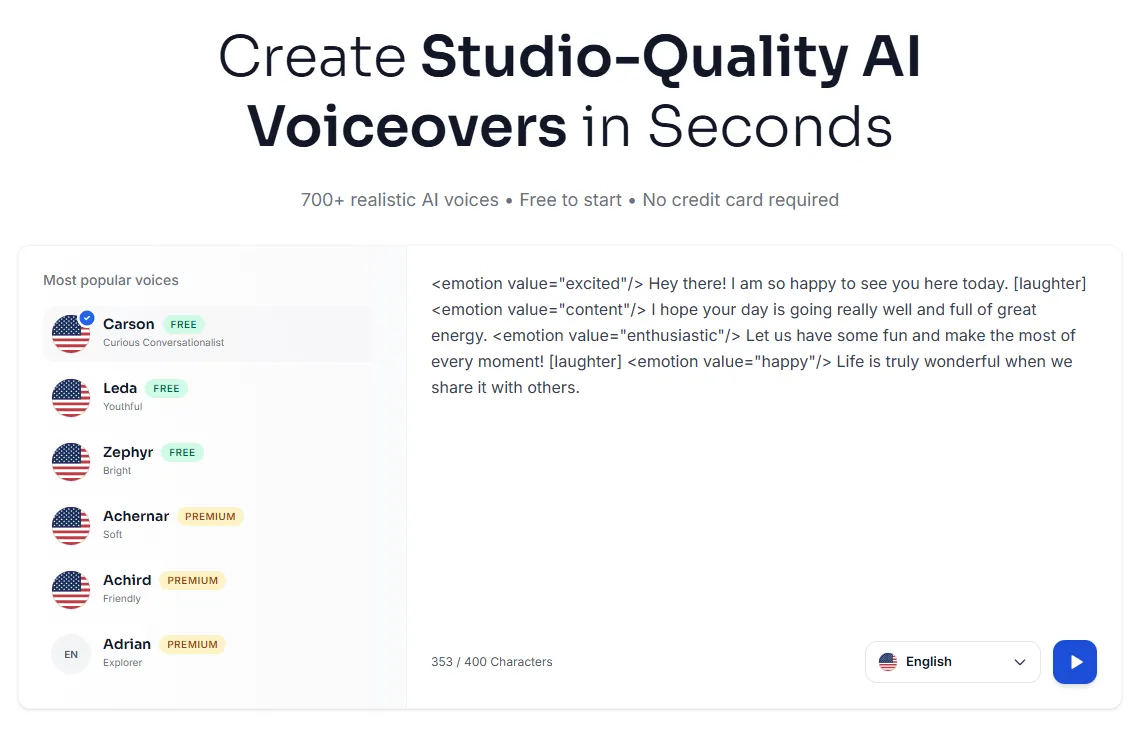
Kveeky is the quickest path from a Hindi script to an audio file. Paste your text in Devanagari, pick a Hindi voice, and download MP3 or WAV.
What you get
- Hindi voices, male and female, plus voices for 8 more Indian languages and Indian English.
- 700+ AI voices in 40+ languages, if you also publish in English or other languages.
- Tone, pitch and speed control, and emotion tags such as
<emotion value="excited"/>for lively lines. - Voice cloning on every plan, including 5 clones on the free plan.
- Commercial usage rights on every paid plan.
Where Kveeky falls short
- The free plan uses standard voices only. Most Hindi voices in our catalog are premium, so regular Hindi work needs a paid plan.
- Our catalog has no Odia or Assamese voices today. If you need those, Azure is the better fit.
- Every plan is credit-metered, so daily long videos need a higher plan.
Want to hear the voices first? Our Hindi text to speech page lets you preview them. For Tamil, the Tamil text to speech voices page works the same way.
2. ElevenLabs: best for expressive Hindi and cloning
ElevenLabs is strong when you want emotional range or Hindi audio in a cloned voice. Its documentation lists Hindi in the Multilingual v2, Eleven v3 and Eleven v4 models. Bengali, Marathi, Telugu and several other Indian languages are listed only for v4 (ElevenLabs models, retrieved 2026-10-06).
Pricing (checked October 6, 2026)
- Free: 10,000 credits a month. No commercial license.
- Starter: $6/month with a first-month discount. Adds a commercial license and Instant Voice Cloning.
- Creator: $22/month. Adds Professional Voice Cloning.
Where it falls short: the free plan can't be used commercially, and credits go quickly if you regenerate long Hindi scripts. Our ElevenLabs review covers it in more depth.
Best for: creators who want a cloned voice speaking Hindi, or very expressive narration.
3. Murf AI: best for studio-style editing
Murf AI suits e-learning, training and presentation voiceovers, where you edit timing and emphasis line by line. Its Hindi page lists 40+ Hindi voices and voices for other Indian languages, including Tamil, Telugu and Bengali (Murf Hindi page, retrieved 2026-10-06).
Pricing (checked October 6, 2026)
- Free: 10 minutes of voice generation. No downloads and no commercial rights.
- Creator: $19/month billed yearly, with commercial rights.
Where it falls short: you can't download anything on the free plan, so you can't test a full workflow without paying.
Best for: course creators and companies making Hindi training or explainer videos.
4. Narakeet: best for long scripts and pay as you go
Narakeet says it has 113 Hindi text to speech voices, with MP3, WAV and M4A downloads (Narakeet Hindi page, retrieved 2026-10-06). It can also turn slides into narrated videos.
Pricing (checked October 6, 2026)
- Free: 20 conversions, no commercial use.
- Paid: one-time purchases, starting at $6 for 30 minutes. Credits don't expire (Narakeet pricing).
Where it falls short: the interface is plain, and fine control over emotion is limited compared with newer tools.
Best for: teachers and publishers who produce long Hindi audio occasionally and prefer not to subscribe.
5. Microsoft Azure AI Speech: best for developers and rare Indian languages
Azure AI Speech is a cloud service for developers, not a creator app. Its language list includes Hindi neural voices plus Odia, Assamese, Bengali, Gujarati, Kannada, Malayalam, Marathi, Punjabi, Tamil, Telugu and Urdu (Azure language support, retrieved 2026-10-06).
Pricing (checked October 6, 2026): the free tier includes 0.5 million characters a month for neural voices (Azure Speech pricing). After that you pay per character.
Where it falls short: you need an Azure account and some technical setup. There is no simple "paste and download" editor for most creators.
Best for: developers building apps, and anyone who needs Odia or Assamese voices.
What is the best free Hindi text to speech tool?
For regular publishing, Kveeky's free plan is the easiest place to start: 500 credits a month (about 6.6 minutes), no credit card, and MP3 or WAV downloads. It uses standard voices only, so you get a limited Hindi voice choice until you upgrade.
Other free options have trade-offs:
- ElevenLabs Free gives 10,000 credits a month but no commercial license.
- Murf Free lets you generate 10 minutes but not download.
- Narakeet Free gives 20 conversions, for non-commercial use only.
- Azure Free (F0) gives 0.5 million characters a month, if you can work with a developer console.
If your video is monetized or for a client, use a paid plan with commercial rights.
How to choose a Hindi TTS tool
Pick by what you publish and how often.
| If you… | Choose | Why |
|---|---|---|
| Make Hindi YouTube, Reels or Shorts every week | Kveeky | Simple editor, MP3/WAV export, $7.50/month billed yearly for 100 minutes |
| Want your own voice speaking Hindi | ElevenLabs or Kveeky | Instant cloning on ElevenLabs Starter; 5 clones on Kveeky Free |
| Build Hindi e-learning with lots of edits | Murf AI | Studio-style timeline and emphasis controls |
| Need a long audiobook once, not monthly | Narakeet | Pay-as-you-go minutes that don't expire |
| Need Odia, Assamese or an app integration | Microsoft Azure AI Speech | Widest Indian-language list, developer API |
Making the same video for several Indian languages? Our Indian language voiceover guide covers script and voice choices per language.
How to make a Hindi voiceover sound natural
The tool matters, but the script matters more. These habits fix most problems with Hindi text to voice.
- Write in Devanagari. Romanized Hindi ("aap kaise ho") can be misread; "आप कैसे हो" is clearer for the voice.
- Decide on Hindi or Hinglish. Everyday YouTube Hindi mixes English words. Keep English brand names in Latin script, and listen to how the voice reads them.
- Write numbers the way you want them read. "₹1,500" may be read in English or Hindi. Write "पंद्रह सौ रुपये" if it matters.
- Use the danda (।) and commas for pauses. Short sentences give the voice natural breaks.
- Match the voice to the audience. A calm, formal voice suits news and education; a younger, energetic voice suits shorts and ads.
- Listen once and fix names. Re-spell names and places that come out wrong, then regenerate only that line.
Our hub guide on multilingual voiceover challenges explains pronunciation and accent problems that apply to every language.
What about AI video generators with Hindi voiceover?
Most creators get better results by making the Hindi voiceover in a text to speech tool, then adding it to the video. Generate the MP3 or WAV, drop it into CapCut, Premiere or any editor, and cut the visuals to the voice.
If you are planning the same product video in Hindi and other languages, see our guide to localizing product videos on a single budget. If you also publish in Mandarin, our free Mandarin text to speech guide covers that language.
Frequently asked questions
What is the most natural sounding TTS for Indian languages?
It depends on the language. For Hindi, Kveeky, ElevenLabs and Murf all offer natural-sounding voices; listen to samples before you choose. For Odia or Assamese, Microsoft Azure AI Speech lists voices where many creator tools have none.
Is ElevenLabs good for Hindi?
Yes. ElevenLabs lists Hindi in its Multilingual v2, v3 and v4 models and is strong on expression and cloning. Its free plan has no commercial license, so monetized videos need at least the $6/month Starter plan.
Can I use Hindi AI voices on YouTube?
Yes, if your plan allows commercial use. Every paid Kveeky plan includes commercial usage rights. ElevenLabs Free, Murf Free and Narakeet Free don't allow commercial use, so check the terms before you monetize.
Does Kveeky support Indian languages other than Hindi?
Yes. Our catalog has voices for Hindi, Bengali, Gujarati, Kannada, Malayalam, Marathi, Punjabi, Tamil and Telugu, plus Indian English. It has no Odia or Assamese voices today.
Should I write Hindi scripts in Devanagari or English letters?
Use Devanagari for the most reliable pronunciation. Keep English brand names in Latin script, then listen and re-spell any word the voice reads wrongly.
How we checked this comparison
This comparison is written by Deepak Gupta for the Kveeky team. Disclosure: Kveeky makes an AI voice generator. It is one of the tools in this list. We compared each tool on its own published plans and language lists, not on marketing claims.
- Language support comes from each vendor's own page, retrieved October 6, 2026: ElevenLabs models, Murf Hindi, Narakeet Hindi and Azure language support.
- Prices come from Kveeky, ElevenLabs, Murf, Narakeet and Azure, retrieved October 6, 2026.
- Kveeky's Indian-language list comes from our shipped voice catalog. No Kveeky usage data is used in this guide.
Ready to try it? Paste 2 lines of your next Hindi script into our Hindi voice preview page, compare 3 voices, and keep the one your audience would trust.