Understanding How Text-to-Speech AI Works

TL;DR
- ✓ Text-to-speech AI converts written text into natural human speech using neural synthesis.
- ✓ The process involves normalization, acoustic modeling, and conversion via a neural vocoder.
- ✓ Transformer-based models predict sound frequencies to create authentic vocal rhythm and tone.
- ✓ Edge AI reduces latency by running speech models locally on device hardware.
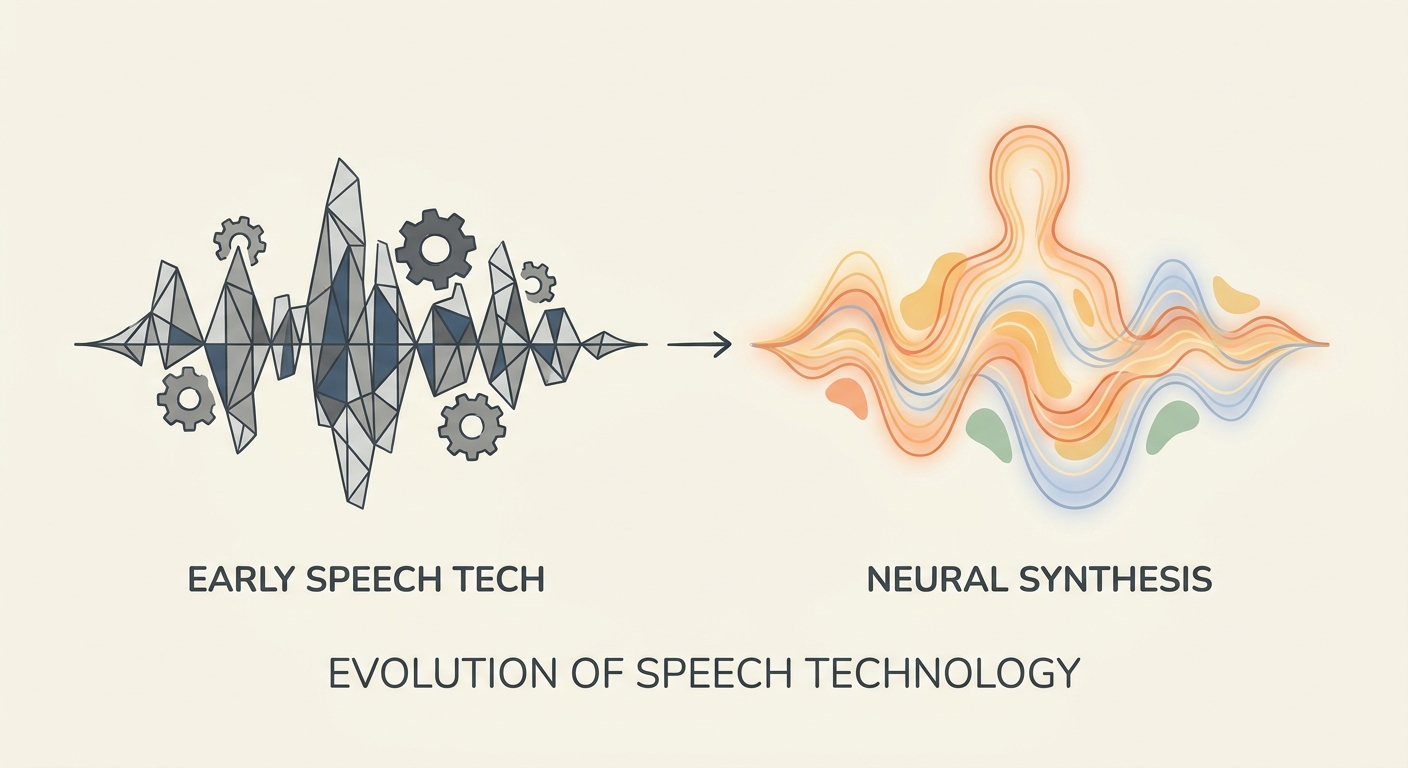
The wall between human speech and machine output hasn't just cracked—it’s been demolished. Remember those old GPS voices? That stuttering, metallic, "turn-left-in-three-hundred-feet" drone that sounded like a robot with a head cold? That era is dead.
Today, we’ve entered the age of neural synthesis. AI doesn't just read words from a page anymore; it performs them. It understands the rhythm, the breath, and the tiny, unconscious pauses that make a conversation feel like, well, a conversation. We’ve moved from rigid, rule-based machines to fluid, neural-driven powerhouses. This is the engine behind every digital avatar and real-time support agent you interact with today. But how does it actually work? Let’s pull back the curtain on the pipeline that turns raw text into a living voice.
The Anatomy of AI Speech: Turning Text into Sound
Think of speech generation as a high-speed factory line. It’s got three distinct stations: the frontend, the brain, and the voice box.
First, the Text Normalizer. Computers are notoriously bad at reading. If you hand a machine the sentence, "Dr. Smith lives at 123 Main St.," it doesn't intuitively know that "Dr." is "Doctor," "123" is "one hundred twenty-three," or "St." is "Street." This stage cleans the data, scrubbing away abbreviations and symbols so the machine doesn't trip over its own shoelaces.
Next, it hits the Acoustic Model, or the "brain." This is where Transformer-based neural networks do the heavy lifting. Instead of flipping through a dictionary of pre-recorded audio snippets, the model predicts a "Mel-spectrogram"—a map of sound frequencies. It understands the relationship between language and physics. It knows exactly how to pitch, stretch, and emphasize every single phoneme based on the context of the sentence.
Finally, we have the Neural Vocoder. This is the vocal cord. It takes that abstract frequency map and turns it into a raw, audible waveform. This is where the "warmth" lives. Old-school methods sounded fuzzy and thin; modern neural vocoders produce audio so crisp it’s often indistinguishable from a pro studio recording.
The Move to Local: Why "Edge AI" Matters
For years, the cloud was the only place with enough muscle to run these models. But the cloud has a problem: it’s slow. When you’re building a real-time conversational agent, a half-second delay feels like an eternity. It kills the immersion.
That’s why the industry is pivoting to "Edge AI." We’re talking about sub-100ms latency—the gold standard for 2026. By optimizing models to run directly on hardware like the M4 chip or dedicated NPUs, developers can cut the network trip out of the equation entirely. The result? Instant interactions. Plus, your data never leaves your device, which is a massive win for privacy. If you’re a business looking to scale, our AI content solutions are built for this exact hybrid approach: heavy-duty training in the cloud, lightning-fast execution on the local device.
Beyond the Monotone: Mastering Emotional Nuance
A voice that just "reads" is boring. The secret sauce is prosody—the rhythm, stress, and intonation that give speech its soul. Think about how many ways you can say, "I'm fine." Depending on your tone, it could mean you're happy, annoyed, terrified, or sarcastic.
Modern models nail this using "latent variables." During training, the AI learns to map emotional labels to specific acoustic patterns. It isn't just learning what to say; it’s learning how to say it. Need a voice that sounds urgent for an emergency alert? Or one that drips with empathy for a health app? You just tweak the parameters. It’s like being a film director. Professional pipelines now let creators treat AI output like a rough cut, massaging the pacing and intensity until it feels human.
The Rise of Digital Humans
Voice AI doesn't exist in a vacuum. The coolest stuff happening in 2026 is multimodal. When a digital human speaks, their mouth movements (visemes) have to perfectly match the audio.
This is a game-changer for media and education. Why hire a dozen actors to dub a training video into different languages when you can use parameter-efficient models to generate thousands of hours of content with a consistent, branded voice? These new models are incredibly efficient. We’re seeing better performance with 60 million parameters than we used to get with billions, which slashes enterprise costs by 20–30% without sacrificing quality.
The Ethical Frontier: Who Owns Your Voice?
With great power comes great responsibility. If you can clone a voice in seconds, you’ve got a massive security headache. The industry is rushing to build guardrails. The NIST guidelines on AI are becoming the North Star for managing voice biometrics and ensuring consent isn't just a suggestion—it's a requirement.
We’re moving into a world where your voice is a digital asset. We need cryptographic watermarking to prove what’s real and what’s synthetic. It’s not just a technical challenge; it’s a societal one. We have to make sure these tools are used to empower people, not to impersonate them.
Accessibility: A Gateway to the Web
Perhaps the best part of all this? Digital inclusivity. For people with visual impairments or motor-skill challenges, the quality of a screen reader is the difference between being connected and being isolated. Old, robotic screen readers were a nightmare to listen to for more than five minutes.
Today’s neural synthesis changes that. By hitting WCAG standards for accessibility with natural, human-like cadence, we’re making the internet actually consumable. Complex literature, technical manuals, long-form news—it’s all becoming accessible, engaging, and easy to digest.
Ready to Build?
The "robotic" phase of voice tech is officially over. We’re in the era of fast, emotional, and private synthesis. If your organization is ready to step up its game and integrate voice AI that actually sounds like a person, contact our team. Let’s talk about how we can build a solution that fits your needs perfectly.
Frequently Asked Questions
How long does it take for AI to learn a new voice?
"Zero-shot" cloning can create a functional, recognizable voice from just a few seconds of audio. However, for professional-grade, high-fidelity use cases—where the AI must capture the nuance and consistency required for long-form narration—fine-tuned cloning on larger, cleaner datasets is recommended to ensure the model doesn't drift or lose its emotional range.
Is AI-generated speech considered "copyrighted" content?
The legal landscape is evolving rapidly. Currently, the distinction is usually made between the underlying model weights (which may be proprietary) and the creative output. While the "essence" of a voice is increasingly treated as a personal right, the copyright status of AI-generated content often depends on the level of human creative control exercised during the generation process.
What is the difference between TTS and "Text-to-Audio"?
TTS is highly specialized for human speech, focusing on phonemes, prosody, and vocal identity. "Text-to-Audio" (or Generative Audio) is a broader field that synthesizes environmental soundscapes, musical elements, and sound effects. While TTS models are built to mimic the human vocal tract, Text-to-Audio models are designed to replicate the physics of sound in the natural world.
Can TTS AI actually sound "human" or will it always sound robotic?
The "robotic" era is essentially over. By moving from legacy RNN/CNN architectures to modern Transformer-based neural synthesis, AI can now replicate the subtle micro-pauses, breathing patterns, and emotional cadences that signify a human speaker. We have moved past the point where the hardware limitations force a robotic tone, allowing the AI to focus on the performance rather than just the pronunciation.