Sexy AI Voice Generator: Create Sultry & Attractive Voices for Content

TL;DR
- This article covers how to use modern ai tools to generate deep, sultry, and attractive voices for your video projects. It explores the technical side of voice synthesis while giving tips on scriptwriting for better emotional impact. You'll learn how to pick the right voice models to make your content sound more professional and engaging for your audience.
A sexy AI voice is usually a warm, smooth, slightly breathy voice read slowly, with soft words and longer pauses. To make one, pick a voice with natural warmth, lower the pitch a little, slow the speed to around 0.9x and write short lines with ellipses. Then add a calm emotion and soft background music.
Last updated: October 6, 2026. We checked the voice research cited below on that date.
This guide is for creators making luxury ads, perfume and fashion promos, ASMR and sleep content, romance audiobook narration, late-night podcast intros and game characters. It covers tasteful, non-explicit content: how to get a sultry tone, how to write for it and the rules to follow.
Key Takeaways
- Sultry comes from delivery, not just the voice. Slow pace, soft volume, breathiness and pauses do most of the work.
- Research links breathiness with attractiveness. A 2013 PLOS ONE study found breathiness made both female and male voices more attractive to listeners.
- Write for intimacy. Short phrases, soft sounds, sensory words and ellipses make any warm voice feel closer.
- Keep it tasteful and legal. Never imitate a real person without permission, and follow your platform's content rules.
- Kveeky gives you 700+ AI voices with tone, pitch and speed control and emotion tags, plus MP3 and WAV export.
On this page: What makes a voice sultry · Step by step · Writing the script · Choosing a generator · Female vs male · Use cases · Rules · FAQ
What makes a sexy AI voice sound sultry?
A sultry voice sounds close, relaxed and unhurried. It feels like the speaker is talking to one person, not announcing to a crowd.
Research gives some clues about why. A 2013 PLOS ONE study by Xu and colleagues tested which voice traits listeners found attractive. It used a natural recording and voices made with an articulatory speech synthesizer:
- Female voices were rated more attractive by male listeners with higher pitch, wider formant dispersion and a breathy voice quality.
- Male voices were rated more attractive by female listeners with lower pitch and narrower formant dispersion.
- Breathiness also helped male voices. The authors suggest it softened the aggressive feel of a very deep voice.
It was a small study with mostly synthetic speech, so treat it as a guide, not a rule. For voiceovers, the practical traits look like this:
| Trait | Sultry setting | Why it works |
|---|---|---|
| Pace | Slow, around 0.9x | Sounds relaxed and confident |
| Pitch | Slightly lower than default | Feels warmer and calmer |
| Breathiness | A soft, airy voice | Feels intimate and gentle |
| Volume and energy | Low, even | Sounds like a close conversation |
| Pauses | Longer, especially before key words | Builds anticipation |
| Words | Soft sounds, sensory words | Matches the mood of the voice |
How to make a sexy AI voice step by step
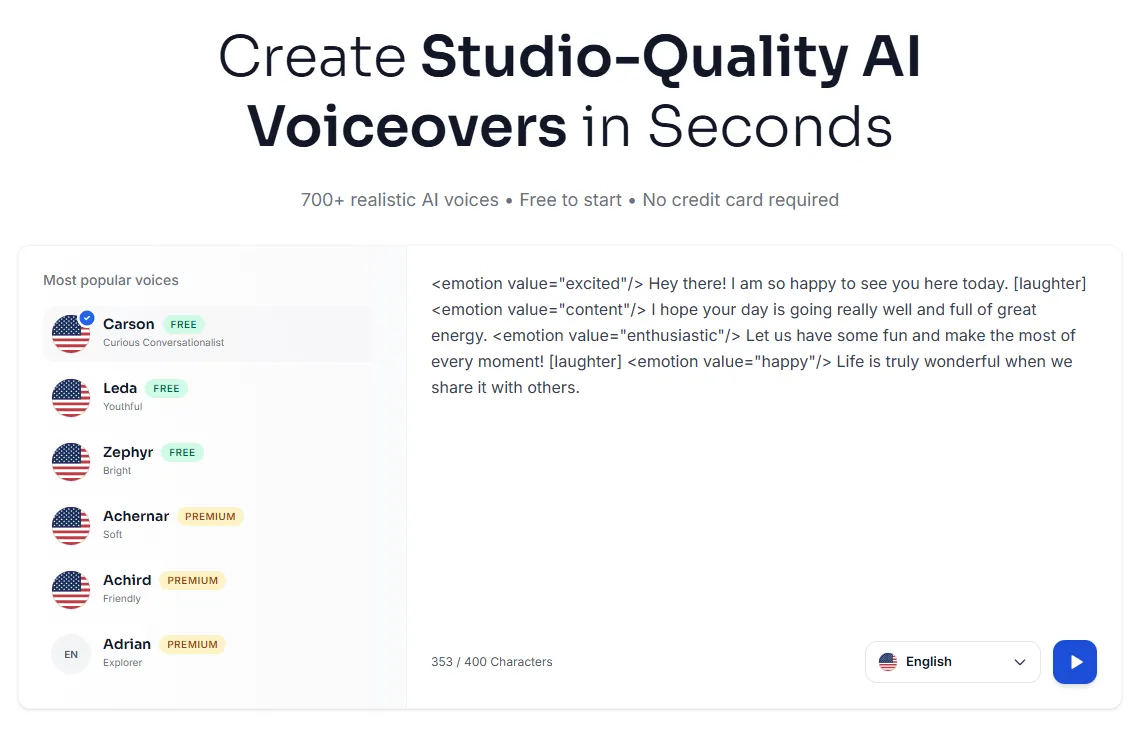
You can get a sultry read from most AI voice generators. Here's the process in Kveeky.
- Write a short script. Start with 3 or 4 lines so you can test quickly.
- Pick 3 warm, smooth voices. Preview them and listen for natural breath and a relaxed tone.
- Lower the pitch slightly. A small step down adds warmth; a big step sounds processed.
- Slow the speed to around 0.9x. Slower delivery is the biggest single change.
- Add a calm emotion. Place a tag such as
<emotion value="calm"/>before the line. - Add pauses with punctuation. Use ellipses and line breaks before the words you want to land.
- Generate, listen and compare. Keep the version that sounds relaxed, not sleepy.
- Download WAV or MP3 and mix it with soft music or ambient sound.
A dry voice can sound too clean. A quiet bed of music or room tone makes a sultry voice feel richer and hides small digital artifacts.
How to write a script for a seductive AI voice
The script matters as much as the voice. Long, complex sentences leave no room for the voice to slow down and breathe.
- Keep phrases short. Short phrases let the pitch fall at the end, which sounds calm and confident.
- Choose soft sounds. Words like "smooth", "velvet", "warm" and "glow" sound softer than harsh, clipped words.
- Use sensory language. Describe how something feels, smells or looks.
- Use ellipses for tension. "Close your eyes... and breathe." holds a beat before the key word.
- Talk to one person. "You" sounds closer than "customers" or "everyone".
How to make the voice drop to a sultry whisper
A voice dropping to a sultry whisper is a strong effect, so use it once, not every line.
- Put the whisper line on its own line, after an ellipsis.
- Generate it separately with a softer, breathier voice or a calm emotion, at a slightly slower speed.
- Lower its volume a little in your editor and remove the music for a moment.
Here's a tasteful example for a perfume ad:
<emotion value="calm"/> It starts with a single drop...
Warm amber. Soft vanilla.
And something you can't quite name.
Lumière... wear it close.
For more ways to shape timing, see our guide to pacing, pauses and emphasis tricks.
What to look for in a seductive voice generator
Any good AI voice generator can sound sultry if it gives you enough control. Test these before you commit.
| Feature | Why it matters | What Kveeky offers |
|---|---|---|
| Voice library | You need warm, smooth, breathy voices to start from | 700+ AI voices in 40+ languages |
| Pitch and speed control | Slow pace and lower pitch create the mood | Tone, pitch and speed control |
| Emotion or style control | Calm, soft delivery on key lines | Emotion tags, such as calm or excited |
| Export quality | Soft voices need clean audio for mixing | MP3 and WAV export |
| Commercial rights | Needed for ads and paid content | Included on every paid plan |
| Free testing | Hear your script before you pay | Free plan: 500 credits a month (about 6.6 minutes), standard voices, no card |
Other generators may offer specific "whisper" styles or different voice libraries. Compare on your own script before deciding.
Female vs male sultry AI voices
Both work; choose based on the mood and audience of your content.
- Female sultry voices: soft, breathy and smooth. They suit perfume, beauty, fashion, wellness and ASMR. Keep the pace slow and the volume low.
- Male sultry voices: low, calm and slightly breathy. They suit luxury cars, watches, whisky-style ads and late-night intros. A little breathiness keeps a deep voice from sounding harsh.
- Match the product. A deep, sultry male voice may feel wrong for a gentle skincare brand. A whispery voice may feel wrong for a serious finance ad.
If you're choosing a female voice, our guide to female speech patterns in AI voices explains what makes one sound natural.
Tasteful ways to use a sultry AI voice
| Use case | Style | Tip |
|---|---|---|
| Luxury and perfume ads | Warm, slow, intimate | Pause before the product name |
| ASMR and sleep content | Soft, breathy, very slow | Keep volume steady and low |
| Romance audiobook narration | Warm, expressive | Vary emotion by scene, not by line |
| Late-night podcast intro | Low, smooth, relaxed | Pair with soft music |
| Game and visual novel characters | Confident, playful | Give the character a fixed voice profile |
For ad work, see our page on AI voiceover for advertisements.
Rules for using sexy AI voices responsibly
A sultry voice is fine for many kinds of content. A few rules keep it that way.
- Never imitate a real person without permission. Copying a celebrity's or anyone's voice for an ad can break their rights. Read our guide on whether voice cloning is legal before you clone anyone.
- Follow platform and tool rules. YouTube, TikTok, app stores and AI voice tools all have content policies. Check them before you publish.
- Keep it non-explicit for general audiences. Suggestive is different from explicit, and most ad platforms reject explicit audio.
- Disclose AI voices where your platform or audience expects it.
- Don't use a seductive tone to mislead, for example in scams or fake personal messages.
Frequently asked questions
Is there a free sexy AI voice generator?
You can test a sultry read for free on Kveeky's free plan: 500 credits a month (about 6.6 minutes) with standard voices and no credit card. Lower the pitch, slow the speed and add pauses.
How do I make an AI voice whisper?
Pick a soft, breathy voice, slow it down and add a calm emotion. Generate the whisper line separately, then lower its volume slightly in your editor.
How do I make a seductive female AI voice?
Choose a smooth, slightly breathy female voice. Slow it to around 0.9x, keep the volume low and write short, soft lines with ellipses.
How do I make a seductive male AI voice?
Choose a low, calm male voice and lower the pitch slightly. Keep a little breathiness so it sounds warm rather than harsh, and slow the pace.
Can I clone a celebrity's sultry voice?
Not without their permission. Using someone's voice for content or ads without consent can break their rights. Use stock AI voices or clone only voices you're allowed to use.
Can I use a sultry AI voice in paid ads?
Yes, if your plan includes commercial rights and the ad follows the platform's rules. Every paid Kveeky plan includes commercial usage rights.
How we checked this guide
This guide is written by Hitesh Kumawat for the Kveeky team. Disclosure: Kveeky makes an AI voice generator.
- Attractiveness findings come from Xu, Lee, Wu, Liu and Birkholz, "Human Vocal Attractiveness as Signaled by Body Size Projection", PLOS ONE, 2013, retrieved October 6, 2026.
- Kveeky features and plan details come from kveeky.com and its pricing page, retrieved October 6, 2026.
- No Kveeky usage data is used in this guide.
Your next step: write a 4-line script for your next ad or intro. Generate it with 3 warm voices at around 0.9x speed, and keep the one that sounds relaxed. If it still sounds flat, add emotion with our guide to AI voice emotion control, or run through our checklist to make an AI voiceover sound less robotic.