
2026 Industry Analysis Ranks Top AI Voice Agents for Scalable Enterprise Support Infrastructure

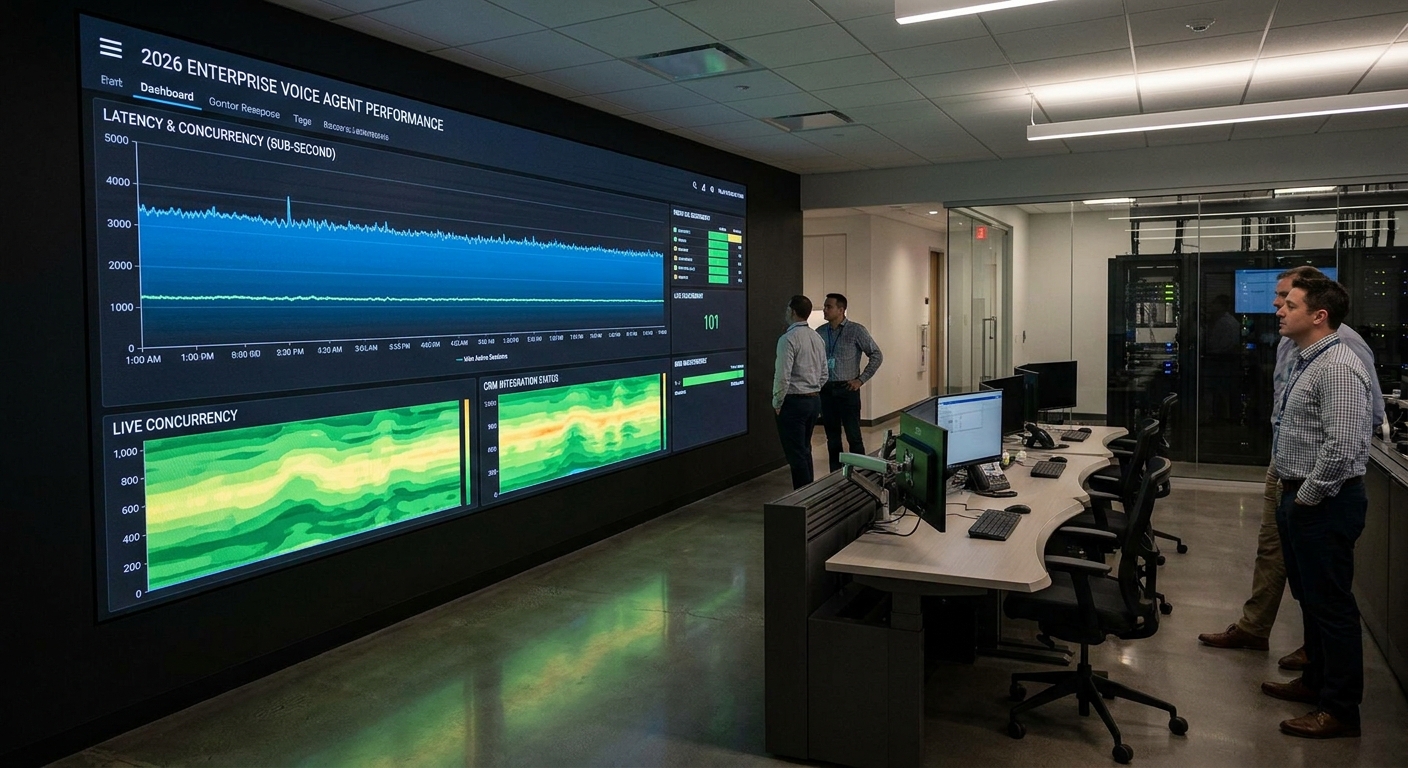
TL;DR
- Enterprise AI must prioritize sub-second latency and seamless CRM integration.
- Barge-in capability is essential for natural, professional customer interactions.
- Performance benchmarks like scalability and consistency prevent PR and operational failures.
- Modern voice agents must function as transaction engines, not just scripted bots.
2026 Industry Analysis: Ranking the Top AI Voice Agents for Enterprise Infrastructure
The 2026 enterprise landscape for AI-driven communication has moved past the honeymoon phase. We’re no longer talking about experimental pilots or "cool" demos; we’re talking about high-stakes infrastructure. Today, the conversation isn't about whether a voice agent sounds human—it’s about whether it can handle the crushing weight of real-world enterprise demands without breaking a sweat.
If you’re a decision-maker, you’ve likely realized that basic feature sets don't cut it anymore. The new gold standard? Sub-second latency, rock-solid concurrency, and the ability to navigate the messy reality of background noise, regional accents, and the inevitable "barge-in" where a customer interrupts the bot mid-sentence. If your agent can’t handle a user cutting it off to ask a clarifying question, it’s not an agent—it’s a liability.
The Shift: From Surface-Level to Systemic Integration
The selection process has become brutal. Gone are the days of being dazzled by a smooth-talking demo. Now, the heavy lifting happens in the back office. Enterprises are looking under the hood, scrutinizing how these platforms play with existing CRM, ERP, and telephony stacks.
The goal has shifted from "simple interface" to "functional powerhouse." We’re talking about agents that don’t just talk; they do. They need to authenticate users, pull data in real-time, and process complex transactions without needing a human to jump in and save the day. If the agent can’t talk to your database, it’s just a glorified script reader.
Performance Benchmarks for the Real World
Building a "human-like" flow is a delicate balancing act of speech-to-text (STT), large language models (LLMs), and text-to-speech (TTS) engines. When these components aren't perfectly synced, the whole experience falls apart. According to recent evaluations of AI voice agents, the most common failure points are inconsistent response times and a total inability to handle dynamic interruptions during peak hours.
To avoid a PR nightmare, you need to stress-test these platforms under load. Here is what actually matters when you’re evaluating enterprise-grade tech:
- Latency Consistency: If the response time isn't sub-second, the interaction feels like a satellite call from the 90s. It kills the flow.
- Barge-in Capability: Can the agent stop on a dime when interrupted? If it keeps talking while the customer is trying to correct it, you’ve lost them.
- Integration Depth: It needs to live inside your ticketing systems and databases. If it can't update a record, it’s useless.
- Scalability: Can it handle a sudden spike in call volume without latency creeping up?
- Cost Transparency: Ignore the base pricing. Look at the total cost per call, including the hidden tax of complex integrations and computational overhead.
The Competitive Landscape
The market is crowded, and every provider claims to be the "best." In reality, it’s about finding the right tool for your specific operational headache.
| Platform | Primary Focus | Notable Characteristic |
|---|---|---|
| Retell AI | Low-latency operations | High-performance at scale Retell AI |
| SquadStack AI | Sales conversions | Optimized for high-intent outreach SquadStack AI |
| Leaping AI | BPO scaling | Designed for large-scale call centers Leaping AI |
| PolyAI | Enterprise/Multilingual | Complex enterprise orchestration PolyAI |
| Bland AI | High-volume scalability | Infrastructure-focused for large throughput |
Navigating the Implementation Minefield
Even with the best tech, implementation is rarely a walk in the park. The biggest trap? Opaque pricing. You might sign up for a low base rate, only to find that your bill balloons once you start integrating complex workflows or hitting high-concurrency limits.
Then there’s the "legacy trap." Trying to wedge a modern AI agent into a clunky, outdated telephony stack is a recipe for performance bottlenecks. If you want a real ROI, you have to prioritize platforms with rock-solid API support and proven compatibility with your existing infrastructure. Players like Cognigy and Kore.ai have built their reputations on deep enterprise orchestration—they know how to handle the multi-turn, messy conversations that require pulling data from five different internal systems at once.
The Future: Production-Ready vs. Demo-Ready
Why are we doing this? It isn't just to save a few bucks on headcount. It’s about availability and consistency. By offloading the rote, transactional work to an agent that doesn't get tired, frustrated, or sick, you free up your human team to handle the high-value, nuanced interactions that actually require empathy and complex problem-solving.
But here is the kicker: the success of this strategy hinges on technical reliability. As the industry matures, the line between "demo-ready" and "production-ready" has become the defining factor for procurement. You aren't just buying a voice engine; you’re buying the monitoring tools that come with it. You need to see what’s happening in real-time, identify the friction points, and squash bugs before the customer even notices.
Choosing an AI voice agent in 2026 is a balancing act. It’s not just about who has the most "human" voice; it’s about who has the most reliable infrastructure. If you focus on sub-second latency, seamless integration, and the raw ability to execute business logic, you’ll navigate the transition just fine. The winners in this space have proven one thing: when you prioritize technical rigor over marketing flash, AI voice agents can actually scale to meet the demands of a global enterprise.