Tether Establishes New Industry Standards for Brain-to-Text Speech Decoding via AI-Augmented BCI Implants

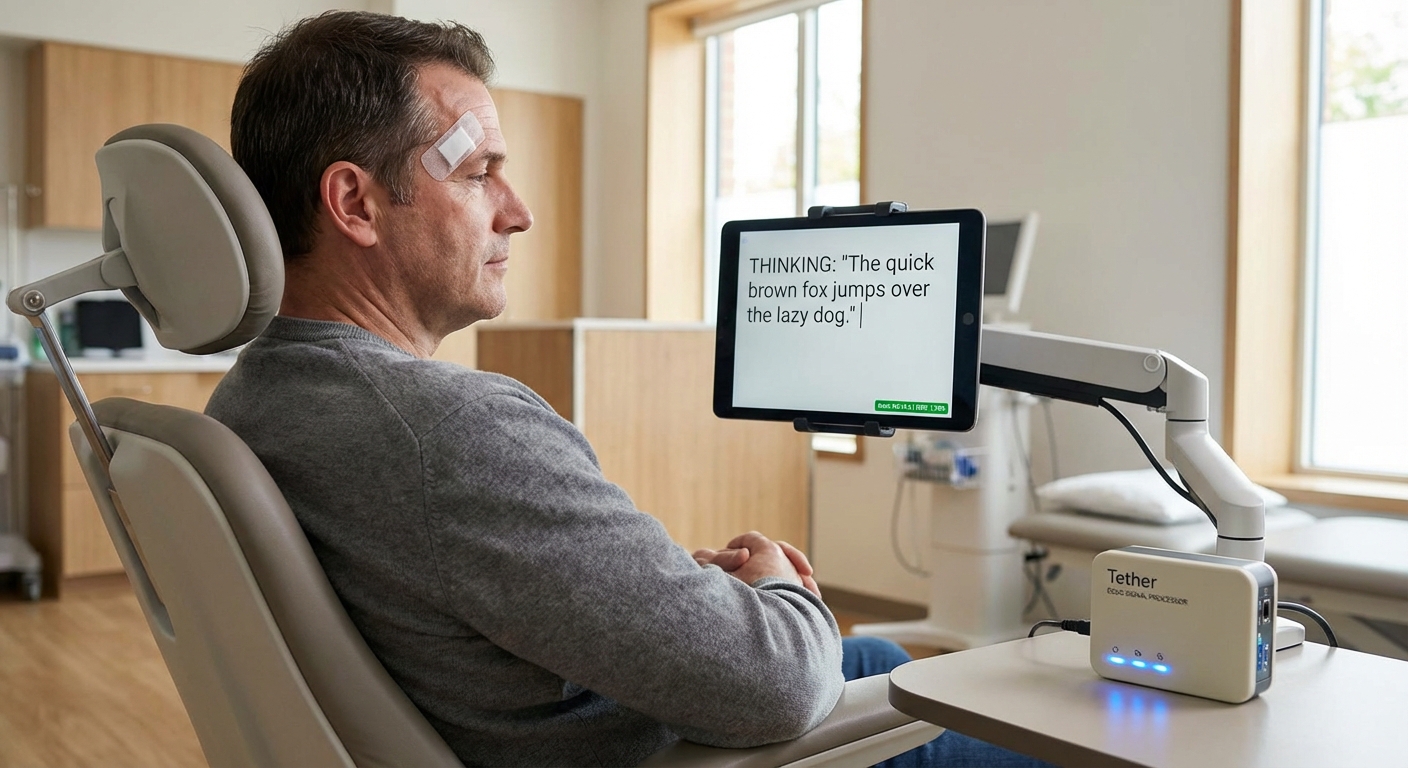
Tether Sets a New Bar: Brain-to-Text Decoding Without the Cloud
Tether EVO just dropped "BrainWhisperer," and it’s a wake-up call for the neurotech industry. This AI-augmented brain-computer interface (BCI) doesn’t just translate raw neural signals into text—it does it with a level of precision that makes previous benchmarks look like beta software. During the "Brain-to-Text '25" Kaggle competition, the system clocked in a 1.78% Word Error Rate (WER), placing it firmly in the top tier of the 466 participants.
But the real story here isn’t just the accuracy. It’s the architecture.
For years, the BCI field has been obsessed with cloud-heavy processing. If you wanted to decode complex neural patterns, you generally needed a server farm to do the heavy lifting. Tether is flipping that script. By leaning into their open-source "Brain OS" platform, BrainWhisperer keeps everything local. No data leaves the user’s hardware. No latency spikes. No privacy nightmares. It’s a bold architectural choice that prioritizes the user’s biological data sovereignty over the convenience of a centralized data center.
Under the Hood: Performance Meets Privacy
BrainWhisperer is a hyper-augmented, intracortical system designed to ingest 256 channels of Electrocorticography (ECoG) data. Think of it as a high-bandwidth translator for the brain. The secret sauce? An ensemble of five distinct AI models working in perfect sync to tokenize neural firing patterns into readable, coherent language.
To keep the system snappy, Tether implemented Low-Rank Adaptation (LoRA). This is the "secret weapon" for personalization. Instead of forcing a massive, bloated model to learn a user's unique neural signature from scratch—which would be a computational disaster—LoRA allows the system to fine-tune itself on the fly. It bridges the gap between abstract neural spikes and actual linguistic intent without needing a supercomputer in the room.
| Metric | Specification/Result |
|---|---|
| Word Error Rate (WER) | 1.78% |
| Competition Ranking | 4th of 466 participants |
| Input Channels | 256 (ECoG) |
| Processing Environment | Local (Brain OS) |
| Model Architecture | Ensemble of 5 AI models |
This shift toward decentralized AI is becoming a signature move for Tether EVO. It’s part of a broader push to bring high-end personalization to everyday devices, mirroring the philosophy behind the QVAC fabric. They’re proving that you don’t need to sacrifice privacy to get enterprise-grade performance.

Solving for the Real World
At the end of the day, this isn't just about winning competitions. The goal is to provide a lifeline for people living with paralysis or severe speech impairments. Achieving a 1.78% WER on local hardware is a massive win for clinical viability. As noted in recent coverage of Tether's BrainWhisperer AI, the reliance on Brain OS ensures that the device remains responsive and, crucially, secure. When you’re dealing with medical-grade implants, you don’t want your neural data floating around in a cloud somewhere.
The development process boiled down to three core pillars:
- Data Throughput: Handling 256 channels of ECoG data requires ruthless efficiency. The tokenization process has to be instantaneous to feel natural.
- Privacy-First Design: By killing the cloud dependency, they’ve essentially neutralized the risk of neural data interception.
- Personalization: LoRA allows the system to calibrate to the individual. Because no two brains fire exactly the same way, this adaptability is the difference between a gadget and a prosthetic.
- Open-Source Foundations: By building on an open-source OS, Tether is ensuring that this tech isn't just a walled garden. It’s built for compatibility.
The success of BrainWhisperer signals that the barrier to entry for high-accuracy neural decoding is finally crumbling. When you combine ensemble AI models with efficient local fine-tuning, you get a robust, reliable path forward for BCI development.
The Road Ahead
The Tether ecosystem is already looking past speech recovery. Brain OS is modular by design. If you can decode speech, you can theoretically decode other neural inputs. We’re looking at a future where BCI implants could support a wide range of human-computer interactions, all processed right there on the edge.
This focus on local processing is a direct response to the industry’s growing anxiety over data sovereignty. As BCI tech transitions from the lab to the clinic, regulators are going to demand exactly what Tether is building: systems that don't leak biological data. By setting this standard now, they’re defining the rules of the road for the next generation of neural interfaces.
Ongoing research into QVAC and similar frameworks suggests that we’re only seeing the tip of the iceberg. As the hardware becomes more refined and the decoding software gets sharper, the gap between thought and output will continue to shrink. BrainWhisperer isn't just a proof-of-concept; it’s a functional demonstration that we finally have the tools to handle the sheer complexity of the human brain with the reliability it deserves.