TL;DR
- ✓ Flat AI narration triggers viewer drop-off by signaling low-effort content to audiences.
- ✓ Granular control over pitch and pacing is critical for human-like AI speech.
- ✓ Mid-tier modulation tools outperformed both budget generators and complex deep-learning models.
- ✓ YouTube algorithms now prioritize human-assisted production over simple high-frequency output.
On this page
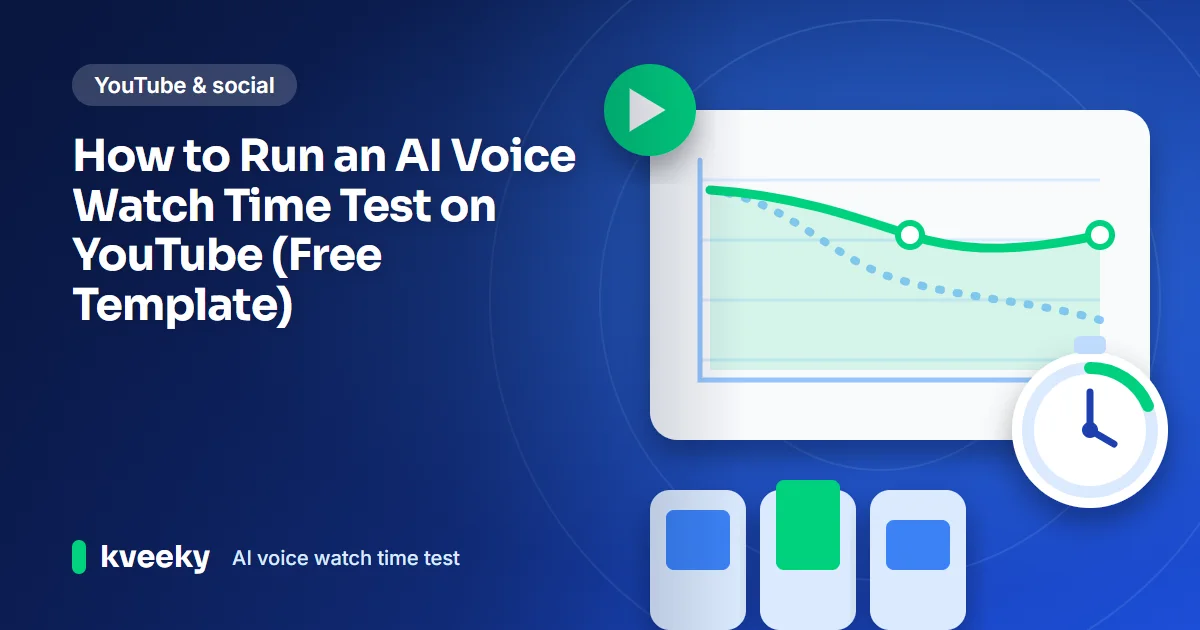
An AI voice watch time test compares how long viewers keep watching videos narrated by different AI voices. Keep the script style, visuals and length the same, change only the voice, then compare intro retention and average view duration in YouTube Studio. Repeat across several videos before you trust a winner.
Last updated: October 6, 2026. This page is a test plan. It reports no test results.
An earlier version of this page described a 30-day test of 5 AI voice tools on a faceless channel. We couldn't confirm that test took place, so we removed its results. What's left is the method: a plan you can run on your own channel, with your own numbers.
Key Takeaways
- Change one thing only. Same topic style, same length, same edit, same music. Only the voice changes.
- Use YouTube Studio's own metrics. Intro retention shows the share of viewers still watching after 30 seconds; average view duration shows minutes watched.
- Videos need at least 60 seconds and 100+ views before YouTube shows key moments, and data takes 1 to 2 days to process.
- Test 2 or 3 voices, not 5. Fewer voices means more videos per voice and clearer results.
- One video proves nothing. Compare averages over several videos per voice, and treat small gaps as noise.
On this page: What it can tell you · Before you start · Test plan · Metrics · Template · Reading results · Fair setup · Mistakes · Monetization · FAQ
What the test can tell you
A watch-time test tells you whether one voice holds your audience better than another, on your kind of video. It can't tell you which tool is best for every channel.
YouTube doesn't split one upload between 2 audio tracks for you. So each voice gets its own videos, and those videos will differ in topic and timing. Your job is to keep everything else as similar as possible and to compare averages, not single videos.
What you need first
- A channel with steady views. YouTube shows key moments only for videos of at least 60 seconds with more than 100 views.
- A repeatable format. List videos, explainers or story videos with the same structure every time.
- 2 or 3 candidate voices. Shortlist them by listening, then test only the finalists.
- A fixed schedule. Same upload days and times for every test video.
- A spreadsheet using the template below.
Plan your rotation. The plan above asks for at least 4 videos per voice and 2 or 3 voices.
Need a free tool to produce the voices? Our guide to the best free AI voiceover tools for YouTube compares the options.
Running the test step by step
- Write down your question. For example: "Does a calm male voice keep viewers longer than an upbeat female voice on my explainers?"
- Pick your baseline. Note intro retention and average view duration for your last 10 videos of similar length.
- Choose 2 or 3 voices. Generate the same 2 test paragraphs with each and drop any that mispronounce your common terms.
- Lock the format. Same intro length, music track, mix level, caption style and target length for every test video.
- Produce at least 4 videos per voice. More is better. Use similar topics so no voice gets all the strong ideas.
- Alternate the voices. Publish A, B, A, B (or A, B, C) so no voice gets all the busy weeks.
- Wait for the data. YouTube says audience retention data typically takes 1 to 2 days to process. Read every video at the same age, such as 7 days after publishing.
- Fill in the template for each video: intro retention, average view duration, views and notes on big dips.
- Compare averages per voice, then look at where the dips happen, not just how big they are.
- Run a second round with the winner against a new challenger before you switch your whole channel.
Testing delivery styles rather than tools? Our guide on A/B testing voiceover styles without re-recording covers that variant.
YouTube Studio metrics to track
These come from YouTube Studio's audience retention reports.
| Metric | What YouTube says it means | Why it matters for a voice test |
|---|---|---|
| Intro | Share of your audience still watching after the first 30 seconds | The voice makes its first impression here |
| Average view duration | Average minutes watched among those who stayed to watch | Shows whether the voice holds attention over the whole video |
| Dips | Moments that were skipped or where viewers stopped watching | Check whether dips line up with flat or mispronounced lines |
| Top moments | Moments where almost no one dropped off | Shows which delivery style works in your format |
| Spikes | Moments that were rewatched or shared | Can point to lines viewers didn't catch the first time |
YouTube also lets you compare a video's retention with the typical retention of your 10 latest videos of similar length. That is a useful sanity check for each test video.
Results template
Copy this table into a spreadsheet. Fill in one row per video, all read at the same video age.
| Video | Voice | Publish date | Length | Views at day 7 | Intro retention | Avg view duration | Biggest dip (time + cause) |
|---|---|---|---|---|---|---|---|
| 1 | A | ||||||
| 2 | B | ||||||
| 3 | A | ||||||
| 4 | B | ||||||
| Average A | A | – | – | ||||
| Average B | B | – | – |
This copies the template header and four rows, tab-separated, so it pastes straight into Google Sheets or Excel. Fill in the rest per video, all read at the same video age.
1 A
2 B
3 A
4 B
Enter the metric for up to 4 videos per voice, read at the same age. Leave a field at 0 if you have fewer. The 1-to-2-point noise rule is our rule of thumb, not a YouTube rule.
How to read your results
These are our suggested rules of thumb, not YouTube rules:
- Small gaps are noise. If the averages differ by only a point or two, run more videos before you decide.
- Look at the shape, not just the number. A voice that loses viewers at the same line every time has a script or pronunciation problem.
- Check views too. A video with far more views than the others can pull its average up or down. Note it and consider a rerun.
- Topic beats voice. If one video wins by a lot, ask whether its topic, title or thumbnail was simply stronger.
Setting up each voice fairly
A voice can lose a test because of the setup, not the voice. Control these before you publish:
- Same speed and pauses. Match the pace, so one voice isn't simply faster.
- Same loudness. Mix every voiceover to the same loudness, so no voice sounds weaker.
- Same pronunciation fixes. Re-spell names the same way for every voice.
- Same file quality. Export every voice in the same format and quality.
Tick each item for every test video.
0 of 5 ticked
In Kveeky you can paste one script, switch between voices, and adjust speed and volume for each. The Emotion setting (Neutral, Happy, Love, Angry, Calm or Sad) lets you match energy across voices. Download each version as an audio file.
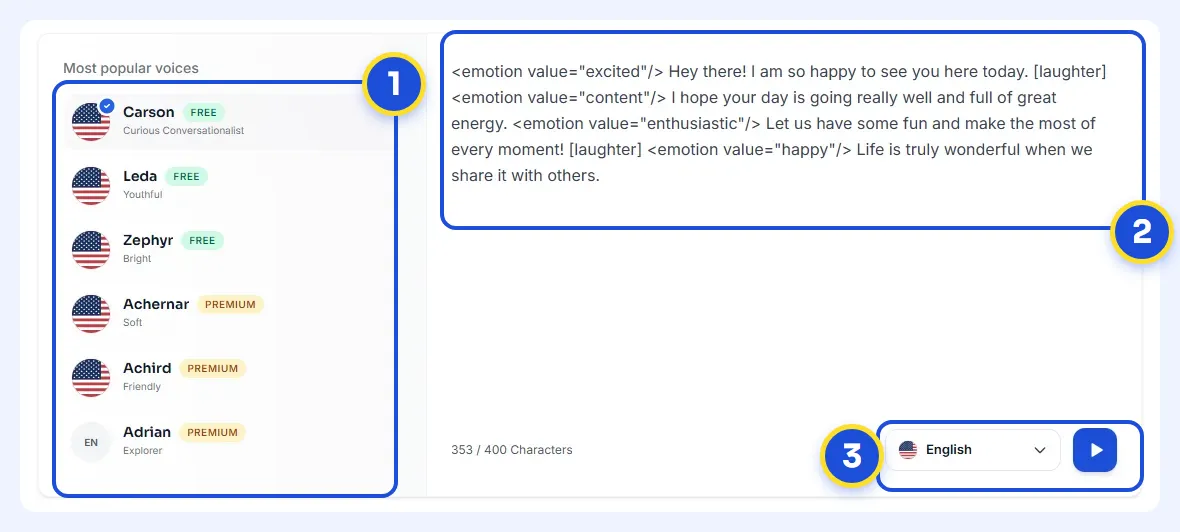
- 1Pick a voice. Voices are tagged Free or Premium.
- 2Type or paste a short line. Pick an emotion if you want one.
- 3Choose the language and press play to hear it.
Try it yourself in the free voice demo on Kveeky, no sign-up needed. For longer scripts and downloads, use the free plan.
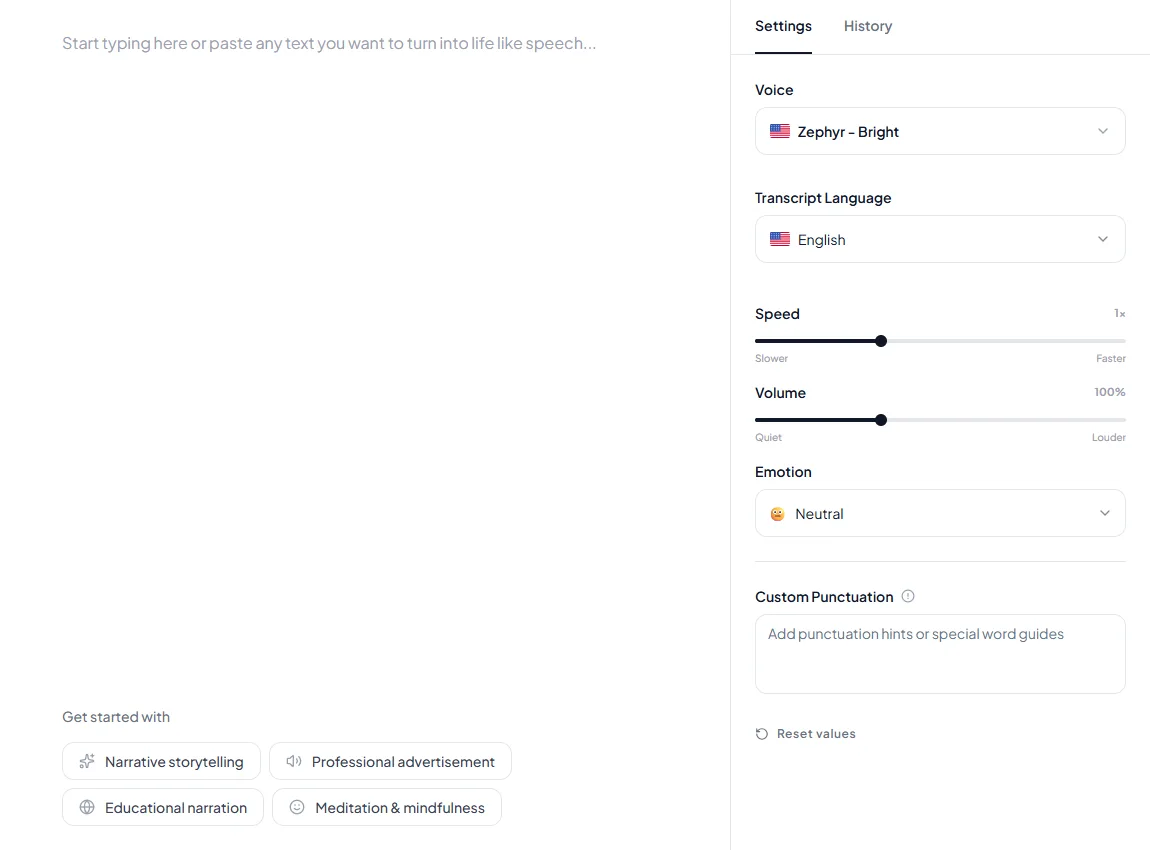
For mixing levels and music under the voice, see why YouTube videos sound amateur and how to fix the audio.
Common test mistakes
- Testing too many voices. 5 voices with 2 videos each gives you 5 unreliable answers.
- Changing the thumbnail style mid-test. Thumbnails change who clicks, which changes retention.
- Reading results too early. Retention data needs 1 to 2 days to process, and views keep arriving after that.
- Comparing a Short with a long video. Keep the format and length the same.
- Letting the best topics go to one voice. Alternate topics as well as voices.
Does YouTube penalize AI voices?
YouTube's monetization policies don't list AI narration as a problem. They target content that is "mass-produced, generic, repetitive, or manipulative," including AI content made from generic templates.
So a test like this also helps with monetization. It pushes you to direct the voice, edit with care and keep each video original.
Frequently asked questions
Did you really test 5 AI voice tools on a faceless channel?
No. An earlier version of this page described that test, but we couldn't confirm it took place. We removed its results and replaced them with a test plan you can run yourself.
How many videos do I need for an AI voice watch time test?
Use at least 4 videos per voice, and more if you can. Each video needs at least 60 seconds and 100+ views before YouTube shows key moments.
Which metric matters most when testing AI voices?
Start with intro retention, the share of viewers still watching after 30 seconds. Then check average view duration to see whether the voice holds attention over the whole video.
How long should I wait before reading the results?
YouTube says retention data typically takes 1 to 2 days to process. Read every test video at the same age, such as 7 days after publishing, so the numbers are comparable.
Can I do YouTube voiceovers for this test with free tools?
Yes, for short videos. Free plans give you a few minutes of audio a month, enough to shortlist voices. A full test with several videos per voice usually needs a paid plan.
How we built this plan
This guide is written by Ankit Agarwal for the Kveeky team. Disclosure: Kveeky makes an AI voice generator.
- Metric definitions, the 60-second and 100-view thresholds and the 1-to-2-day processing time come from YouTube Help: key moments for audience retention, retrieved October 6, 2026.
- The monetization quote comes from YouTube channel monetization policies, retrieved October 6, 2026.
- The steps and rules of thumb are our recommendations, not results. No Kveeky usage data and no test data are used in this guide.
Ready to run round 1? Pick 2 voices, generate your first test paragraphs on Kveeky's free plan, and plan your videos with our guide to AI voiceovers for YouTube videos. For context on the whole workflow, see our hub on AI voiceover for video production.
Turn your script into a voiceover
Paste your text, pick a voice and download the audio. Free to start, no credit card.