TL;DR
- This article explores the transformative impact of AI voiceover technology on video production, covering its benefits, applications, and selection criteria. It delves into how AI voiceovers enhance efficiency, reduce costs, and expand creative possibilities for video producers, offering practical insights into leveraging this cutting-edge tool.
On this page
AI voiceover for video turns a written script into narration with a text-to-speech voice, so you can voice a video without booking a narrator or a studio. In Kveeky, you paste the script, pick one of 700+ voices, adjust speed, volume and emotion, and download the audio for your video editor.
Last updated: October 6, 2026. Plan details were checked on kveeky.com/pricing on that date.
Record nothing: write the script, paste it into a text-to-speech tool, pick a voice, set the speed and download the audio. Then cut your picture to the voice and lower the music under it. On the Kveeky free plan you get 500 credits a month (about 40 seconds) with no credit card.
This guide is for video producers, YouTubers, marketers and training teams who want to know where AI narration fits in a real production workflow. It covers the jobs AI voice does well and how to make a voiceover step by step. It also covers how to choose a tool, and when a human voice actor is still the better call.
Key Takeaways
- What it is: AI voiceover is text-to-speech narration you generate from a script and drop onto your video timeline. It replaces the recording session, not the edit.
- Where it fits best: explainers, product demos, training videos, YouTube narration, social clips and quick language versions of the same video.
- Where it saves time: script changes. You edit a line of text and regenerate it, instead of booking a pickup session with a narrator.
- Kveeky in one line: 700+ AI voices, 40+ languages with voices, an Emotion setting with 6 choices, and voice cloning (see the pricing page for your plan). The free plan gives 500 credits a month (about 40 seconds) with no credit card.
- Kveeky is a voice tool, not a video generator. You bring the visuals; Kveeky makes the narration that goes with them.
- Hire a human for long-form drama, character performance that carries a story, or a brand voice that must be a specific person.
On this page: What it is · Where it fits · Time and cost · Step by step · Choosing a tool · Script and sync tips · AI vs voice actors · AI video tools · Responsible use · FAQ
Pick your video type to get the voice advice from the table below.
Pick one to see the advice.
What is AI voiceover for video?
AI voiceover for video is narration created by a text-to-speech (TTS) model instead of a person at a microphone. You give the tool a script, choose a voice, and get back an audio file.
Modern neural TTS voices handle rhythm, stress and intonation far better than the flat, robotic voices of older systems. You still choose the voice, the pace and the tone, much like casting and directing a narrator.
The file itself is only half the job. Someone still has to place it on the timeline, cut the picture to it, and balance it against music. That's why AI voiceover sits inside a normal video workflow rather than replacing it.
Content production applications
AI voiceover works best when the voice has to be clear, consistent and easy to change. These are the most common jobs in video production.
| Video type | What the voice needs to do | Practical tip |
|---|---|---|
| Explainer videos | Make one idea clear at a time | Choose a calm, mid-pace voice and add a short pause after each key point |
| Product demos | Match on-screen clicks and features | Write one sentence per screen action so the cut lines up |
| Training and e-learning | Stay the same across many modules | Lock one voice and one speed for the whole course |
| YouTube narration | Hold attention for several minutes | Vary sentence length and use a stronger emotion on hooks and reveals |
| Social media clips | Land a hook in the first seconds | Speed the voice up slightly and keep the script short |
| Ads | Sound right for the brand in a fixed time slot | Generate 2 or 3 reads with different tones and test them |
| Language versions | Say the same thing in another language | Have a native speaker check the translated script before you generate |
The reason AI voiceover applications are spreading in content marketing is simple: teams publish more video than they can schedule narrators for. A voice that can be regenerated on demand removes the scheduling bottleneck.
Time and cost savings
AI voiceover cuts the steps between a finished script and usable narration. The biggest saving comes from revisions, not from the first take.
| Step | Human voiceover | AI voiceover |
|---|---|---|
| Casting | Auditions or a talent agency | Preview voices in the tool |
| Recording | Book a session, direct the read | Generate from the script |
| Script change | Pickup session, then match room tone | Edit the text and regenerate that line |
| New language | Find and book a new narrator | Translate the script and pick a voice in that language |
| Consistency over a series | Depends on the narrator's availability | Same voice and settings every time |
| Emotional range and acting | Strongest option | Good for narration, weaker for drama |
Cost depends on how many finished minutes you need. Our breakdown of AI voiceover cost per video works through real per-minute numbers. If you want the whole timeline, including visuals, see how long it takes to make a video with AI.
Making a voiceover in Kveeky
Here's the workflow we recommend for a short explainer or YouTube video. It works the same way for longer projects; you just generate in sections.
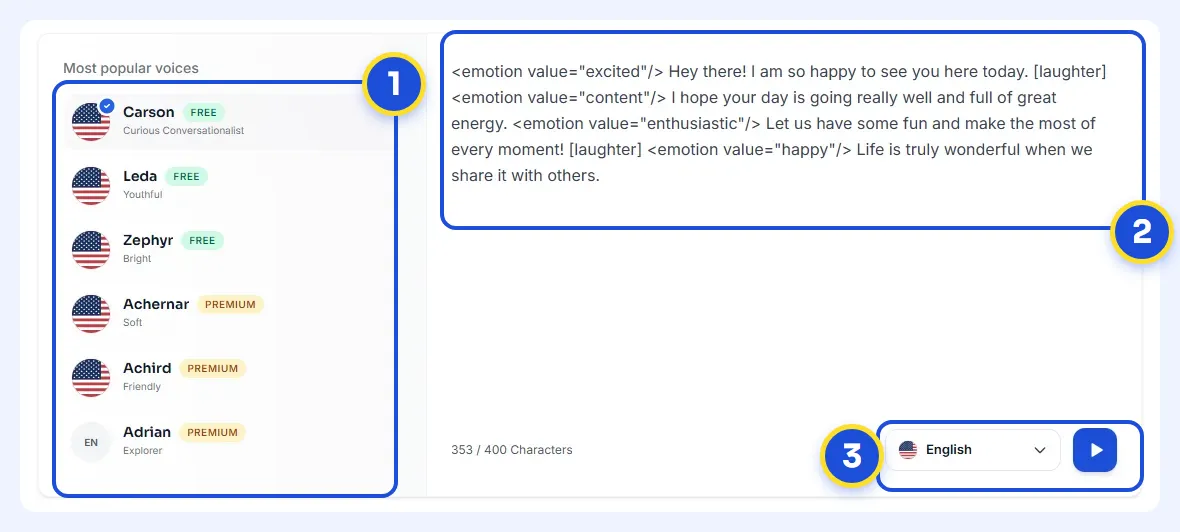
- 1Pick a voice. Voices are tagged Free or Premium.
- 2Type or paste a short line. Pick an emotion if you want one.
- 3Choose the language and press play to hear it.
Try it yourself in the free voice demo on Kveeky, no sign-up needed. For longer scripts and downloads, use the free plan.
- Finish the script first. Read it aloud once. If you stumble, the AI voice will too.
- Paste it into Kveeky. Split long scripts into scenes so you can regenerate one scene without touching the rest.
- Pick a voice. Browse by language, then preview 3 or 4 voices with your own opening line, not a sample sentence.
- Set delivery. Adjust speed and volume, and pick an Emotion (Neutral, Happy, Love, Angry, Calm or Sad) for a hook or a light moment. Kveeky has no pitch control, so choose a voice that already sounds right.
- Generate and listen. Fix mispronounced names by re-spelling them the way they sound. Use commas and full stops to add pauses.
- Download the audio file. Keep the best-quality file your plan offers if you plan to mix or master it.
- Edit to the voice. Drop the file on your timeline, cut the picture to the narration, and duck the music under it.
If the read still sounds flat, shorten the sentences and move the key word to the end of the line. Then try a second voice before you change anything else.
Can you use your own voice?
Yes. Kveeky offers voice cloning, and the number of clones depends on your plan (up to 20 on Business). Check the pricing page for what your plan includes. This is useful when a channel or brand already has a recognizable narrator. Only clone a voice you own or have written permission to use.
What does Kveeky cost for video work?
The free plan gives 500 credits a month (about 40 seconds) with standard voices and no credit card. That's enough to test a full short video.
| Plan | Monthly billing | Yearly billing (per month) | Included per month |
|---|---|---|---|
| Free | $0 | $0 | 500 credits (about 40 seconds), standard voices |
| Basic | $9 | $7.50 | 100 min, all 700+ voices, 5 clones |
| Pro | $19.99 | $12.50 | 133 min, 10 clones, voice localization |
| Premium | $29 | $24.17 | 200 min |
| Business | $99 | $82.50 | 1,000 min, 20 clones |
Every paid plan includes commercial usage rights for the audio you generate. Check the current Kveeky plans and prices before you buy, because plans can change.
Choosing the best voiceover
The best AI voiceover for video is the one that sounds right with your script, in your language, at a price that fits your output. Test with your own script before you commit.
Use these questions to compare tools:
- Does it have voices in your language and accent? Check per language, not the headline count. For regional accents, preview each voice; an American and a British English voice suit different audiences. You can browse Kveeky's text-to-speech language pages to check a language first.
- Can you control delivery? Look for speed, emotion and, if you need it, pitch controls, plus a simple way to fix pronunciation.
- What formats can you export? MP3 is fine for drafts and social video. WAV is better for mixing.
- What do the rights cover? Read the plan terms for commercial use, especially on free plans.
- How is usage metered? Most tools charge in credits or minutes. Estimate your monthly finished minutes, then add room for retakes.
- Can you clone a voice? Useful for a consistent brand narrator. Check how many clones each plan includes.
For product explainers, pick a voice that sounds like a helpful colleague rather than an announcer. Hype voices tend to undercut trust when you're explaining how something works.
Script and sync tips
Copy this pattern, swap in your own screens and paste it into the Kveeky editor. Each line is one screen action, so the picture cuts cleanly to the voice.
Most "robotic" AI voiceovers are script problems. These habits fix the majority of them before you press generate.
- Write for the ear. Short sentences, one idea each. Spoken English can drop words that written English needs.
- Spell out tricky items. Write numbers, dates, units and acronyms the way you want them read. "2026" might be read differently from "twenty twenty-six".
- Use punctuation as direction. A comma is a short pause. A full stop is a longer one. A new paragraph gives the voice room to reset.
- Generate a placeholder early. Use an AI read as a scratch track for the rough cut. Many teams keep it if it works, or swap in a human read later.
- Cut picture to voice, not the reverse. Lock the narration first, then trim shots to fit it. It's faster than stretching audio.
- Leave room for music. Lower the music whenever the voice speaks, then check the mix on phone speakers as well as headphones.
Paste the narration for your video to see its length at 150 words a minute, and how much of the free plan it uses.
0 words = 0 min 0 s.
Tick each one as you go.
AI voiceover or voice actor?
Use AI voiceover when clarity, speed of change and consistency matter most. Use a voice actor when performance is the product.
AI is a strong fit for training libraries, product updates, explainers and high-volume social video. A human actor is still the better choice for character-driven stories, emotional brand films and work where a director needs many interpretations of one line. Many producers run a hybrid stack: AI for drafts and volume, human talent for hero pieces.
We cover this trade-off in detail, including how voice actors are adapting, in our guide to AI voice acting for video producers.
Voiceover vs avatar tools
These are different tools for different jobs. An AI voiceover tool makes audio. An AI video generator makes moving pictures, and an avatar tool makes a digital presenter who speaks on screen.
Kveeky is a voice generator. It doesn't create video or avatars. If your visuals already exist, such as screen recordings, stock footage, animation or clips from an AI video model, a voice tool is usually all you need.
If you're choosing a video tool as well, start with our overview of text-to-video AI generators. If you're weighing avatar platforms, our HeyGen alternatives comparison explains when a voice-only tool is enough.
Using AI voices responsibly
AI voice is a tool, and the same rules apply as with any recording you publish.
- Get consent before cloning. Only clone your own voice or a voice whose owner has agreed in writing.
- Don't imitate real people. Avoid voices that could mislead viewers into thinking a real person said something.
- Disclose when it matters. YouTube asks creators to disclose realistic AI content that makes a real person appear to say something they didn't. Cloning your own voice for voiceovers or dubs is listed as a change that doesn't need disclosure (YouTube Help, retrieved 2026-10-06).
- Keep scripts private. Don't paste confidential or personal data into any online tool unless your company allows it.
More voiceover guides
Every guide in this topic, in one place:
- The Rise of AI Voice Acting: A Comprehensive Guide for Video Producers
- How to Run an AI Voice Watch Time Test on YouTube (Free Template)
- How Much Does AI Voiceover Actually Cost Per Video? (Real Numbers)
- 5 Best TikTok TTS Generators: Free & Paid Options Compared (2026)
- The Real Cost of Hiring a Voice Actor for 100 YouTube Videos
- Free AI Video Generation Tools to Try
- The Top 10 HeyGen Alternatives in 2026 (Free & Paid)
- From 10K to 100K Subscribers With AI Voiceovers: A Hypothetical Playbook
- Text to Video AI Generator: Create Videos from Text
- Time Required for AI Video Creation Process
- How to Use TikTok Text-to-Speech Generator: Complete Guide (2026)
- What is an Audio Blog and How Can You Create One
- Why Your YouTube Videos Sound Amateur (And It's Not Your Microphone)
- Best Free AI Voiceover Tools for YouTube (2026)
Making YouTube videos? Start with our complete guide to using AI voice for YouTube. Launching a show instead? See how to start a podcast with AI voices.
Frequently asked questions
What is Kveeky?
Kveeky is an AI voice generator for creators and small teams. You paste a script, pick one of 700+ voices across 40+ languages, and download the audio.
Is AI voiceover good enough for professional videos?
For narration, explainers, training and social video, yes, in most cases. Listen to your own script in a few voices first. For dramatic or character-heavy work, a human voice actor usually still sounds better.
Can I use Kveeky voiceovers in commercial videos?
Every paid Kveeky plan includes commercial usage rights for the audio you generate. If you plan to publish client or sponsored work, use a paid plan and check the pricing page for current terms.
How do I add an AI voiceover to a video?
Generate the voiceover, download the audio file, and import it into your video editor. Place it on the timeline, cut your visuals to match the narration, then lower the music under the voice.
Does Kveeky make videos or avatars?
No. Kveeky makes the voice track only. You create the visuals in your editor or another video tool, then add the Kveeky audio.
How much free AI voiceover do I get with Kveeky?
The free plan includes 500 credits a month, which is about 40 seconds of audio, with standard voices. No credit card is needed.
How we checked this guide
This guide is written by Hitesh Kumawat for the Kveeky team. Disclosure: Kveeky makes an AI voice generator.
- Kveeky plan details come from kveeky.com/pricing, retrieved on October 6, 2026.
- Voice and language counts are the approved figures from the shipped Kveeky catalog (700+ voices, 40+ languages with voices).
- YouTube's disclosure rules come from YouTube Help, "Disclosing use of GenAI content", retrieved October 6, 2026.
- No Kveeky usage data is used in this guide. No competitor prices are quoted.
- This guide replaces several older Kveeky guides for video producers. Their useful tips are merged here, and their unverified claims were removed.
Ready to try it on a real project? Take the script for your next explainer, generate it in 2 or 3 voices on the free plan, and cut a 30-second test. Our guide on how to add text to speech to a video walks through the editing step.
Turn your script into a voiceover
Paste your text, pick a voice and download the audio. Free to start, no credit card.