TL;DR
- Use an AI podcast voice to launch your show: a 10-step checklist, script template, gear by budget, Apple and Spotify rules, and when to use your own voice.
On this page
To start a podcast with an AI podcast voice, pick a narrow niche, write a short script for the ear, and generate the narration with a text-to-speech tool. Then edit it, add music, export at the right loudness and publish through a host to Apple Podcasts and Spotify. Disclose the AI voice in the audio and in the episode notes.
Last updated: October 7, 2026. Platform rules and audio specs were checked on Apple's and Spotify's own help pages on that date.
This guide is for solo creators and small teams who want a podcast without a studio. It also helps hosts who want AI voices for parts of their show. It covers the full launch: niche, format, script, equipment, voice, editing, hosting and distribution, plus the honest limits of AI voices.
Key Takeaways
- You can start a podcast with no microphone at all. A fully AI-voiced show needs a script, a text-to-speech tool, a free editor and a host.
- Disclosure is a platform rule. Apple Podcasts requires creators who use synthetic voices to disclose it in each episode and show (retrieved 2026-10-07).
- Cloning someone else's voice gets shows removed. Spotify removes podcast content that copies another creator's likeness without permission, including AI voice clones (retrieved 2026-10-07).
- Hybrid shows often work best: your own voice for opinions and interviews, AI voices for intros, ad reads, recaps and translated versions.
- Export to the target. Apple asks for about -16 LKFS loudness with true peak no higher than -1 dBFS, and recommends 96–128 kbps for mono MP3.
- Kveeky has 700+ AI voices in 40+ languages, 6 emotions to choose from, audio download, and commercial usage rights on every paid plan.
On this page: 10-step checklist · Niche and format · Script · Equipment · AI voice rules · Where AI fits · AI vs your voice · Choosing a voice · Your own voice · Publish · In Kveeky · AI in podcasting · Limits · FAQ
10-step launch checklist
To start a podcast, decide who it's for, plan the format, and script and record a few episodes. Then publish them through a host that sends your show to the podcast apps. The checklist below works for a show voiced by you, by AI voices or by both.
| # | Step | Done when… |
|---|---|---|
| 1 | Pick a niche and one listener | You can finish the sentence "This show helps ___ do ___" |
| 2 | Choose a format and length | You know if it's solo, co-hosted, interview or narrative, and how long each episode runs |
| 3 | Decide who speaks | You've chosen AI voice, your own voice or a hybrid (see the decision table below) |
| 4 | Write 3 episode scripts | Each script follows the template below and reads well out loud |
| 5 | Set up your gear or your voice tool | A 30-second test sounds clear on headphones and phone speakers |
| 6 | Record or generate the audio | Every line is recorded or generated, with mistakes fixed |
| 7 | Edit, add music and export | Loudness is about -16 LKFS and the file is MP3 or the format your host asks for |
| 8 | Make cover art and show notes | Square cover art is ready, and the notes include an AI disclosure if you use AI voices |
| 9 | Choose a host and submit your feed | Your RSS feed is submitted to Apple Podcasts, and the show is live on Spotify |
| 10 | Launch and keep a schedule | 3 episodes are live, and the next 2 are scripted |
Launching with 3 episodes gives a new listener more than one episode to try. It also tests whether you can keep the schedule before you announce it.
Niche and format
Choose the narrowest niche you can talk about for 20 episodes, and a format you can produce every week without help. A narrow show is easier to describe, easier to search for and easier to recommend.
Which niche is best for a podcast?
The best niche is one where you know more than your listener and where people already search for answers. Search Apple Podcasts or Spotify for your topic: existing shows prove there's an audience, and their gaps show you an angle.
- Too broad: "fitness", "business", "tech".
- Better: "strength training after 40", "bookkeeping for freelance designers", "AI tools for small-team marketers".
- Test it: list 20 episode titles in 15 minutes. If you can't, the niche is too narrow or not yours.
If you plan to use AI voices, match the voice to the niche too. A gaming show and a finance show need very different delivery.
Which formats work best with AI voices?
AI voices fit scripted formats best, because every word is written before you generate it. Unscripted formats still need real people.
| Format | How well AI voices fit | Why |
|---|---|---|
| Solo narrated explainer or news recap | Very well | Fully scripted, one voice, short segments |
| Narrative storytelling or audio drama | Well, with work | Needs several distinct voices and careful emotion control |
| Scripted 2-host conversation | Fair | Works if the dialogue is written to sound natural |
| Interview | Poorly | The guest's real voice is the point; use AI only for the intro and outro |
| Live chat or roundtable | Poorly | Spontaneous talk can't be scripted in advance |
Scripting your first episode
Script your first episode as a spoken conversation with one listener: a hook, a short intro, 3 main points, a recap and one call to action. A podcast script is the written plan of what each voice says, in order, with timing and cues for music.
Write for the ear, not the eye. Use short sentences, say numbers the way you'd speak them, and repeat the key point before you move on. Our guide to writing a script for AI voiceover covers punctuation and pronunciation in more detail.
Podcast episode script template
Copy this template for each episode. In Kveeky, set the Emotion dropdown for each block; other tools use different controls.
EPISODE [number]: [title that names the benefit]
Target length: [minutes]   Voices: [HOST] / [CO-HOST or GUEST]

[COLD OPEN, about 15 seconds]
HOST: [One surprising fact, question or result from this episode.]

[MUSIC: intro sting, fade under]

[INTRO, about 30 seconds]
HOST: Welcome to [show name], the show that helps [listener] [do what].
HOST: Today: [topic]. By the end, you'll know [promise].
HOST: This episode uses AI-generated voices. [Your name] wrote and checked the script.

[POINT 1]
HOST: [Claim in one sentence.] [Example or story.] [What the listener should do.]

[POINT 2]
CO-HOST: [Question a listener would ask.]
HOST: [Answer.] [Example.]

[POINT 3]
HOST: [Claim.] [Example.] [Common mistake to avoid.]

[RECAP, about 20 seconds]
HOST: So, 3 things: [point 1], [point 2], [point 3].

[CALL TO ACTION, about 10 seconds]
HOST: [One action only: follow the show, reply with a question, or visit a link.]

[MUSIC: outro, fade out]
Read the script out loud once before you record or generate it. Any sentence you stumble on will sound worse in audio, whether a person or an AI voice reads it.
Show me: how long each part of a 10-minute script should be
At an average speaking pace of about 150 words per minute (2.5 words a second), the template above breaks down like this:
- Cold open, intro, recap and call to action: about 75 seconds in total, roughly 190 words.
- Each of the 3 points: about 175 seconds, roughly 440 words, which leaves 525 seconds for the 3 points together.
- Total: about 1,500 words for 10 minutes. Check your own script with the words-to-minutes calculator.
Podcast equipment
For a show in your own voice, you need a microphone, closed-back headphones, a quiet soft room and an audio editor. For a fully AI-voiced show, you need no microphone at all: a text-to-speech tool, headphones and an editor are enough.
We don't sell gear or earn a commission on it, and prices change too often to quote. The table describes what each budget tier buys, so you can compare models at your own retailer.
| Budget tier | Microphone | Listening | Room | Software | Good for |
|---|---|---|---|---|---|
| AI-voiced only | None needed | Any headphones for checking | Not important | Text-to-speech tool plus a free editor such as Audacity | Narrated explainers, recaps, translated shows |
| Starter | A USB microphone; a dynamic model is more forgiving in an untreated room | Closed-back headphones | Rugs, curtains, a sofa or a closet full of clothes | Free editor | Your first 10 solo episodes |
| Upgrade | An XLR dynamic microphone with an audio interface, a mic arm and a pop filter | Closed-back headphones | A few acoustic panels behind and beside you | Editor with loudness metering | Weekly shows, 2 hosts in one room |
| Remote guests | Each person uses their own microphone and headphones | Headphones for everyone, so the call doesn't echo | A quiet room for each speaker | A remote recording tool that records each speaker on a separate track | Interview shows |
Audacity is a free, open-source editor for Windows, macOS and Linux (audacityteam.org, retrieved 2026-10-07). The room matters more than the microphone price: if your audio sounds hollow, our guide on why recordings sound amateur explains how to fix the room first.
Using an AI podcast voice
Yes. Apple Podcasts and Spotify both allow AI voices, but Apple requires you to disclose them, and both ban using AI to impersonate real people or mislead listeners. Treat disclosure as part of production, like cover art.
What Apple Podcasts, Spotify and YouTube require
| Platform | Rule on AI voices | What it means for you |
|---|---|---|
| Apple Podcasts | Creators using synthetic voices, AI-generated hosts or AI replicas of real people must "prominently disclose" it. That covers the content and metadata of each episode and show (Content guidelines 1.11). AI must not be used to fabricate news or present false narratives (1.12). | Say it in the audio and write it in the episode and show descriptions |
| Spotify | Spotify removes podcast content that uses a replica of another creator's likeness without permission, "whether that's using AI cloning or any other method". | Never clone or imitate a real host without written permission |
| YouTube (video episodes) | Realistic altered or synthetic content must be disclosed. Its help page lists "cloning one's own voice to create voice overs or dubs" as an example that doesn't need the label. | Check the disclosure setting when you upload a video version |
Sources: Apple Podcasts for Creators, "Content guidelines"; Spotify, "Podcast content that impersonates another creator's likeness"; YouTube Help, "Disclosing use of GenAI content"; all retrieved 2026-10-07.
A disclosure line you can copy
Put a short line in the intro and the same line in the show notes. For example:
Paste it into your intro script and your show notes. Replace the bracket with your name.
For a hybrid show, be specific: "The ad read and the Spanish version use an AI voice. Everything else is me." Listeners trust a show that tells them what's real. To word the label for Apple Podcasts, YouTube or an ad, use our AI voice disclosure generator.
Where AI voices fit
AI voices fit anywhere the words are written in advance: whole episodes, intros and outros, ad reads (see the audio ad specs by platform), character dialogue, article read-outs and translated versions. They save recording time and keep the sound consistent, because the same voice and settings give the same delivery every week.
A fully AI-voiced show
A fully AI-voiced show turns scripts straight into episodes, with no recording sessions. It suits explainers, news recaps, study guides and story series. The trade-off is personality: listeners follow hosts, so your point of view has to come through in the writing.
AI intros, outros and ad reads
Many hosts keep their own voice for the episode and use an AI voice for repeated parts. A fixed intro, an outro and short ad reads sound the same every time, and you can rewrite an ad read without booking a session. Kveeky's AI voiceover for podcasts page shows this intro and outro use case.
Multi-voice dialogue and storytelling
Voiceover improves podcast storytelling by giving each character, narrator or host a voice listeners can tell apart. Distinct voices let you write scenes, arguments and role-plays instead of one long monologue. To build a scene, generate each speaker's lines separately and put them in order in your editor. Our guide to generating dialogue with multiple AI voices walks through it.
Turning articles and newsletters into episodes
Text-to-audio lets you turn content you've already written into podcast episodes or audiobook-style chapters. A blog post, newsletter or report becomes an episode after you rewrite it for the ear: shorter sentences, no tables, and spoken transitions. Our guide to creating an audio blog covers the difference between a read-out article and a podcast.
Translating episodes into other languages
AI voices make a second-language version of a scripted episode affordable. Translate the script, have a native speaker check it, then generate it in a voice for that language. Kveeky has voices in 40+ languages, and its Pro, Premium and Business plans include voice localization.
Business podcasts and webinars
For business podcasts and webinars, voiceover gives a consistent, clear sound across episodes, even when different team members write them. Common uses include internal update podcasts, product-release recaps, a narrated intro for a webinar recording, and audio versions of reports. Keep the human voices for leaders and guests whose own voice builds trust.
AI, own voice or hybrid
Choose an AI voice if your show is fully scripted and time is your bottleneck. Choose your own voice if your personality or your guests are the product. Choose a hybrid if you want both.
Tap the sentence that sounds most like your plan. You get a starting point, not a verdict.
| Question | AI voice | Your own voice | Hybrid |
|---|---|---|---|
| Time per episode | Lowest: write, generate, edit | Highest: set up, record, retake, edit | Medium |
| Gear needed | None beyond headphones | Microphone, headphones, a quiet room | Microphone plus a voice tool |
| Personality and trust | Comes only from the writing | Strongest | Strong where it counts |
| Consistency | Same delivery every week | Varies with your energy and room | Repeated parts stay identical |
| Other languages | Easy with a translated script | Only languages you speak | AI voice for translated versions |
| Interviews | Not possible | Yes | Yes |
| Disclosure needed | Yes, on Apple Podcasts | No | Yes, for the AI parts |
| Best for | Explainers, recaps, story series, internal podcasts | Opinion shows, interviews, community shows | Most solo creators and small teams |
If you want AI convenience but your own sound, a clone of your own voice is a fourth option. Only clone a voice you own or have written permission to use.
Choosing a podcast voice
Choose the voice that fits your listener and topic, then test it on a full minute of your real script, not a single sentence. A voice that sounds good for 10 seconds can tire the ear over 20 minutes.
What makes a great podcast voiceover is clarity, a steady pace and a tone that matches the content. Check these 5 things:
- Fit. Calm and warm for wellness or finance; brighter and faster for tech news or gaming.
- Clarity at speed. Play it at 1.5x. If you still understand every word, it's clear enough.
- Long-form comfort. Listen to 3 minutes without looking. Stop if the rhythm starts to feel repetitive.
- Contrast for 2 voices. Co-hosts should differ in at least 2 of pitch, pace, accent or energy.
- Pronunciation. Test your brand name, guest names and niche terms before you commit.
Recording yourself well
A good podcast voice is your normal speaking voice, delivered clearly and at a steady pace, as if you're talking to one person. You don't need a deep "radio voice". You need energy, clear words and a good microphone distance.
What makes a good podcast voice?
Listeners respond to voices that sound natural, warm and easy to follow. The basics:
- Talk to one person. Picture a single listener and speak to them, not to "everyone out there".
- Vary your pace. Slow down for the key point; speed up a little for stories.
- Smile on upbeat lines. It changes your tone, and listeners hear it.
- Stay a hand's width from the microphone, at the same distance for the whole session.
How do you get your voice ready for a podcast?
Warm up for 5 minutes before you record. Drink water, hum, do a few lip trills and read a paragraph out loud. Stand up if you can, because it makes deep breathing easier.
Record at the time of day your voice sounds best. Keep water nearby and pause the recording instead of pushing through a dry throat.
How do you start talking in a podcast?
Start with the most interesting line of the episode, not "Um, hi, welcome to episode 1". Script your first 3 sentences word for word, even if you improvise the rest. Once you're 30 seconds in, nerves usually fade.
If you freeze mid-recording, stay silent for 2 seconds and start the sentence again. A clean pause is easy to cut in editing.
Editing, hosting and publishing
Edit out mistakes and long gaps, add music, set the loudness, export an MP3, then upload it to a podcast host. The host creates your RSS feed, which you submit once to Apple Podcasts and other apps. New episodes then appear there automatically.
Here's what Apple and Spotify publish about files and listings:
| Requirement | Apple Podcasts | Spotify for Creators |
|---|---|---|
| Audio formats | Apple Podcasts Connect: WAV, FLAC or MP3. RSS feeds: MP3 or AAC. | MP3, M4A or WAV, in mono or stereo |
| Recommended MP3 settings | Mono: 44.1 or 48 kHz, 96–128 kbps. Stereo: 44.1 or 48 kHz, 128–256 kbps. | No bitrate given on the upload help page |
| Loudness | About -16 LKFS (±1 dB), true peak no higher than -1 dBFS | No target given on the upload help page |
| Cover art | 3000 x 3000 px (1400–3000 px if sent by RSS), PNG or JPG, no transparency | Not specified on the upload help page we checked |
| Hosting | Needs an RSS feed from a host; every show passes technical checks and a review before it appears | Free hosting; shows hosted there appear on Spotify automatically |
| Other apps | Not applicable | You submit the RSS feed to Apple Podcasts and other apps yourself |
Sources: Apple Podcasts for Creators, "Audio requirements", "Show Cover" and "Submit a new show"; Spotify, "Publishing audio episodes in Spotify for Creators" and "Distributing your show to other platforms"; all retrieved 2026-10-07.
Apple notes that a submitted show isn't available until at least one episode is published. For music, use tracks you have a license for, because you confirm rights to third-party content when you submit to Apple.
Many creators also post each episode as a video. Our AI voiceover for video guide covers that side of the workflow, from script to finished video.
Tick each item as you finish it. Your ticks are saved in this browser.
Ticked: 0 of 7
Podcasting with Kveeky
In Kveeky, you paste each speaker's lines, pick a voice per speaker, generate each part and download the audio. Then you assemble the parts in your editor. Here's the workflow:
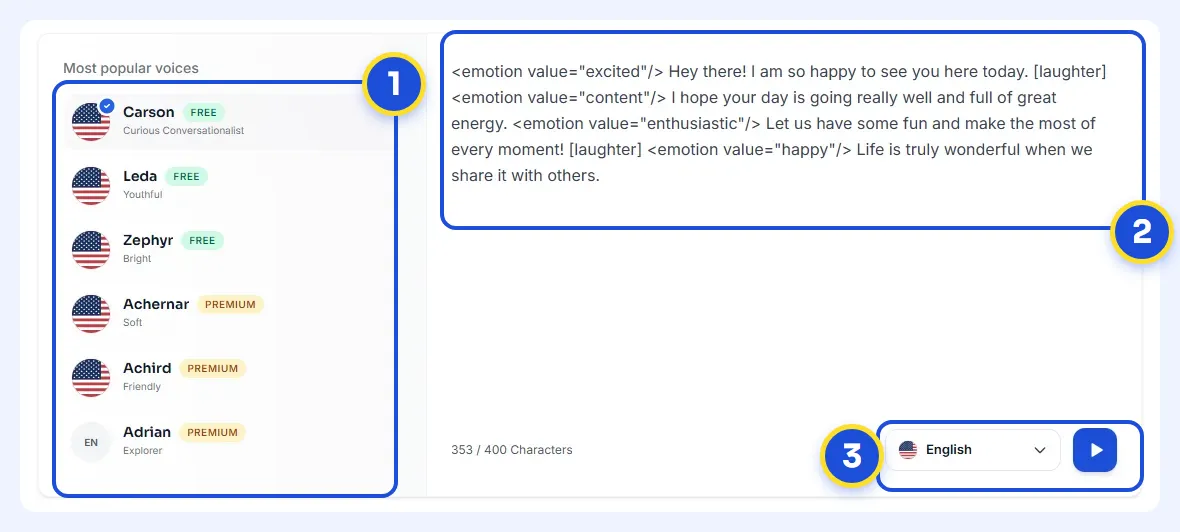
- 1Pick a voice. Voices are tagged Free or Premium.
- 2Type or paste a short line. Pick an emotion if you want one.
- 3Choose the language and press play to hear it.
Try it yourself in the free voice demo on Kveeky, no sign-up needed. For longer scripts and downloads, use the free plan.
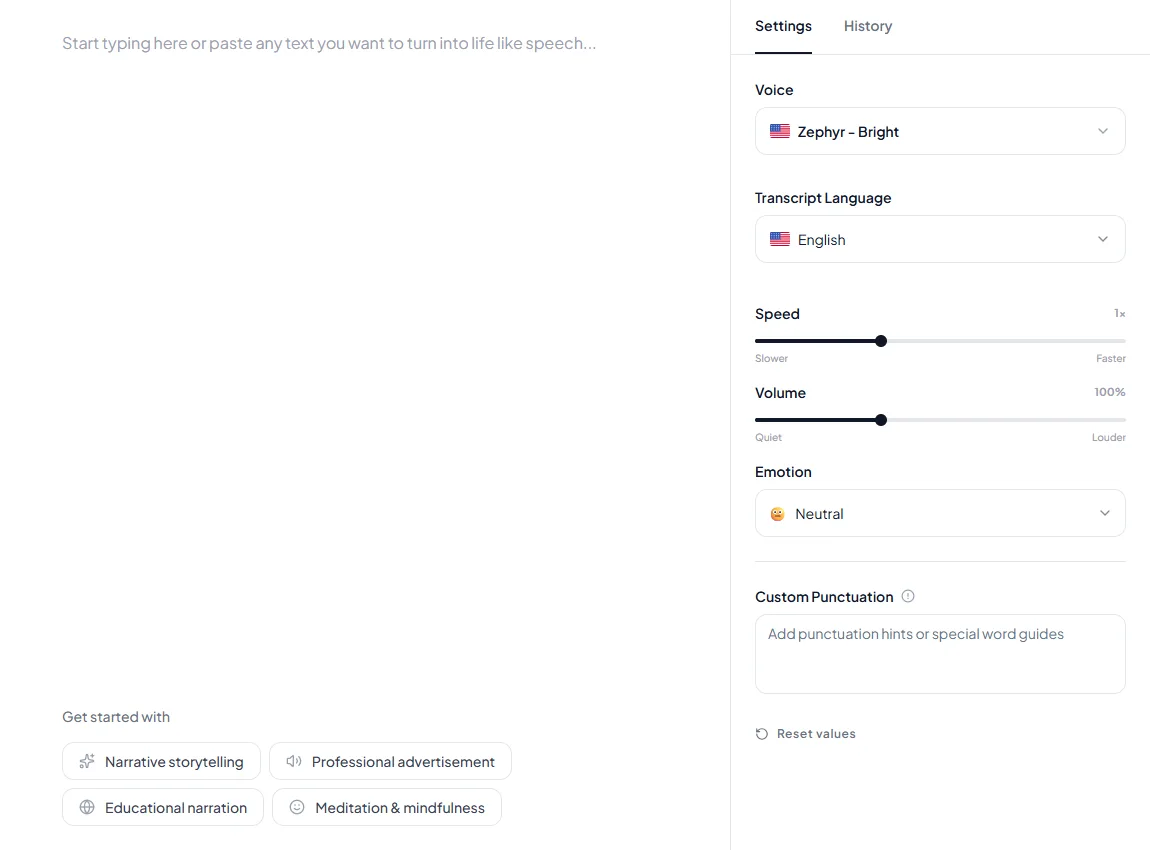
- Split the script by speaker. Keep HOST and CO-HOST lines in separate blocks, using the template above.
- Pick 1 voice per speaker. Choose from 700+ voices and note each voice name, so every episode sounds the same.
- Add delivery cues. Pick an Emotion such as Happy for the cold open or Calm for a reflective segment, and adjust speed and volume.
- Generate each block separately. Multi-voice dialogue is made by generating each speaker's lines on their own, then putting them in order.
- Download the audio for editing. Edit and mix it in your editor, then export the finished episode at the platform's target.
- Listen through once on headphones. Regenerate any line with a wrong pronunciation or odd emphasis before you publish.
Expected result: a scripted 10-minute episode with 2 voices, a cold open, music and a disclosure line, ready for your host.
The free plan gives 500 credits a month (about 40 seconds) with standard voices and no credit card, which is enough for a trailer or a test episode. For a weekly show, the minutes add up fast:
| Plan | Price per month (monthly / yearly billing) | Minutes per month | 20-minute episodes per month, before retakes |
|---|---|---|---|
| Free | $0 | About 0.67 | 0 (trailer or test only) |
| Basic | $9 / $7.50 | 100 | 5 |
| Pro | $19.99 / $12.50 | 133 | 6 |
| Premium | $29 / $24.17 | 200 | 10 |
| Business | $99 / $82.50 | 1,000 | 50 |
Prices and minutes come from Kveeky's pricing page, retrieved 2026-10-07. Every paid plan includes commercial usage rights for generated audio. Regenerated lines use credits too, so leave some room.
Enter your show's numbers. It uses the plan minutes from the table above and adds a retake allowance, because regenerated lines use credits too.
AI in podcasting in 2026
AI is changing podcasting in 3 visible ways: platforms are testing AI voices for translation, adding AI audio features for listeners, and tightening rules on disclosure and impersonation. For creators, that makes honesty and a clear point of view more valuable, not less.
- Translation in the host's voice. In September 2023, Spotify piloted Voice Translation. It translated selected episodes into Spanish, French and German in the podcaster's own voice (Spotify Newsroom, retrieved 2026-10-07).
- Listener-made AI audio. On May 21, 2026, Spotify announced Personal Podcasts. Listeners write a prompt, and Spotify generates short, private audio episodes for them (Spotify Newsroom, retrieved 2026-10-07).
- Stricter rules. Apple's content guidelines now require AI disclosure. On May 19, 2026, Spotify restated that it removes podcasts that impersonate a creator's likeness, including with AI voice cloning (Spotify Newsroom, retrieved 2026-10-07).
What this means in practice: generic AI-read summaries now compete with audio that listeners can generate for themselves. A show that wins has a specific audience, original insight, and voices that are disclosed and consistent.
Current AI voice limits
AI voices are strong at clear, scripted narration. They are weaker at spontaneous conversation, subtle comedy and long emotional scenes, and they can't replace a real guest.
- No real conversation. AI voices read what you write. Interruptions, banter and follow-up questions must be scripted, and they often sound planned.
- Fatigue over long episodes. A single voice can feel repetitive after 20 or 30 minutes. Break episodes into segments, add a second voice or add music beds.
- Names and jargon. Uncommon names, brands and acronyms can be mispronounced. Spell them the way they sound and listen to every line.
- Language coverage varies. Not every language has the same choice of voices. Check that your language has voices before you plan a translated show.
- Trust. Some listeners prefer human hosts. Clear disclosure and a strong script matter more for an AI-voiced show than for a human one.
Frequently asked questions
Is a professional voiceover necessary for a podcast?
No. Most podcasts are voiced by their hosts, and a fully scripted show can use AI voices. A professional voice actor is worth it for audio drama, premium branded shows, or when you want a recognizable human voice that you don't have.
How do you get into voice acting for podcasts?
Start with a home setup that records clean audio, then record a short demo of 3 to 4 contrasting reads. Audition for independent audio dramas and indie shows, and be reliable about deadlines. Repeat bookings usually come from easy collaboration, not just a great voice.
Do I have to tell listeners my podcast uses AI voices?
On Apple Podcasts, yes: creators using synthetic voices must disclose it in the content and metadata of each episode and show. Put a short line in the intro and in the show notes, even on platforms that don't require it.
Can I make money from a podcast that uses AI voices?
Platforms judge the show, not only the voice. Every paid Kveeky plan includes commercial usage rights for generated audio. You still have to follow each platform's rules, such as Apple's disclosure rule and Spotify's ban on impersonating real creators.
Can I start a podcast for free?
Yes. Spotify for Creators offers free hosting, Audacity is a free editor, and Kveeky's free plan gives about 40 seconds of AI voice a month with no credit card. A weekly AI-voiced show will need a paid voice plan.
Can I use a clone of my own voice for my podcast?
Yes, if it's your own voice and you consent. Check the Kveeky pricing page for which plans include voice cloning. Apple still asks you to disclose synthetic voices, while YouTube lists cloning your own voice for voiceovers as an example that doesn't need its label.
How we checked this guide
This guide is written by Mohit Singh for the Kveeky team. Disclosure: Kveeky makes an AI voice generator. We don't sell podcast equipment or earn commissions, so the equipment table names no brands or prices.
- Apple Podcasts for Creators: Content guidelines, Audio requirements, Show Cover and Submit a new show, retrieved 2026-10-07.
- Spotify: Podcast content that impersonates another creator's likeness, Publishing audio episodes in Spotify for Creators, Distributing your show to other platforms and Spotify for Creators podcast hosting, retrieved 2026-10-07.
- Spotify Newsroom: AI Voice Translation pilot (September 25, 2023), Building a More Trusted Podcast Experience (May 19, 2026) and new podcast features (May 21, 2026), retrieved 2026-10-07.
- YouTube Help: Disclosing use of GenAI content, retrieved 2026-10-07.
- Audacity: audacityteam.org, retrieved 2026-10-07.
- Kveeky plans: kveeky.com/pricing, retrieved 2026-10-07.
- No Kveeky usage data is used in this guide. Episode counts per plan are our own arithmetic from the published minutes.
Ready to hear your show before you record a word? Paste the cold open from the template above into Kveeky, try 2 or 3 voices, and compare them with the examples on our AI voices for podcasts page.
- The perfect script structure for AI voiceovers with more templates.
- Generate dialogue with multiple voices for two-host scenes.
- Audio blogs with a voice generator to turn articles into episodes.
- Is voice cloning legal? before you clone any voice.
- Free vs paid text to speech to see what a free plan covers.
- Multilingual voiceover with AI for translated episodes.
Also on Kveeky: Pricing · Words-to-minutes calculator · AI voices · Spanish text to speech
Turn your script into a voiceover
Paste your text, pick a voice and download the audio. Free to start, no credit card.