What is an Audio Blog and How Can You Create One

An audio blog is a blog post you can listen to. The written article is published with a spoken version, recorded by you or generated with an AI voice, usually in a player at the top of the page. You create one by turning your post into a script, recording or generating the audio, and embedding the file.
Last updated: October 6, 2026. Kveeky plan details were checked on kveeky.com/pricing on that date.
This guide is for bloggers, newsletter writers and content teams who want their posts to reach people who'd rather listen than read. It explains what the format is, how it compares with a podcast, and the fastest way to add audio to the posts you already have.
Key Takeaways
- Definition: an audio blog is a written post with a spoken version. It's also called a voice blog, an audioblog or a "listen to this article" post.
- Not quite a podcast: a podcast is a show people subscribe to. This format is attached to an article, and the text stays on the page.
- Two ways to make the audio: record it yourself, or generate it with a text-to-speech (TTS) voice. AI narration is faster when you publish often.
- Plan the length: at a narration pace of about 150 words a minute, a 1,500-word post becomes roughly 10 minutes of audio.
- Kveeky's free plan gives 500 credits a month (about 6.6 minutes), enough to test a short post with no credit card.
On this page: Definition · Audio blog vs podcast · Why add audio · How to create one · AI narration · Record or AI · Embed the audio · Articles read aloud · Ideas · FAQ
What is an audio blog?
It's a blog post with a spoken version that readers can play instead of reading. The audio and the text cover the same content, and both live on the same page.
Audio blogging started with people recording short voice posts. Today most are narrated versions of written articles. Some publishers record a person; many now use an AI voice so every post gets audio on the day it goes live.
You'll see a few names for the same idea:
- Audio blog or audioblog
- Voice blog or voice blogging
- "Listen to this article" or "article read aloud", the label many publishers put on the player
Audio blog vs podcast: what's the difference?
A narrated post belongs to an article. A podcast is a standalone show. The table shows how the two usually differ.
| Feature | Audio blog | Podcast |
|---|---|---|
| Where it lives | On the blog post page, next to the text | In podcast apps, through an RSS feed |
| Source | Usually a narrated version of a written post | Usually recorded as audio first |
| Style | Scripted and close to the written text | Often conversational, with hosts or guests |
| Length | Matches the article, often a few minutes | Often longer episodes |
| Effort per episode | Low, because the script already exists | Higher: planning, recording and editing |
| Search value | The text on the page stays indexable | Depends on show notes and transcripts |
The line can blur. Some writers also publish their narrated posts as a podcast feed. If you go that route, the same narration file can serve both.
Why add audio to your blog?
Audio gives people a second way into the same post. It helps when they can't, or don't want to, look at a screen.
- Listening on the move. Readers can play a post while they commute, cook or exercise.
- Accessibility. Audio helps some readers with low vision, dyslexia or reading fatigue. Keep the text too, because screen readers and search engines rely on it.
- Longer posts get finished. A 12-minute read is easier to get through as audio for some people.
- More reuse. The same audio file can go into a video, a social clip or a newsletter.
- A recognizable voice. Using one narrator across posts gives your blog a consistent sound.
How to create an audio blog in 7 steps
You don't need a studio. Here's the process for a post you've already written.
- Pick the posts. Start with evergreen posts that get steady traffic. They earn back the effort longest.
- Turn the post into a script. Remove things that only work on screen: "see the table below", long URLs, code, image captions.
- Write for the ear. Break long sentences, spell out abbreviations, and say numbers the way you want them read.
- Add a short intro and outro. For example: "You're listening to [post title] from [blog name]." End with one clear next step.
- Record or generate the narration. Use your own microphone, or a TTS voice (see the next section).
- Check the audio once. Listen at normal speed. Fix mispronounced names and any line that sounds rushed.
- Embed the file and publish. Put the player near the top of the post, above the first heading.
Audio quality matters as much as the voice. These audio fixes for amateur-sounding videos apply to blog narration too.
How to turn a blog post into audio with an AI voice
AI narration is the quickest way to add audio to every post. You paste the script, choose a voice and download the file. Here's how it works in Kveeky.
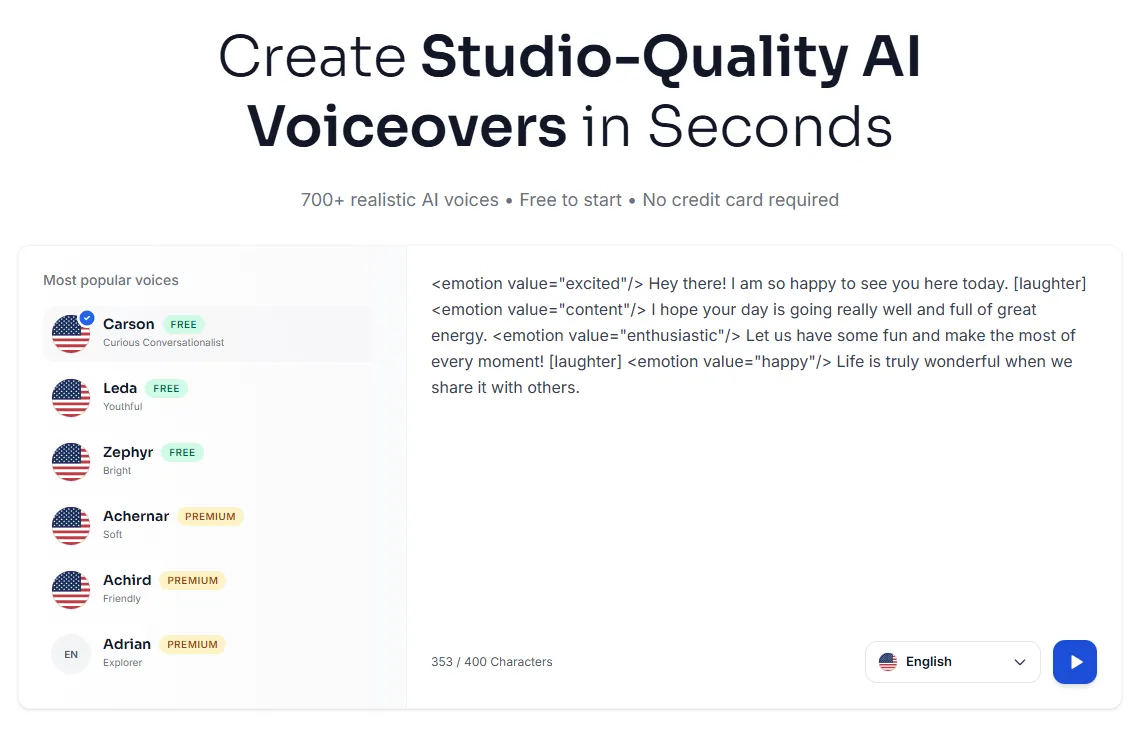
- Paste your script into the Kveeky editor. For long posts, work section by section.
- Choose a voice. Kveeky has 700+ voices across 40+ languages. Pick a calm, clear voice for articles; save energetic voices for short, punchy posts.
- Adjust delivery. Set the speed, pitch and tone. Emotion tags such as
<emotion value="excited"/>can lift an intro, but use them lightly in long reads. - Generate and listen. Re-spell any word the voice gets wrong, then regenerate only that section.
- Download MP3 or WAV. MP3 is the usual choice for web players because the files are smaller.
How much audio will you need? Divide your word count by about 150 words a minute for a rough estimate. A 1,000-word post is around 6 to 7 minutes, which fits in Kveeky's free monthly allowance of about 6.6 minutes.
If you publish every week, a paid plan makes more sense. Our breakdown of AI voiceover cost per video shows how per-minute pricing adds up. Basic is $9/month, or $7.50/month billed yearly, for 100 minutes a month and all 700+ voices. Every paid plan includes commercial usage rights. See the Kveeky pricing page for the other plans.
Record yourself or use an AI voice?
Both work. The right choice depends on how often you publish and how personal the blog is.
| Option | Best for | Trade-off |
|---|---|---|
| Record your own voice | Personal blogs, opinion posts, founders' notes | Needs a quiet room, a decent microphone and editing time |
| AI voice | Frequent posts, how-to guides, news and updates | Less personal; check pronunciation of names and terms |
| Clone of your own voice | Keeping your sound without recording every post | Only clone a voice you own or have written permission to use |
Kveeky includes voice cloning on every plan, with 5 clones on the free plan. If you also turn posts into videos, our guide to AI voiceover for video producers shows how the same narration fits on a timeline.
How to add audio to a blog post
The simplest way to add audio to a blog is the HTML <audio> element. It embeds a sound file and, with the controls attribute, shows the browser's own play, pause, seek and volume controls (MDN Web Docs, retrieved 2026-10-06).
<audio controls src="/audio/my-post.mp3"></audio>
Most website builders and blog platforms also have an audio block or embed option that does the same thing without code. Whichever you use:
- Place the player near the top, so readers see the option before they start reading.
- Label it clearly, for example "Listen to this article (7 min)".
- Say if the voice is AI-generated. A short note under the player builds trust.
- Update the audio when you update the post. Old audio on a refreshed article confuses listeners.
Articles read aloud: options for your readers
Not every reader needs you to publish audio. Phones and browsers can already read text aloud, which is a useful fallback.
- Android: Select to Speak reads selected items on screen aloud. Turn it on in Settings > Accessibility > Select to Speak (Android Accessibility Help, retrieved 2026-10-06).
- iPhone and iPad: iOS has built-in spoken content features. Our iOS text-to-speech guide walks through the settings.
- Reader apps: dedicated text-to-speech readers can play web pages and documents. We compare options in our roundup of AI text-to-speech reader and exporter tools.
The difference is control. Built-in readers use whatever voice the device has. Publishing your own narration lets you choose the voice, fix pronunciation and keep the sound the same for every reader.
Audio blog ideas and examples
You don't need a new format to start audio blogging. These ideas work with content you already have.
- Narrated evergreen guides. Add audio to your 5 most-read how-to posts first.
- Short daily or weekly briefs. A 2 to 3 minute update is easy to script and easy to finish.
- Founder or editor notes. Opinion posts work best in your own voice, or a clone of it.
- Language versions. Translate a popular post and publish narration in a second language. Check which languages have voices on Kveeky's text-to-speech language pages.
- Post summaries. A 60-second spoken summary at the top of a long article helps readers decide whether to read on.
Ready to go beyond audio articles? Follow our workflow for starting a podcast with AI voices.
Frequently asked questions
What is an audio blog called?
It's also called an audioblog, a voice blog or a "listen to this article" post. All of these mean a blog post that comes with a spoken version readers can play.
Is an audio blog the same as a podcast?
No. A narrated post is attached to a written article and lives on the same page. A podcast is a standalone show that people subscribe to in podcast apps.
Can I create an audio blog for free?
Yes. You can record yourself with free audio software, or use an AI voice tool with a free tier. Kveeky's free plan gives 500 credits a month, about 6.6 minutes of audio, with no credit card.
How long should an audio blog be?
As long as the article it narrates. At about 150 words a minute, a 1,000-word post runs around 6 to 7 minutes. For long guides, consider a short spoken summary instead.
Should I keep the written post if I add audio?
Yes. The text is what search engines read and what screen-reader users rely on. Treat the audio as a second way to consume the same post, not a replacement.
Can I use AI voices to narrate blog posts?
Yes. AI voices are a practical way to narrate every post on the day it's published. Pick a calm, clear voice, check pronunciation once, and say near the player that the narration is AI-generated.
How we checked this guide
This guide is written by Ankit Agarwal for the Kveeky team. Disclosure: Kveeky makes an AI voice generator.
- Kveeky plan details come from kveeky.com/pricing, retrieved on October 6, 2026.
- The
<audio>element details come from MDN Web Docs, and the Select to Speak steps from Android Accessibility Help, both retrieved on October 6, 2026. - The 150 words a minute figure is a planning assumption for estimates, not a measured Kveeky speed. Real length depends on the voice and speed setting.
- No Kveeky usage data is used in this guide.
Start with one post. Pick your most-read article, turn its first section into a script, and generate a 2-minute sample on Kveeky's free plan. Then compare a few narration styles in our guide to AI voiceover for podcasts and spoken content.