AI Text to Speech Reader and Exporter Tools

TL;DR
- This article covers ai text-to-speech (tts) readers and exporter tools. Including how they work, their benefits for video production, and explore some of the best options available today. Also, we offer guidance on selecting the right tool for specific needs, and maximizing their potential for creating engaging, accessible audio content.
An AI text to speech reader plays text aloud for you, while an exporter saves that speech as an MP3 or WAV file. Built-in readers in Word, Edge, iPhone and Android only play audio. To keep a file, use a tool that exports: Balabolka and TTSMP3 are free, NaturalReader exports on paid plans, and Kveeky exports voiceovers you can publish.
Last updated: October 7, 2026. Features, limits and prices were checked on each vendor's own page on October 6, 2026; the quick answers on readers and audiobooks were checked on October 7, 2026.
This guide is for people who want both: hear a script or document, then keep the audio. We compare 10 tools on reading, exporting, free use and commercial rights, then show a simple script-to-voiceover workflow.
Key Takeaways
- Readers and exporters are different jobs. A reader plays text aloud. An exporter gives you a file you can edit, share or publish.
- Free readers rarely export. The support pages for Word Read Aloud, Edge Read aloud, iPhone Read & Speak and Android Select to Speak describe playback, not saving files.
- Free tools that export: Balabolka saves text as an audio file on Windows, and TTSMP3 converts up to 3,000 characters to MP3.
- For publishing, check commercial rights. NaturalReader's personal plans are for personal use only. Every paid Kveeky plan includes commercial usage rights.
- Best workflow: proof your script with a free reader, then export the final voiceover from a voice generator.
On this page: Reader vs exporter · Comparison table · Tools that read and export · Readers only · What to look for · Script workflow · Readers and audiobooks · FAQ
What is the difference between a TTS reader and an exporter?
A reader turns text into speech while you listen. It's for proofreading, studying and accessibility. An exporter turns text into an audio file, usually MP3 or WAV, that you can drop into a video, course or podcast.
Some tools do both. Others do only one. The table below shows which is which, so you don't pick a reader when you need a file.
AI text to speech reader and exporter tools compared
All details were read on each vendor's own page on October 6, 2026. A dash means the page we checked did not state it.
| Tool | Reads aloud to you | Exports audio | Free option | Commercial use |
|---|---|---|---|---|
| Kveeky | Previews your script | MP3 and WAV | 500 credits/month (about 6.6 min), no card | Every paid plan |
| NaturalReader | Yes: documents, web pages, scans | MP3 on paid personal plans | Free plan for listening | Only in the separate Commercial version |
| ElevenLabs | Yes, in the free ElevenReader app | Yes, from its web studio | 10,000 credits/month on the web | From the $6/month Starter plan |
| Balabolka | Yes, many file types | Saves text as an audio file | Freeware (Windows) | — |
| TTSMP3 | Plays the result | MP3 | Free, 3,000 characters per conversion | Check its terms |
| Narakeet | Plays the result | Audio and narrated video | 20 conversions | Paid packs only |
| Voicemaker | Plays the result | Yes | 250 characters per conversion | From $5/month Starter |
| Microsoft Word Read Aloud | Yes | Not described on its support page | With Microsoft 365, Office 2019 or 2021 | — |
| Microsoft Edge Read aloud | Yes, web pages in Reading mode | Not described on its support page | Free | — |
| iPhone/iPad Read & Speak | Yes | Not described on its support page | Free, built in | — |
Tools that read and export
Kveeky: export voiceovers you can publish
Kveeky is a voice generator, not a document reader. You paste a script, preview it in one of 700+ AI voices, adjust tone, pitch and speed, and export MP3 or WAV.
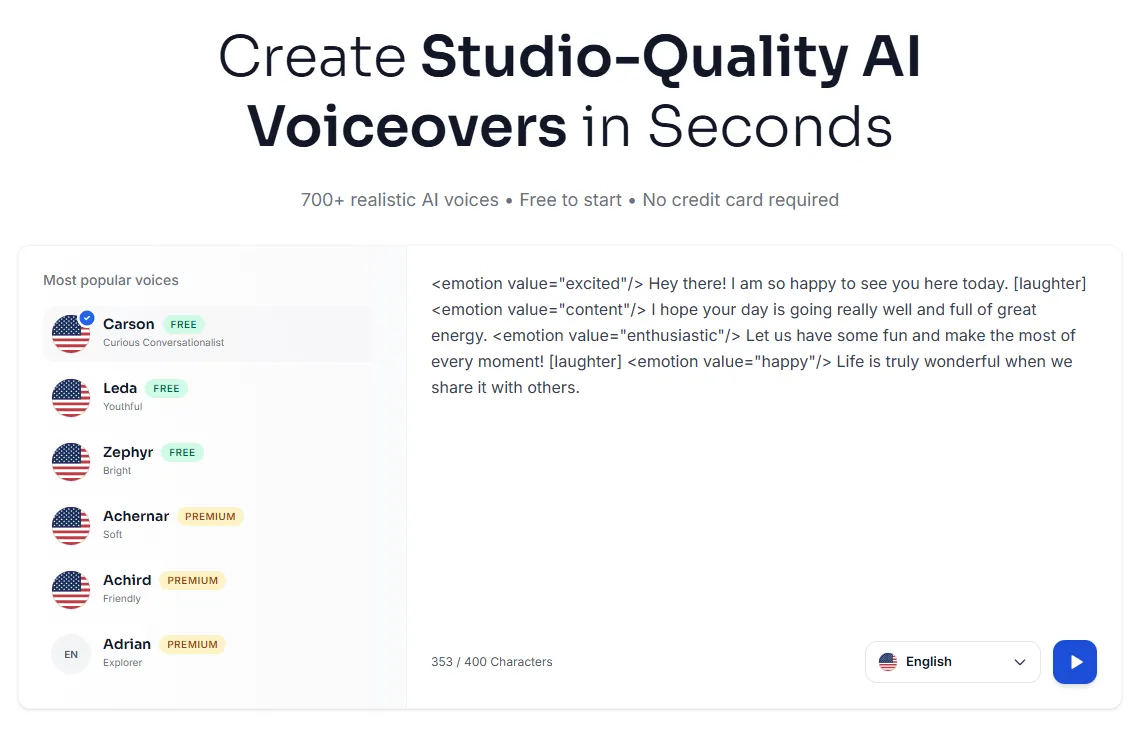
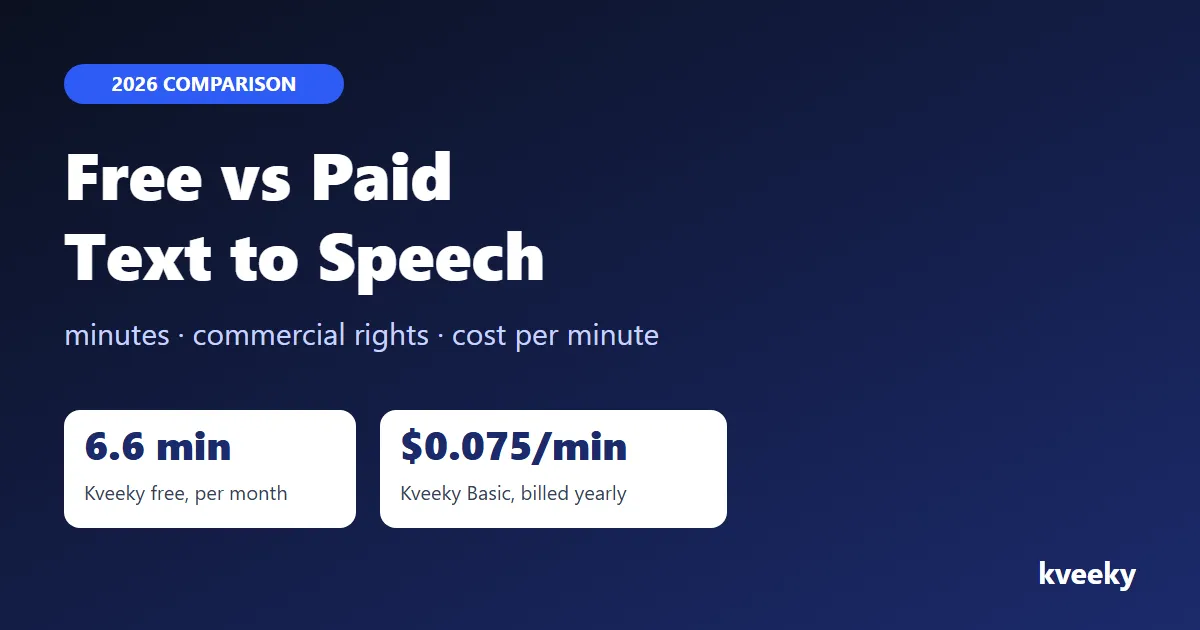
- Free: 500 credits a month (about 6.6 minutes), standard voices, no credit card.
- Paid: from $9/month, or $7.50/month billed yearly, for 100 minutes and all voices.
- Rights: every paid plan includes commercial usage rights. See Kveeky pricing.
Where it falls short: it won't read your PDFs or web pages back to you. Pair it with a free reader for that.
NaturalReader: the closest all-in-one
NaturalReader reads documents, web pages and scanned text. Its paid personal plans add MP3 downloads of up to 1 million characters a month, starting at $79/year for Lite.
Where it falls short: audio from personal plans is licensed for personal use only. Publishing needs the Commercial version, from $29/month or $16.50/month billed yearly.
ElevenLabs: free reader app plus a paid exporter
The ElevenReader app is free on iOS and Android, and reads PDFs, ePubs and articles. Exporting voiceovers happens in the ElevenLabs web studio, where the free plan has 10,000 credits a month and no commercial license.
Where it falls short: the reader and the exporter are separate products with separate limits.
Balabolka: free on Windows
Balabolka is freeware that reads many formats, including PDF, DOCX and EPUB, and can save text as an audio file.
Where it falls short: it uses the voices installed on your computer, so quality varies.
TTSMP3, Narakeet and Voicemaker: export-first tools
These tools are built to make files. TTSMP3 converts up to 3,000 characters at a time to MP3 for free. Narakeet's free tier gives 20 conversions, then sells minute packs from $6 for 30 minutes. Voicemaker's free plan allows 250 characters per conversion for personal use.
Where they fall short: short free limits, and commercial use only on paid plans (Narakeet, Voicemaker) or unstated (TTSMP3).
Free readers that only play audio
These are free and good for listening, proofreading and accessibility. The support pages we checked describe playback, not saving files.
- Microsoft Word Read Aloud: Review tab, then Read Aloud. See our Word text to speech tutorial.
- Microsoft Edge Read aloud: open Reading mode (F9), then select Read aloud.
- iPhone and iPad Read & Speak: turn on Speak Selection or Speak Screen in Accessibility settings.
- Android Select to Speak: turn on the shortcut in Accessibility settings, then tap text to hear it.
If listening is all you need, our Speechify alternatives guide compares 15 reading options.
What to look for in an exporter
- Export format. MP3 is small and works almost everywhere. WAV keeps full quality for editing.
- Per-conversion limit. 250 or 3,000 characters means long scripts take many steps.
- Commercial rights. Needed for YouTube monetization, ads, courses and client work.
- Delivery control. Speed, pitch, pauses and emotion make the file usable without re-recording.
- Pronunciation fixes. You need a way to correct names and acronyms.
Some tools accept SSML, the W3C markup for controlling pauses, emphasis and pitch. A short example:
<speak>
  Welcome to the course. <break time="500ms"/>
  Today you'll learn <emphasis level="strong">3 simple steps</emphasis>.
</speak>
Check each tool's documentation before you rely on SSML, because support varies.
How to use an AI voice script reader, then export a voiceover
This workflow uses a free reader for proofing and a voice generator for the final file.
- Draft the script in Word or Google Docs.
- Listen to it with a free reader, such as Word Read Aloud. You'll hear clumsy sentences your eyes skip.
- Fix the script. Shorten long sentences and re-spell tricky names.
- Paste it into a voice generator like Kveeky and pick a voice.
- Set delivery. Adjust speed and pitch, and add emotion tags such as
<emotion value="excited"/>where needed. - Export MP3 or WAV, then add it to your video or podcast editor.
For more ways to compare tools, see our 10 best free AI voiceover generators and the checklist for choosing text to voice software.
Text readers and audiobooks: quick answers to common questions
These short answers cover what people ask about text readers: speed, PDFs, eBooks, long documents, languages, children and audiobooks. Facts were checked on each source's own page on October 7, 2026.
What is the purpose of a text reader?
A text reader turns written text into speech so you can listen instead of, or while, you read. It helps people with low vision, dyslexia or reading fatigue, and it lets anyone keep reading hands-free while commuting, cooking or exercising. Many readers also highlight each word as it's spoken, which helps you follow along.
Can a text reader adjust reading speed?
Yes, almost every reader can. Word's Read Aloud lets you change voice and speed, and Android's Select to Speak player has buttons to increase or decrease speed (Google, Android Accessibility Help, retrieved 2026-10-07). Start near normal speech, then speed up as you get used to the voice; slow it down for dense or technical passages.
Can text readers read PDFs and eBooks?
Yes. Microsoft Edge's built-in PDF reader includes Read aloud and highlights the text as it reads (Microsoft Learn, PDF reader in Microsoft Edge, retrieved 2026-10-07). The free ElevenReader app reads PDFs and ePubs, and Balabolka opens PDF, DOCX and EPUB files on Windows.
To turn an eBook chapter into an audio file, copy the text you have the rights to use into an exporter. Then generate it in sections and download each one as MP3 or WAV.
Can text readers convert scanned images into readable text?
Some can, using optical character recognition (OCR). Android's Select to Speak can read text from your camera or from pictures with OCR, and NaturalReader reads scanned text. Voice generators work from text, so run scans through an OCR tool before you paste them in.
How do text readers handle multiple languages?
A reader speaks each language with a voice built for that language, so the result depends on which voices it has. If the voice doesn't match the text, you'll hear the wrong accent or garbled words. Kveeky has voices in 40+ languages, and the language pages show which voices exist for each one.
What are the best text readers for children?
Look for word highlighting, adjustable speed and simple controls. Microsoft's Immersive Reader in Word shows syllable breaks, Line Focus for reading line by line, and Picture Dictionary images for single words (Microsoft Support, Use Immersive Reader in Word, retrieved 2026-10-07). It's also available in Word for the web, so it suits shared family or classroom computers.
How do text readers help in language learning?
They let you hear correct pronunciation while you read the same words, and you can slow the voice down for hard sentences. Immersive Reader can also translate a word or the whole document into your preferred language. For practice audio in the language you're learning, our guide to multilingual AI voiceover covers how voices differ across languages.
What role do text readers play in online education?
They give students a second way into the same material: listening as well as reading. A 2018 meta-analysis of text-to-speech and read-aloud tools found an average effect size of 0.35 on reading comprehension for students with reading difficulties (Wood et al., Journal of Learning Disabilities, retrieved 2026-10-07). The authors call for more studies, so treat it as a support, not a cure; our post on text to speech for ADHD covers one group in detail.
What features do advanced AI text readers add?
Many modern readers offer neural voices alongside older system voices. They also add word highlighting, OCR for scans, translation and, in Edge, Copilot summaries of the page. For publishing, the feature that matters most is export: a reader that only plays audio can't give you a file.
Is there a free app that will read text to you?
Yes. iPhone and iPad have Read & Speak, Android has Select to Speak, and Microsoft Edge has Read aloud, all free. On Windows, NVDA is a free, open-source screen reader for blind and low-vision users (NV Access, About NVDA, retrieved 2026-10-07).
Can free text-to-speech tools convert long documents?
For listening, yes: Edge's Read aloud reads long web pages and PDFs straight through. For exporting, free plans cap you per conversion or per month, such as TTSMP3's 3,000 characters per conversion and Kveeky's 500 credits a month.
ANALYSIS: a 10,000-word report at an assumed 150 words a minute runs about 67 minutes. That fits inside Kveeky Basic's 100 minutes a month, but not a free plan.
Can you make an audiobook with free text to speech?
You can make one, but where you sell it decides whether AI narration is allowed. ACX, which distributes audiobooks to Audible, states: "Unauthorized use of text-to-speech, AI, or automated recordings in ACX titles is prohibited" (ACX, Audio Submission Requirements, retrieved 2026-10-07).
Google Play Books makes auto-narrated audiobooks free for a limited time from an EPUB you sell there. It supports English, Spanish, German, French, Hindi and Brazilian Portuguese (Google, Auto-narrated audiobooks, retrieved 2026-10-07).
For your own site, a course or a podcast feed, a voice generator works well. Kveeky's free plan covers a sample chapter, and our page on AI voiceover for audiobooks shows the workflow.
What is the difference between a text reader and an audiobook?
A text reader speaks any text live, on your device, and you control the voice and speed. An audiobook is a finished, edited recording of a whole book, delivered as audio files. ACX, for example, asks for 192 kbps or higher MP3 files of no more than 120 minutes each, so a book needs production work that a reader skips.
Frequently asked questions
What is an AI text to speech reader?
An AI text to speech reader turns written text into speech while you listen. It's used for proofreading, studying and accessibility. Examples include Word Read Aloud, Edge Read aloud, iPhone Read & Speak and NaturalReader.
Can I save text to speech as an MP3 for free?
Yes. TTSMP3 converts up to 3,000 characters at a time to MP3 for free, and Balabolka can save text as an audio file on Windows. Kveeky's free plan exports MP3 or WAV within 500 credits a month.
Can Microsoft Word save Read Aloud as an audio file?
Microsoft's support page for Word Read Aloud describes playing, pausing and changing voice and speed. It doesn't describe saving audio. To get a file, paste the text into a tool that exports MP3 or WAV.
Which reader and exporter can I use commercially?
Check the plan. NaturalReader's personal plans are personal use only, so publishing needs its Commercial version. Every paid Kveeky plan includes commercial usage rights, and ElevenLabs adds a commercial license from Starter.
What is the best AI voice script reader for video creators?
Use a free reader, such as Word Read Aloud, to proof the script. Then export the final voiceover from a voice generator like Kveeky, which gives you 700+ voices and MP3 or WAV files.
What is the best free AI voice generator for creating audiobooks?
For selling on Audible through ACX, none: ACX prohibits unauthorized text-to-speech and AI narration. Google Play Books creates auto-narrated audiobooks free for a limited time. For your own site or course, Kveeky's free plan covers a sample chapter, and paid plans start at $9/month.
How we checked this guide
This guide is written by Mohit Singh for the Kveeky team. Disclosure: Kveeky makes an AI voice generator. We compared tools on their own published plans and support pages.
- Retrieved October 6, 2026: Kveeky, NaturalReader personal plans and commercial plans, ElevenLabs, ElevenReader, Balabolka, TTSMP3, Narakeet, Voicemaker.
- Reader behaviour: Microsoft Word Read Aloud, Microsoft Edge, Apple Support and Android Accessibility Help, retrieved October 6, 2026. SSML is defined by the W3C.
- Quick answers on readers and audiobooks, retrieved October 7, 2026: Google, Android Accessibility Help: Select to Speak; Microsoft Learn, PDF reader in Microsoft Edge; Microsoft Support, Use Immersive Reader in Word; NV Access, About NVDA; ACX, Audio Submission Requirements; Google, Play Books auto-narrated audiobooks; Wood, Moxley, Tighe and Wagner, Does Use of Text-to-Speech and Related Read-Aloud Tools Improve Reading Comprehension for Students With Reading Disabilities? A Meta-Analysis, Journal of Learning Disabilities, 2018. The 67-minute example is our arithmetic at an assumed 150 words a minute.
- No Kveeky usage data is used in this guide.
Turning articles into audio episodes? See how Kveeky handles AI voiceovers for podcasts, from script to exported file.