TL;DR
- This article covers how a video creator broke through a growth plateau by switching to ai narration tools to scale production. We look at the workflow changes that allowed for daily uploads and how voice technology improved audience retention. You will learn the exact steps to integrate automated audio into your content strategy without losing that human feel.
On this page
This is a hypothetical scenario, not a real case study. It shows how a creator at 10,000 subscribers could use AI voiceovers to skip recording and audio cleanup, then spend that time on topics and hooks. AI voiceovers don't grow a channel by themselves; they free up time for the work that does.
Last updated: October 6, 2026. No real channel, subscriber numbers or results are reported in this post.
Earlier versions of this page told the story as if it happened to a real creator. We couldn't verify it, so we rewrote it as a clearly labelled example.
Our creator, "Sam", is invented. The workflow, costs and checks are real, and you can copy them.
Can AI voiceovers take a channel from 10K to 100K subscribers? Not on their own. In this hypothetical, they remove recording and audio cleanup so a creator can publish 3 videos a week instead of 1. That is about 104 minutes of narration a month, which fits Kveeky Pro (133 minutes). Growth still comes from topics, titles, thumbnails and the first 30 seconds.
Key Takeaways
- This is an illustrative scenario. "Sam" is a hypothetical creator. Nothing here is a reported result.
- The real gain is time. AI voiceovers remove recording, retakes and voice cleanup, so you can publish on a steady schedule.
- The voice doesn't pick your topics. Growth still depends on ideas, titles, thumbnails and the first 30 seconds of each video.
- Cost is modest. 3 videos a week at about 8 minutes each needs roughly 104 minutes of audio a month. That fits Kveeky Pro (133 minutes).
- Measure it. Compare YouTube Studio's intro retention and average view duration before and after you switch.
On this page: The scenario · The bottleneck · Workflow · Cost · What matters more · Measuring it · Risks · FAQ
The hypothetical creator
Sam runs an explainer channel about personal finance. Sam reached 10,000 subscribers by recording narration at home, one video a week. Every detail below is an assumption we chose to make the math concrete.
| Assumption | Value in this scenario |
|---|---|
| Niche | Faceless personal-finance explainers |
| Starting point | 10,000 subscribers, 1 video a week |
| Goal | 3 videos a week without hiring help |
| Video length | About 8 minutes of narration per video |
| Languages | English first, Spanish later |
| Voice budget | Under $25 a month |
Change these numbers to match your own channel. The steps work the same way.
The recording bottleneck
At 1 video a week, recording your own voice is manageable. At 3 a week, the same steps take 3 times as long, and they're the least creative part of the job.
For a home recording, the time goes to 4 places:
- Setting up. Waiting for a quiet room, checking levels, warming up your voice.
- Retakes. Stumbles, mispronounced names and lines that sound flat.
- Cleanup. Cutting breaths, mouth clicks and background noise.
- Fixes after review. Changing one sentence means setting everything up again.
Sam's problem isn't talent. It's that narration time grows with every extra video, while research and scripting already fill the week.
Weekly workflow changes
With AI narration, the script becomes the recording. Sam's week could look like this:
- Monday: write 3 scripts. Short sentences, one idea per paragraph, the hook in the first line.
- Tuesday morning: generate all 3 voiceovers. Paste each script, keep the same voice for brand consistency, and set speed and tone.
- Tuesday: fix problem lines. Re-spell names phonetically, add commas for pauses, and regenerate only the lines that sound wrong.
- Wednesday to Friday: edit 1 video a day. Drop the audio on the timeline first, then cut visuals to the voice.
- Weekend: publish and review. Schedule uploads and note what to change in next week's scripts.
In Kveeky, step 2 means picking 1 of 700+ voices and downloading the audio. The Emotion setting (Neutral, Happy, Love, Angry, Calm or Sad) can lift a hook, and Speed and Volume handle the rest.
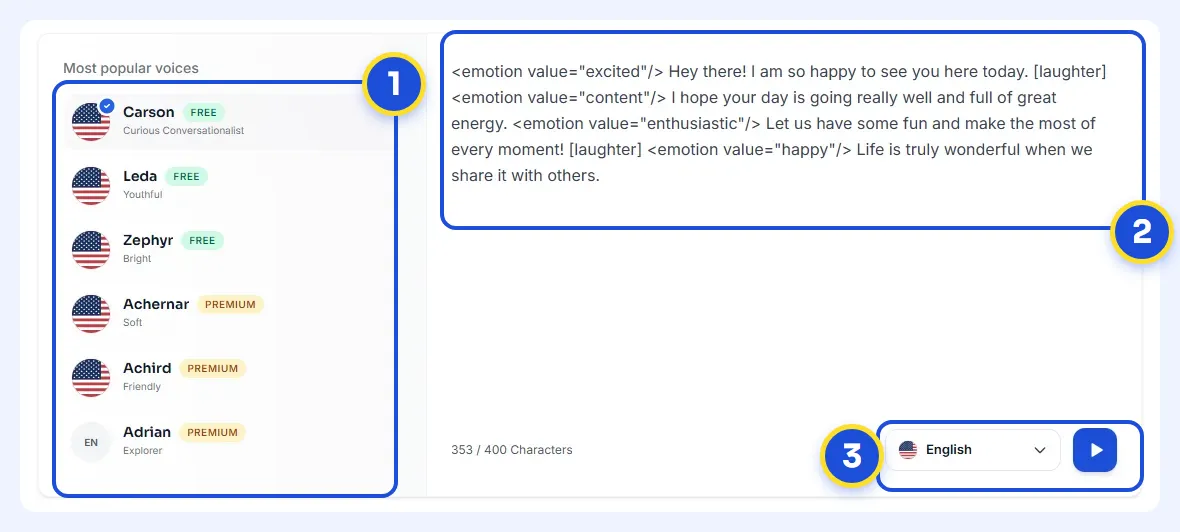
- 1Pick a voice. Voices are tagged Free or Premium.
- 2Type or paste a short line.
- 3Choose the language and press play to hear it.
Try it yourself in the free voice demo on Kveeky, no sign-up needed. For longer scripts and downloads, use the free plan.
A clean voice file still needs light mixing. Our guide on why YouTube videos sound amateur covers levels, music and loudness.
AI voiceover cost
ANALYSIS. 3 videos a week × about 8 minutes × about 4.33 weeks ≈ 104 minutes of narration a month. Retakes add more, so plan for headroom.
| Kveeky plan (checked October 6, 2026) | Minutes per month | Monthly billing | Yearly billing | Fits Sam? |
|---|---|---|---|---|
| Free | About 0.67 | $0 | $0 | Only for testing voices |
| Basic | 100 | $9 | $7.50 | Just short at 3 videos a week |
| Pro | 133 | $19.99 | $12.50 | Yes, with room for retakes |
| Premium | 200 | $29 | $24.17 | Yes, room for a Spanish version of some videos |
Every paid plan includes commercial usage rights, which matters once a channel is monetized. Pro also adds voice localization, which suits Sam's plan to publish in Spanish later.
Change the numbers to match your channel. It uses 4.33 weeks a month, as in the analysis above, and the plan allowances from the table.
Not sure how long a script runs? The words to minutes calculator turns a word count into minutes, and the AI voiceover cost per video guide breaks the cost down further.
For comparison, our analysis of what a human voice actor costs for 100 YouTube videos shows published rate ranges per video.
Decisions that matter more
A better voice won't rescue a weak idea. In Sam's scenario, the hours saved on recording go to 4 things:
- Topic choice. Pick questions your audience is already searching for.
- Titles and thumbnails. They decide whether anyone starts the video.
- The first 30 seconds. Get to the point fast and promise a clear payoff.
- Consistency. A steady schedule gives viewers a reason to subscribe.
Match the voice to the niche, too. A calm, even voice suits finance; the same voice may feel slow on a gaming channel.
Measuring if it works
Compare your videos before and after the switch in YouTube Studio. YouTube's audience retention report shows an Intro figure, which is the share of viewers still watching after the first 30 seconds.
Track 3 numbers for 10 videos before and 10 after:
- Intro retention from the key moments report.
- Average view duration, the average minutes watched.
- Uploads per month, because the goal is to publish more.
If retention holds while uploads go up, the switch is working. Our step-by-step AI voice watch-time test plan shows how to run a fairer comparison.
Paste it into a spreadsheet and fill one row for each of your 10 videos before the switch and 10 after.
Legal and ethical risks
The main risks are rights, disclosure and consent. Check each one before you publish, especially for client work.
- Commercial rights. Use a plan whose terms cover monetized or client videos. Kveeky includes commercial usage rights on every paid plan.
- Disclosure. YouTube asks creators to disclose realistic synthetic content, such as a real person appearing to say something they didn't. Cloning your own voice for voiceovers is listed as not needing disclosure.
- Consent. Never clone someone else's voice without their clear permission.
- Mass production. YouTube's monetization policy targets content that is mass-produced, generic or repetitive, so keep each video original.
Our guide to whether voice cloning is legal covers consent and likeness laws in more detail. It is general information, not legal advice.
Before you scale, check YouTube's monetization and disclosure rules in our AI voice for YouTube guide.
Tick each one. These come from the risks and workflow above.
Frequently asked questions
Is this a real case study?
No. "Sam" is a hypothetical creator we invented to show the workflow and costs. Earlier versions of this page presented the story as real, and we couldn't verify it, so we rewrote it as a labelled scenario.
Can AI voiceovers help a YouTube channel grow?
AI narration can save time on every upload, which makes a steady schedule easier. Growth itself still depends on topics, titles, thumbnails and retention, not on the voice alone.
How many minutes of AI voiceover does a 3-videos-a-week channel need?
At about 8 minutes per video, it's roughly 104 minutes a month before retakes. Kveeky Pro includes 133 minutes a month, which leaves room for fixes.
Will viewers notice an AI voice?
Some will. Choose a voice that fits your niche, fix pronunciation and pacing, and watch your intro retention. If it drops after the switch, try another voice or adjust delivery.
What are the legal and ethical risks of using AI voiceovers for client work?
Check that your plan's terms cover commercial or client use, get consent before cloning any voice, and disclose realistic synthetic content where YouTube requires it. When in doubt, ask a lawyer.
How we wrote this scenario
This guide is written by Deepak Gupta for the Kveeky team. Disclosure: Kveeky makes an AI voice generator.
- The creator, channel and numbers in this post are hypothetical. No real channel's data or results are used.
- Kveeky plan details come from kveeky.com/pricing, retrieved October 6, 2026.
- YouTube details come from YouTube Help: key moments for audience retention, monetization policies and altered or synthetic content disclosure, retrieved October 6, 2026.
- The minutes-per-month figure is our own calculation from the assumptions in the table above.
Want to try Sam's workflow on your own channel? Write next week's 3 scripts, generate them with Kveeky's free plan, and follow our guide to AI voiceovers for YouTube videos. For the bigger picture, read our hub on AI voiceover in video production.
Turn your script into a voiceover
Paste your text, pick a voice and download the audio. Free to start, no credit card.