TL;DR
- How to use AI voice for YouTube in 2026: monetization and disclosure rules from YouTube's own pages, a 7-step workflow, plus length and tone tables.
On this page
Here's how to use AI voice for YouTube: write your own script, turn it into narration with an AI voice generator, and edit it into your video. Then upload and answer YouTube's "AI use" question honestly. YouTube doesn't block AI voices from earning money. It blocks channels whose videos are mass-produced, repetitive or copied.
Last updated: October 7, 2026. YouTube's monetization, disclosure, eligibility and Shorts help pages were re-read on that date.
This guide is for creators who want narration without recording every line: faceless channels, tutorials, explainers, documentaries and Shorts. It covers the rules first, then the workflow, then the craft. Each section links to a deeper guide when you need more detail.
Key Takeaways
- AI voices are allowed and can be monetized. YouTube's monetization policies judge whether each video is original and varied, not which tool made the voice (YouTube Help, retrieved 2026-10-07).
- The July 15, 2025 update renamed the "repetitious content" policy to "inauthentic content" and clarified that it covers repetitive or mass-produced videos.
- Disclosure depends on realism, not on AI. You must tick "AI use" for realistic content that could mislead, such as a real person saying something they didn't. Cloning your own voice for voiceovers is on YouTube's no-disclosure list.
- Plan scripts at about 150 words per minute, then adjust by format: faster for Shorts, slower for tutorials and documentaries.
- Kveeky's free plan gives 500 credits a month (about 40 seconds) with standard voices and no credit card. Every paid plan includes commercial usage rights for generated audio.
Yes, YouTube allows AI voice narration, and you can earn from it when each video is original and varied. You only tick the "AI use" box when the result is realistic and could mislead viewers; cloning your own voice is on YouTube's no-disclosure list. Plan about 150 words per minute, and use the calculator below to size your script.
On this page: Allowed? · Monetization · Checklist · Disclosure · Detection · 7-step workflow · Length · Tone · Tools · Free options · Engagement · Brand · Pro tips · All guides · FAQ
AI voice rules on YouTube
Yes. YouTube has no rule against narrating a video with a text-to-speech or AI voice. The same Community Guidelines, copyright rules and monetization policies apply as for any other video.
Two rules matter more for AI-voiced videos than for others. First, realistic AI content that could mislead viewers must be disclosed when you upload. Second, monetized channels must show original, varied work, which is where many AI-voiced channels fail.
YouTube's monetization policies list "using AI to edit your video scripts" as an example of acceptable creative help (YouTube Help, YouTube channel monetization policies, retrieved 2026-10-07). A synthetic narrator is a production tool in the same way. What counts is what the video gives the viewer.
Monetizing AI voice
Yes, you can monetize AI voice on YouTube. YouTube doesn't name AI narration as a reason to refuse monetization. It refuses channels whose content is mass-produced, repetitive, reused without added value, or that use AI personas as experts on sensitive topics.
First, your channel has to reach a threshold. You need 1,000 subscribers plus either 4,000 qualified watch hours in the last 12 months or 10 million qualified Shorts views in the last 90 days (YouTube Help, YouTube Partner Program overview & eligibility, retrieved 2026-10-07).
Meeting a threshold doesn't get you in automatically. Reviewers check the channel as a whole, and may focus on your main theme, most viewed videos, newest videos and the videos with the most watch time. They may also check titles, thumbnails, descriptions and your "About" section.
What changed in July 2025?
On July 15, 2025, YouTube renamed its "repetitious content" policy to "inauthentic content." It clarified that the policy covers content that is repetitive or mass-produced. YouTube said this content had always been ineligible, and that its reused content policy did not change.
When we re-read the page on October 7, 2026, it gave one example that targets AI directly. AI-generated content from generic or unoriginal templates that gives "the impression of mass production" without the creator's own insight can't be monetized. The page also had sections on unsatisfying or off-putting content and on AI personas for sensitive topics.
The AI persona rule is the one AI-voiced channels most often miss. Channels that use an AI persona presenting as a human expert on health, legal, financial or political topics can't monetize. YouTube's examples include an AI "doctor" and AI podcast hosts giving investment tips.
Monetization-safety checklist for AI-voiced channels
Use this checklist before you apply to the YouTube Partner Program and again before each upload. The right column restates examples from YouTube's monetization policies, retrieved October 7, 2026. The policies say their example lists are not complete.
| Check | Pattern YouTube allows | Pattern YouTube lists as not monetizable |
|---|---|---|
| Script | Your own script, research, commentary or story | Videos that only read material you didn't create, such as text from websites or news feeds |
| Variation | Same intro and outro, but each video has a distinct storyline, focus or concept | Videos that feel interchangeable, made from one template with minimal variation |
| Visuals | Footage, demos or graphics that carry the narration | Image slideshows or scrolling text with minimal or no narrative, commentary or educational value |
| Use of AI | AI that helps deliver a unique, well-researched or creative narrative | AI content from generic templates that looks mass-produced and adds no insight of yours |
| Persona | A narrator who explains, without posing as a human expert | An AI persona giving medical, legal, financial or political advice as if it were a human expert |
| Reused clips | Clips with a critical review, explanation or new storyline | Clips edited together with little or no narrative |
| Storyline | A cohesive story with a clear beginning, middle and end | Unrelated AI clips stitched together to shock, or the same scenario repeated with the same outcome |
| Whose voice | A stock AI voice, or a clone of your own voice | A realistic voice of a real person saying things they didn't say (needs disclosure and can be removed on a privacy complaint) |
Tick what is true for the video you are about to upload. It mirrors the table above and does not replace YouTube's review.
0 of 6 ticked
One more check sits outside YouTube's rules: the rights to the audio itself. Read your voice tool's terms before you monetize. On Kveeky, every paid plan includes commercial usage rights for generated audio (Kveeky pricing, retrieved 2026-10-07).
Disclosing an AI voice
Only when the result is realistic and could mislead. YouTube requires disclosure when AI makes a real person appear to say or do something they didn't, or alters footage of a real event or place. It also covers realistic scenes that didn't happen and AI music that's the main focus of the video.
YouTube's list of things you don't need to disclose includes "cloning one's own voice to create voice overs or dubs." It also lists AI help with scripts, titles, thumbnails and captions, plus voice or audio repair (YouTube Help, Disclosing use of GenAI content, retrieved 2026-10-07).
A stock AI narrator reading your own script isn't on YouTube's "must disclose" examples. A voice that sounds like an identifiable real person is a different case. YouTube's privacy guidelines let a person ask for removal of AI content that "looks or sounds like" them (YouTube Help, YouTube Privacy Guidelines, retrieved 2026-10-07). If your video also runs as a Meta ad or a podcast episode, the AI voice disclosure generator shows each platform's rule side by side.
Choose what your video contains. This restates the rules in this section; YouTube's own page is the final word.
How to disclose in YouTube Studio:
- Open YouTube Studio and start your upload.
- In the Attributes section, find AI use.
- Select Yes if the video meets the disclosure rules, or No if it doesn't.
- Finish the rest of your video details and publish.
YouTube states that disclosing AI content won't limit a video's audience or affect its eligibility to earn money. Creators who consistently fail to disclose may face a label added by YouTube, content removal or suspension from the Partner Program.
YouTube AI voice detection
YouTube says it may add an AI label automatically in 3 cases. They are content made with YouTube's own AI tools, content carrying C2PA metadata, and content "our internal systems detect is AI generated or altered" (YouTube Help, retrieved 2026-10-07). YouTube doesn't publish how that detection works or how accurate it is, so we won't guess.
If a label is applied automatically, you get a notification in YouTube Studio. In most cases you can correct a wrong label by answering No in the AI disclosure survey under Attributes. Labels on content made with YouTube's AI tools, content with C2PA metadata, or labels added after manual review can't be changed.
Detection is not the monetization test; reviewers judge whether your channel is original and varied. A well-made AI-voiced tutorial and a mass-produced AI channel can both be labelled, but only the second fails that test.
AI voice for YouTube in 7 steps
The workflow is script, voice, review, edit, upload, disclose, then measure. It's the same whether you make a 60-second Short or a 20-minute documentary. This is also how most YouTubers do a voiceover today, recorded or AI.
- Write the script for the ear. Use short sentences, one idea each, and your own research or opinion. Our guide to writing an AI voiceover script covers punctuation for pauses and phonetic spellings.
- Pick a voice and generate. Paste the script into your voice tool, choose a voice that fits your niche, and set speed, volume and emotion. Generate long videos in sections, one per chapter, so fixes are quick.
- Listen once and fix problems. Re-spell names the voice gets wrong, split long sentences and add pauses with commas or full stops. Then re-generate only the lines you changed.
- Edit the audio into your video. Import the audio file into your editor, cut the visuals to the voice, and keep music well below the narration. Add captions for viewers watching with the sound off.
- Upload in YouTube Studio. Write a title and description that describe what this video adds. Reviewers look at metadata too.
- Answer the AI use question. Under Attributes, select Yes or No using the rules in the disclosure section above.
- Check retention and adjust. In YouTube Studio analytics, look at where viewers drop off. If they leave in the first seconds, test a different hook or voice on the next video.
Expected result: a finished video with clean narration, captions, an honest AI disclosure answer and a script that's yours.
How Kveeky helps
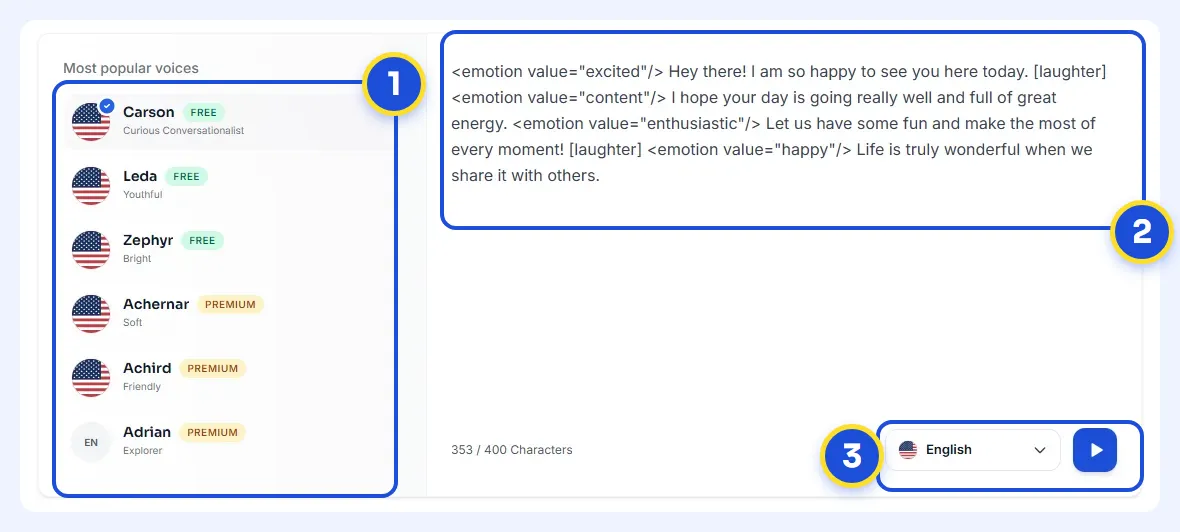
- 1Pick a voice. Voices are tagged Free or Premium.
- 2Type or paste a short line. Pick an emotion if you want one.
- 3Choose the language and press play to hear it.
Try it yourself in the free voice demo on Kveeky, no sign-up needed. For longer scripts and downloads, use the free plan.
In Kveeky, steps 2 and 3 look like the screenshot above. You paste the script, pick one of 700+ voices across 40+ languages, and adjust speed and volume. The Emotion setting (Neutral, Happy, Love, Angry, Calm or Sad) changes how the line is read, and custom punctuation hints help with names and pauses.
Ideal voiceover length
As long as the script needs, and no longer than the video. YouTube sets no voiceover length. Plan the length from your word count: minutes of narration equal words divided by speaking pace.
The National Center for Voice and Speech puts the average English speaking rate at about 150 words per minute (NCVS, Tutorials: Voice Production, retrieved 2026-10-07). The table adjusts that base by format. It's a planning guide, not a rule: the pace ranges are our estimates, so time your own preview and adjust.
| Format | Example length | Planning pace | Words to write | Why this pace |
|---|---|---|---|---|
| YouTube Shorts | 30 to 60 seconds (Shorts can run up to 3 minutes) | 150–165 wpm | 75–83 words for 30 seconds; 150–165 words for 60 seconds | The hook has to land before viewers swipe |
| Explainers | 5 minutes | 140–155 wpm | 700–775 words | One idea per scene, with short pauses between points |
| List and top-10 videos | 10 minutes | 145–160 wpm | 1,450–1,600 words | Brisk transitions keep each item moving |
| Tutorials and screen recordings | 10 minutes | 130–145 wpm | 1,300–1,450 words | Viewers need time to follow each click |
| Documentaries and story narration | 20 minutes | 125–140 wpm | 2,500–2,800 words | Slower delivery leaves room for mood, music and pauses |
Since October 15, 2024, square or vertical videos up to 3 minutes long are categorized as Shorts (YouTube Help, Understand three-minute YouTube Shorts, retrieved 2026-10-07). Narration rarely fills the full runtime, so subtract music-only intros and silent demo segments before you count words.
A quick worked example: an 8-minute explainer at 150 words per minute needs about 1,200 words. Kveeky's free plan gives about 40 seconds a month, which is roughly 100 words at that pace. The Basic plan's 100 minutes a month covers about 10 videos of 10 minutes each.
Pick a format and the minutes of narration. Paces are the midpoints of the table above; credits use the free-plan rate of 500 credits for about 40 seconds.
Choosing a voice tone
Match the tone to what viewers came for, then tune speed and emotion. Gaming wants energy, finance wants calm, and tutorials want clarity. Our guide to matching AI voice tone to your niche goes deeper on 3 of these.
| Niche | Tone | Pace | Settings to try |
|---|---|---|---|
| Gaming | Energetic, quick, playful | Fast | Raise speed slightly; use the Happy emotion on hooks only |
| Finance and business | Calm, steady, measured | Medium | Pick a deeper-sounding voice and the Calm emotion; no hype words; present the voice as a narrator, never as a human adviser |
| Self-help and wellness | Warm and gentle | Slow, with pauses | Lower speed; add pauses with full stops and line breaks |
| Tech tutorials | Clear, neutral, friendly | Slow during on-screen steps | Neutral voice; spell product names phonetically |
| True crime, history and documentary | Low, serious, even | Slow to medium | Deeper voice; avoid cheerful voices entirely |
| Kids and learning | Bright, friendly, simple | Slow | Very clear voice; short sentences; follow YouTube's quality principles for kids content |
| Product reviews | Conversational and honest | Medium | Your own cloned voice keeps reviews personal |
If your first choice sounds flat, our guide to pacing, pauses and emphasis in AI voices shows how to fix delivery without switching voices.
AI voice tools for YouTubers
YouTubers use 4 kinds of voiceover: their own recorded voice, a dedicated AI voice generator, a clone of their own voice, or a hired voice actor. The best AI voice generator for YouTube is the one whose voices fit your niche and whose plan covers your monthly minutes and commercial use.
| Option | Best for | Trade-off | Where to compare |
|---|---|---|---|
| Record your own voice | Personality-led channels and vlogs | Needs a quiet room, editing time and a consistent setup | Why YouTube audio sounds amateur |
| AI voice generator (Kveeky, ElevenLabs, Murf and others) | Faceless channels, tutorials, explainers, multilingual videos | Voices and free tiers vary; usage is metered by credits or minutes | Free AI voiceover tools for YouTube, compared |
| Clone of your own voice | Keeping your voice without recording every line | Needs a clean sample; never clone someone else without consent | How voice cloning works |
| Hired voice actor | Flagship series and drama-heavy storytelling | Highest cost per video and slower turnaround | What a voice actor costs for 100 videos |
Where Kveeky fits: 700+ voices and 40+ languages, from a free plan to $9/month ($7.50/month billed yearly) for 100 minutes. Where it falls short: the free plan uses standard voices only, and every plan is credit-metered, so daily long-form uploads need a larger plan.
Want to see whether a voice holds viewers? This AI voice watch time test for YouTube gives you a template to compare voices on your own channel.
Free AI voice for YouTube
Use a free plan for the voice and a free editor for the video. Kveeky's free plan gives 500 credits a month (about 40 seconds) with standard voices and no credit card; see the pricing page for what cloning includes (Kveeky pricing, retrieved 2026-10-07).
- Sign up for a free plan and paste a short script, such as a Short or the intro of a longer video.
- Try 3 or 4 voices on the same 2 sentences before you generate the full script.
- Download the audio and add it in your video editor.
- Upload, answer the AI use question and watch retention.
Paste these into 3 or 4 voices and listen for how each handles the hook, the number and the pause. Pick the voice you would still enjoy at minute eight.
For a business YouTube channel: a free plan is fine for testing voices and drafting. Before you publish monetized or promotional videos, check that your plan's terms cover commercial use.
Every paid Kveeky plan includes commercial usage rights for generated audio. Free tiers from other tools differ, and our comparison of free AI voiceover tools for YouTube lists each one's limits with dates.
Voiceovers and engagement
A voiceover tells viewers what to look at and why it matters, which turns loose footage into a story. Pace, pauses and emphasis do the work that a presenter's face does on camera.
- Clarity: narration explains what the visuals can't, which matters most in tutorials and explainers.
- Structure: a spoken hook, a clear middle and a payoff give each video the storyline YouTube's policies reward.
- Mood: a slower, lower voice builds tension in a story; a brighter one keeps a list video moving.
- Reach: a voiceover in a second language can open a video to a new audience, alongside captions.
Engagement claims are easy to make and hard to prove. Measure yours: compare audience retention in YouTube Studio between videos that change only the voice or the script style. Our AI voiceover growth playbook for YouTube is a hypothetical plan for spending the time AI voice saves on hooks and topics.
Voiceovers and branding
They keep the voice consistent, so viewers recognize the channel by ear. A brand voice is one voice, one pace and one style of opening, used on every video in a series.
- Pick one voice per series and write down its name, speed and emotion settings so every video matches.
- Use a recurring opener or sign-off. YouTube allows the same intro and outro, as long as the bulk of each video is different.
- Clone your own voice if viewers know you from live streams or podcasts. YouTube doesn't require disclosure for cloning your own voice for voiceovers.
- Carry the voice across formats. Use the same voice for Shorts and long videos, so a viewer who finds you in Shorts hears the same channel later.
- Keep the tone true to the topic. A trusted finance channel should not suddenly sound like a hype gaming channel.
Pro voiceover tips
Write for the ear, preview before you publish, and keep the voice clear of music. Most bad voiceovers come from the script and the mix, not the voice.
- Read the script aloud once before you generate. If you stumble, the AI voice will too.
- Put the hook in the first sentence. Say what the viewer gets, then deliver it.
- Use punctuation as direction. Commas give short pauses, full stops longer ones, and line breaks separate ideas.
- Fix pronunciation once, then reuse it. Keep a list of phonetic spellings for names and brand terms in your niche.
- Generate in chapters. Small sections are faster to fix than one 20-minute file.
- Duck the music. Keep background music well under the voice during narration.
- Use emotion sparingly. One excited line on the hook works; excitement on every line sounds fake.
- Add captions so viewers can follow without sound.
Common mistakes:
- A cheerful voice on a serious topic. Match tone to message.
- Editing the video before the voice is final. Lock the voiceover first, then cut to it.
- Reading other people's articles aloud. YouTube lists videos that only read material you didn't create as not monetizable.
- Uploading near-identical videos in bulk. Mass production is what the inauthentic content policy targets.
- Skipping the preview. One listen catches most errors.
If your narration still sounds mechanical, these fixes to make an AI voiceover sound less robotic solve the most common problems.
YouTube voiceover guides
This guide is the starting point for YouTube voiceovers. Each guide below goes deeper on one job. For voiceover across every video format, not only YouTube, start with our practical guide to AI voiceover for video.
| If you want to… | Read |
|---|---|
| Compare free AI voice tools, with dated limits | Best free AI voiceover tools for YouTube |
| Write a script an AI voice reads well | How to write an AI voiceover script |
| Test which voice keeps viewers watching | Run an AI voice watch time test |
| Fix audio that sounds amateur | YouTube audio quality fixes |
| Compare AI voice with a hired narrator | The cost of a voice actor for 100 YouTube videos |
| Plan channel growth around AI voiceovers | A 10K to 100K subscriber playbook |
Frequently asked questions
Is it OK to use AI voice for YouTube videos?
Yes. YouTube allows AI and text-to-speech voices. Your videos still have to follow the Community Guidelines, and realistic AI content that could mislead viewers must be disclosed with the AI use setting in YouTube Studio.
Will an AI voice get my channel demonetized?
Not by itself. YouTube removes monetization from channels whose videos are mass-produced, repetitive, reused without added value, or that use AI personas as experts on health, legal, financial or political topics. Original, varied videos with an AI voice can earn money.
Do I need to disclose a clone of my own voice?
No. YouTube's list of content you don't need to disclose includes cloning your own voice to create voiceovers or dubs. Disclosure is required when AI makes a real person appear to say something they didn't.
Can I use an AI voice that sounds like a celebrity?
Avoid it. A realistic voice of a real person saying things they didn't say needs disclosure, and YouTube's privacy guidelines let that person request removal. Use a stock voice or your own clone instead.
How many words do I need for a 10-minute YouTube voiceover?
At about 150 words per minute, 10 minutes is about 1,500 words. Tutorials run slower, about 1,300 to 1,450 words, and list videos faster. Treat these as planning figures and time your own preview.
Can I use Kveeky audio in monetized YouTube videos?
Every paid Kveeky plan includes commercial usage rights for generated audio. YouTube's own rules still apply: the video must be original and varied to monetize, whichever voice tool you use.
How we checked this guide
This guide is written by Mohit Singh for the Kveeky team. Disclosure: Kveeky makes an AI voice generator.
We describe YouTube's published rules as they read on the retrieval date. This is not legal advice, and YouTube can change its policies at any time.
- YouTube Help, YouTube channel monetization policies, retrieved 2026-10-07: the July 15, 2025 update, generic or repetitive content, reused content, AI personas and reviewer focus.
- YouTube Help, Disclosing use of GenAI content, retrieved 2026-10-07: the AI use setting, what must and needn't be disclosed, automatic labels and penalties.
- YouTube Help, YouTube Partner Program overview & eligibility, retrieved 2026-10-07: eligibility thresholds.
- YouTube Help, Understand three-minute YouTube Shorts, retrieved 2026-10-07: Shorts length.
- YouTube Help, YouTube Privacy Guidelines, retrieved 2026-10-07: removal requests for AI content that looks or sounds like a person.
- National Center for Voice and Speech, Tutorials: Voice Production, retrieved 2026-10-07: average English speaking rate of about 150 words per minute. The per-format pace ranges are our planning estimates.
- Kveeky plans and limits: kveeky.com/pricing, retrieved 2026-10-07.
- No Kveeky usage data is used in this guide. Every figure above is external and linked, or from kveeky.com/pricing.
Your next step: take the script for your next video, count its words, and check the length against the pace table. Then generate the narration and listen once before you edit. Our page on AI voiceover for YouTube videos has voice samples you can try for free.
Related guide: AI Image Enhancement Tools: Snapcorn and More for Creators.
Turn your script into a voiceover
Paste your text, pick a voice and download the audio. Free to start, no credit card.