TL;DR
- Voice changer vs text to speech vs voice cloning: what each does, latency, consent rules and a decision table for streams, calls, dubbing and voiceovers.
On this page
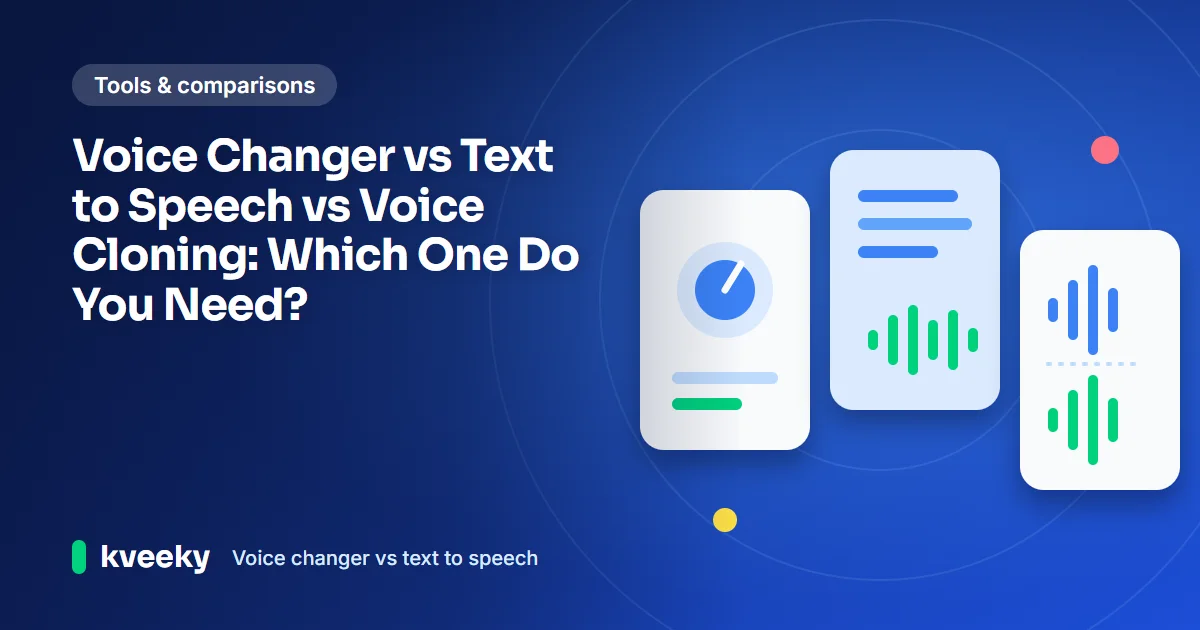
Voice changer vs text to speech comes down to your input: a voice changer turns your own speech into another voice, live or from a recording. Text to speech reads a typed script aloud in an AI voice. Voice cloning copies one real person's voice, which text to speech then uses to read any script.
Last updated: October 7, 2026. Tool facts were checked on each vendor's own page, and legal rules on the regulator's page, on that date.
This guide is for streamers, gamers, video creators and small teams who searched for a voice changer and want to know if it is the right tool. We compare the 3 technologies side by side and match 8 common goals to the right one. We also list the consent rules to check before you copy a real voice.
Key Takeaways
- Different inputs. A voice changer starts from your voice and text to speech from text. Voice cloning starts from a voice sample, then works like TTS.
- Only voice changers work live. Real-time voice conversion runs during streams, games and calls. A low-latency research model reports under 20 ms on a consumer CPU (arXiv 2311.00873, retrieved 2026-10-07).
- A voice changer keeps your language. It changes who you sound like, not what language you speak. For other languages you need translation plus TTS, or a dubbing tool.
- Copying a real voice needs consent. Tennessee's ELVIS Act covers simulated voices, and the EU AI Act requires deepfake audio to be disclosed from 2 August 2026.
- Kveeky is text to speech plus voice cloning. It is not a real-time voice changer. Use it when your starting point is a script.
On this page: The difference · Types of voice changers · How voice conversion works · Real time and calls · Apps · Decision table · Multilingual · Benefits · Celebrity voices · Consent checklist · Where Kveeky fits · What's changing · FAQ
Tap what you have in hand. You get a one-line answer and where to read more.
Changer vs TTS vs cloning
A voice changer converts speech into speech, text to speech converts text into speech, and voice cloning creates a new voice that TTS can then use. The table compares them on the points that decide which one fits your job.
| Voice changer (speech to speech) | Text to speech | Voice cloning | |
|---|---|---|---|
| Input | Your live microphone or a recording of you speaking | A typed script | A short, clean sample of one person's voice, then a script |
| Output | Your words, timing and emotion in a different voice | A new read of the script in a stock AI voice | New speech from any script in the cloned person's voice |
| Latency | Live for real-time tools; a processing step for uploaded files | Not live: you generate an audio file, then use it | A one-time setup to create the voice, then the same as TTS |
| Who performs | You do. Your acting carries through | The AI decides the delivery, guided by your settings | The AI, in a specific person's voice |
| Best for | Streaming, gaming, calls, re-voicing a take you already like | Voiceovers, explainers, e-learning, social video from a script | A consistent branded narrator or your own voice without re-recording |
| Main risks | Impersonation and scams on live calls; artifacts on noisy input | Flat delivery, mispronounced names | Misuse of someone's identity; deepfake rules |
| Consent needs | None for a generic voice; the owner's permission for any real person's voice | Usually none: stock voices are licensed by the tool | Always the speaker's own consent, in writing for anyone but yourself |
The simplest test: if you are going to speak, you want a voice changer. If you are going to type, you want text to speech. If the voice has to be one specific person, you want voice cloning, with that person's permission.
Show me: one line, three ways
- Voice changer: you say "Welcome back to the channel" into a microphone. The output is the same sentence, with your timing and emotion, in another voice.
- Text to speech: you type "Welcome back to the channel". The AI decides the delivery, guided by the voice, speed and emotion you choose.
- Voice cloning: you first give a clean sample of one person's voice (with consent). Then you type the line and the cloned voice reads it.
For the mechanics of the text side, our explainer on how text to speech works covers the 3-stage pipeline from script to audio.
Kinds of voice changers
There are 3 kinds: classic effects changers, real-time AI voice changers and offline speech-to-speech tools. They differ in how much of your voice survives and whether they work live.
| Type | How it changes your voice | Works live? | Typical use |
|---|---|---|---|
| Effects changer | Shifts pitch and formants, adds robot, radio or echo effects. Your own voice stays recognizable | Yes | Pranks, game chat, comedy bits |
| Real-time AI voice changer | A model re-synthesizes what you say in a target voice while you talk | Yes, with a small delay | Streams, Discord, VTubing, privacy in voice chat |
| Offline speech to speech | You upload a recording and get it back in another voice, with your timing and emotion kept | No | Re-voicing a take, character voices, fixing lines in a recording |
People often call all 3 "voice changers". When a product says "voice-to-voiceover", it usually means the offline type: you record the performance, and the tool swaps the voice.
How voice conversion works
AI voice conversion splits your speech into what you said and who said it, then rebuilds the audio with a different speaker identity. Your words, rhythm and emphasis stay; the voice colour changes.
A published example shows the steps clearly. The kNN-VC method extracts self-supervised speech features from your audio and from a few examples of the target speaker. It then swaps each frame of your features for the closest match from the target. A vocoder turns the result back into sound (Baas et al., arXiv 2305.18975, retrieved 2026-10-07).
Online voice conversion apps follow the same idea. You upload a file or stream your microphone, the model runs on the vendor's servers or on your computer, and you get audio in the chosen voice. Voice style transfer is a close cousin that copies delivery rather than identity; our guide to voice style transfer for video producers explains where the 2 overlap.
Can voice conversion match different tones and emotions?
Yes, and that is its main strength over text to speech. Because you perform the line, your whisper, laugh or shout carries into the new voice. ElevenLabs' docs, for example, say its Voice Changer keeps "whispers, laughs, cries, accents" and other emotional cues (ElevenLabs docs, "Voice changer", retrieved 2026-10-07).
The flip side: the output is only as good as your performance. A flat reading stays flat in any voice.
Can a voice changer change your accent?
Usually not. Most voice changers keep your pronunciation, so your accent comes through in the new voice. Accent conversion is a separate research problem. One ICASSP 2023 paper converts speech to several accents while keeping the speaker's voice (Jin et al., arXiv 2211.13282, retrieved 2026-10-07).
If you need a different accent in a voiceover today, the practical route is text to speech with a voice that already has that accent.
Real-time voice conversion
Yes. Real-time AI voice changers convert your voice while you speak, with a small delay. Research shows how small that delay can get. The open-source LLVC model reports latency under 20 ms at 16 kHz on a consumer CPU (Sadov et al., arXiv 2311.00873, retrieved 2026-10-07).
Real products add their own buffering, so expect a delay you might notice in a fast conversation. Quality also drops with background noise and cheap microphones. Test with your own setup before you go live.
Can I change my voice during a call?
Yes, on a computer. Desktop voice changers create a virtual microphone, and any app that accepts a microphone can use it. Voice.ai, for example, lists Discord, Zoom, WhatsApp and Google Meet among the apps it works with (Voice.ai, "Voice Changer", retrieved 2026-10-07).
Regular phone calls are harder, because the phone uses its built-in microphone. If you want privacy or cannot speak, there is a TTS option instead. Apple's Live Speech speaks what you type in FaceTime and phone calls (Apple Support, "Use Live Speech", retrieved 2026-10-07).
Never use a changed voice on a call to deceive someone. The FCC ruled that AI-generated voices in robocalls count as "artificial" under the Telephone Consumer Protection Act (FCC news release, February 8, 2024, retrieved 2026-10-07).
Apps that change your voice
Plenty of apps change your voice, so pick the type first, then the app. The examples below are listed only to show each category, with facts taken from each vendor's own page on October 7, 2026. They are not endorsements.
| Tool | Type | What its own page says | Free option |
|---|---|---|---|
| Voicemod | Real-time voice changer and soundboard | Works with Discord, games, OBS and Twitch; "More than 200 voices" | Free download |
| Voice.ai | Real-time AI voice changer | Runs on PC and Mac; works in games, calls and chats that accept a microphone | Described as free, no credit card |
| ElevenLabs Voice Changer | Offline speech to speech | Upload or record audio up to 5 minutes per segment; multilingual model covers 29 languages | Uses account credits |
| Apple Live Speech | Type-to-speak (text to speech), not a changer | Speaks typed text in FaceTime and phone calls; can use a Personal Voice | Built into supported Apple devices |
Sources: Voicemod, Voice.ai, ElevenLabs Voice Changer docs and Apple Support, all retrieved 2026-10-07.
Are there free AI voice generators with real-time voice conversion?
Yes, free real-time voice changers exist. Voicemod offers a free download, and Voice.ai describes its changer as free. Free text-to-speech tools are a different category; our roundup of the best free AI voiceover generators compares those.
How to convert your voice, step by step
- Decide live or recorded. Live means a real-time changer. A recording means an offline speech-to-speech tool.
- Use a clean input. A quiet room and a decent microphone matter more than the model.
- Pick a target voice that suits your natural pitch. Big jumps, such as a deep male voice to a child's voice, add artifacts.
- Test a short clip and listen on headphones for robotic edges or lisps.
- Set your app's microphone to the changer's virtual microphone for live use, or export the file for editing.
- Label the result if it imitates anyone real, and keep proof of consent.
Decision table by goal
Match your goal, not the technology name. These 8 goals cover most searches for voice changers and AI voices.
| Your goal | Use | Why |
|---|---|---|
| Stream, game or VTube in a different voice | Real-time voice changer | Only a live changer keeps up with you as you talk |
| Privacy on a voice or video call | Real-time changer on desktop, or type-to-speak such as Live Speech | A changer hides your timbre; type-to-speak hides your voice completely |
| Re-voice a take you already performed well | Offline speech to speech | It keeps your timing and emotion and swaps only the voice |
| Character voices for an animation or game video | Text to speech with character-style voices, or speech to speech if you want to act them | TTS is faster for many short lines; STS keeps your acting |
| Voiceover from a script | Text to speech | No recording at all: paste, pick a voice, download |
| Your own voice on every video without recording | Voice cloning, then text to speech | Record a sample once, then edit the script, not the audio |
| Dub a video into another language | Translation plus text to speech, or a dubbing tool | A voice changer keeps your original language |
| Speak when you cannot use your own voice | Type-to-speak, optionally with a personal cloned voice | Text input works without speech at all |
If you land on text to speech or cloning, our guide to customizing an AI voice for your videos shows how to tune tone and pacing.
Multilingual voice conversion
Only partly. Voice conversion can keep one voice consistent across languages you can already speak, but it does not translate. For a project in languages you don't speak, you need a translated script and a TTS voice in each language.
ElevenLabs' docs, for example, say its multilingual speech-to-speech model supports 29 languages, which means it can re-voice speech in those languages (ElevenLabs docs, retrieved 2026-10-07). You still have to perform each language yourself.
For most small teams, the faster route is: translate the script, have a native speaker check it, then generate each language with text to speech. Our guide to multilingual AI voiceover and the overview of AI dubbing and video localization walk through that workflow.
Benefits of voice-to-voiceover
Voice-to-voiceover tools let 1 performer produce many voices while keeping a real human performance. That's their main benefit over text to speech, which has no performer at all.
- Acting survives. Timing, pauses, laughs and emphasis come from you.
- One person, many characters. You can voice a whole cast for a short video or game demo.
- Privacy. You can publish or stream without your real voice.
- Fixes without re-casting. Some tools let you replace a word or line in an existing recording.
Can voice-to-voiceover speed up content creation?
Sometimes. It saves time when you already record well and need several voices, because you skip casting and booking. It does not save recording time, since you still perform every line.
If your bottleneck is recording itself, text to speech saves more. You edit a sentence in the script and regenerate it instead of setting up the microphone again.
Does voice-to-voiceover improve accessibility in media?
The bigger accessibility gains come from text to speech and personal voices. WCAG 2.2 asks for audio description of prerecorded video at Level AA (W3C, "Understanding SC 1.2.5", retrieved 2026-10-07). A TTS voice is one practical way to produce that narration track.
For people who cannot speak or are losing their voice, type-to-speak tools help most. Apple's Live Speech can speak typed text with a Personal Voice, a synthesized voice that sounds like the user (Apple Support, retrieved 2026-10-07). Voice conversion helps less here, because it needs speech as its input.
Sounding like a celebrity
Technically, many apps offer celebrity-style voice models, but using a recognizable celebrity voice in public content without permission is risky. Tennessee's ELVIS Act, signed on March 21, 2024, added "voice" to the state's protection of personal likeness (Office of the Governor of Tennessee, "Gov. Lee Signs ELVIS Act into Law", retrieved 2026-10-07).
So the honest answer to "which celebrities can I sound like?" is: none you can safely publish without a license. A private joke with friends is different from a monetized video.
The safer route for content is a character-style voice with a similar energy, such as a deep movie-trailer narrator, rather than a named person. You can browse character-style options in our AI voice library.
Our full guide, is voice cloning legal?, covers US state laws, the NO FAKES Act and the EU rules in detail.
Can an app help you practise mimicking voices for acting?
Not really. A voice changer changes the output, so you sound different without your own voice learning anything. To practise impressions or character acting, record yourself, compare with a reference clip, and repeat short lines.
A voice changer is still useful at the end of that process. Once you can act a character well, speech to speech can push the timbre further than your vocal cords can.
Consent and legal checklist
Before you copy any real person's voice, with a changer or a clone, check every line below. This is general information, not legal advice.
- Is it your own voice? If yes, you are fine, but keep your raw recordings as proof.
- Do you have written consent? For anyone else, get permission that names the use, the channels, the duration and any payment.
- Is the person famous or identifiable? Treat celebrities, creators and public figures as off-limits without a license, since Tennessee's ELVIS Act covers simulated voices.
- Will it reach the EU? From 2 August 2026, deployers must disclose deepfake audio as artificially generated or manipulated. Creative and satirical works get a lighter duty (EU AI Act Service Desk, Articles 50 and 113, retrieved 2026-10-07).
- Is it on a phone call or robocall? AI-generated voices count as "artificial" under the US TCPA, so robocall consent rules apply (FCC, February 8, 2024).
- Could anyone think it's a real business or official? The FTC's impersonation rule targets scams that pose as government agencies or businesses. In February 2024, the FTC proposed extending it to individuals (FTC press release, retrieved 2026-10-07).
- Did you label it? Say in the video, caption or description that the voice is AI-generated or AI-altered.
- Do the tool's terms allow it? Kveeky's Terms of Service, for example, forbid impersonating any person or entity and require that you have the right to use what you upload (kveeky.com/terms, retrieved 2026-10-07).
The FTC also lists extortion scams on families and small businesses, and harm to voice artists' income, as voice-cloning risks (FTC, November 16, 2023, retrieved 2026-10-07). Those risks apply to live voice changers too.
Tick each line that is true for your project. If you cannot tick one, stop and sort it out first. General information, not legal advice.
0 of 7 done
Where does Kveeky fit?
Kveeky is a text-to-speech and voice cloning tool, not a voice changer. You paste a script, pick one of 700+ voices in 40+ languages or your own clone, and download the audio. It does not convert your live voice, and it does not re-voice uploaded recordings.
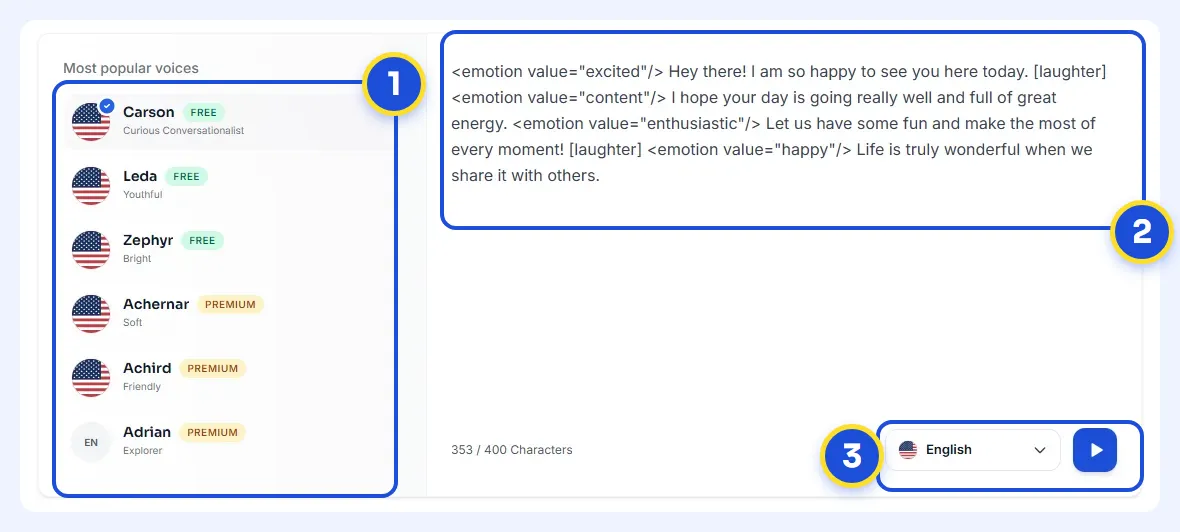
- 1Pick a voice. Voices are tagged Free or Premium.
- 2Type or paste a short line. Pick an emotion if you want one.
- 3Choose the language and press play to hear it.
Try it yourself in the free voice demo on Kveeky, no sign-up needed. For longer scripts and downloads, use the free plan.
That makes it a fit for the script-based rows in the decision table:
- Voiceovers from a script. Speed and volume controls, plus a choice of 6 emotions (Neutral, Happy, Love, Angry, Calm and Sad).
- Your own voice without recording every video. The free plan includes 500 credits a month (about 40 seconds), with no credit card. Which plans include voice cloning is listed on the pricing page.
- Paid use. Plans start at $9/month, or $7.50/month billed yearly, and every paid plan includes commercial usage rights for generated audio. See the Kveeky plans and clone limits.
If you need live voice changing for streams or calls, use a real-time changer instead. Many creators use both: a changer for live content and TTS for edited videos. Our hub on voice cloning explains how to record a clean sample for a clone.
Paste this into the free voice demo on the Kveeky homepage, play it in 2 or 3 voices, then read the same lines aloud yourself and compare. That is the quickest way to feel the difference between a typed script and your own performance.
What is changing in conversion
Voice conversion is getting faster, needing less reference audio and facing more disclosure rules. These are the documented shifts, not predictions.
- Less reference audio. Methods such as kNN-VC work from just a few examples of the target speaker (arXiv 2305.18975).
- Lower latency on ordinary hardware. LLVC reports under 20 ms latency on a consumer CPU (arXiv 2311.00873).
- Accent control. Research systems now change accent while keeping the speaker's voice (arXiv 2211.13282).
- Disclosure duties. EU AI Act Article 50 transparency rules apply from 2 August 2026, and US regulators already treat AI voices in robocalls as artificial.
For creators, the practical effect is simple. Live voice changers will keep improving, and labelling AI-altered voices is moving from good manners to a legal duty in more places.
Frequently asked questions
Is a voice changer the same as text to speech?
No. A voice changer takes your spoken voice and makes it sound like someone else. Text to speech takes typed text and reads it aloud in an AI voice, with no recording from you.
Is Kveeky a voice changer?
No. Kveeky is a text-to-speech and voice cloning tool: you type a script and download the audio. It does not change your voice live or re-voice uploaded recordings.
Are there free real-time AI voice changers?
Yes. Voicemod offers a free download, and Voice.ai describes its real-time voice changer as free. Check each app's terms and your hardware, since quality depends on your microphone and computer.
Is it legal to use a voice changer?
Changing your own voice is generally legal. Using a voice changer to impersonate a real person, commit fraud or make AI-voiced robocalls is not. Get written consent before you imitate anyone and label AI-altered audio.
Can a voice changer translate my voice into another language?
No. A voice changer keeps the language you speak and changes only how you sound. For another language, translate the script and use text to speech, or use a dedicated dubbing tool.
Should I use voice cloning or a voice changer for YouTube videos?
For edited videos, voice cloning with text to speech is usually faster, because you change the script instead of re-recording. Use a voice changer when your live acting matters more than speed.
How we checked this guide
This guide is written by Ankit Agarwal for the Kveeky team. Disclosure: Kveeky makes an AI voice generator. It does text to speech and voice cloning, not real-time voice changing, and other tools are named only as examples.
- Kveeky plans, credits and clone limits: kveeky.com/pricing.md, retrieved 2026-10-07. Kveeky Terms of Service: kveeky.com/terms, retrieved 2026-10-07.
- Voice conversion research: arXiv 2305.18975 (kNN-VC), arXiv 2311.00873 (LLVC) and arXiv 2211.13282 (accent conversion), retrieved 2026-10-07.
- Law and regulation: FCC news release, February 8, 2024; FTC impersonation rule release; FTC on voice cloning harms; Tennessee Governor's office on the ELVIS Act; EU AI Act Article 50 and Article 113. All retrieved 2026-10-07.
- Accessibility: W3C, Understanding SC 1.2.5 and Apple Support on Live Speech, retrieved 2026-10-07.
- Tool facts: Voicemod, Voice.ai and ElevenLabs, each from its own page, retrieved 2026-10-07. Features change often, so confirm on the vendor's page.
- No Kveeky usage data is used in this guide. This is general information, not legal advice.
Your next step: if your starting point is a script, paste one paragraph into Kveeky, try 2 or 3 voices, and compare them with your own read. For game trailers and character content, see how teams use AI voiceovers for video games.
- Text to speech vs voice cloning: which should you use?
- How to control emotion in AI voiceovers
- Is AI voice safe? Cloning scams and how to protect yourself
- The ethics of AI voice cloning for video production
- How to write an AI voiceover script
- Kveeky plans and what the free plan includes
- Browse character and AI voices
Turn your script into a voiceover
Paste your text, pick a voice and download the audio. Free to start, no credit card.