TL;DR
- This article explores the neural network architectures revolutionizing AI voice generation, covering WaveNet, Deep Voice, Tacotron, Transformers, FastSpeech, Flow-Based models, and GANs. Discover how these architectures enhance voice quality, speed, and controllability, impacting applications like video production and e-learning. Learn about the latest advancements and how they're shaping the future of AI voiceovers.
On this page
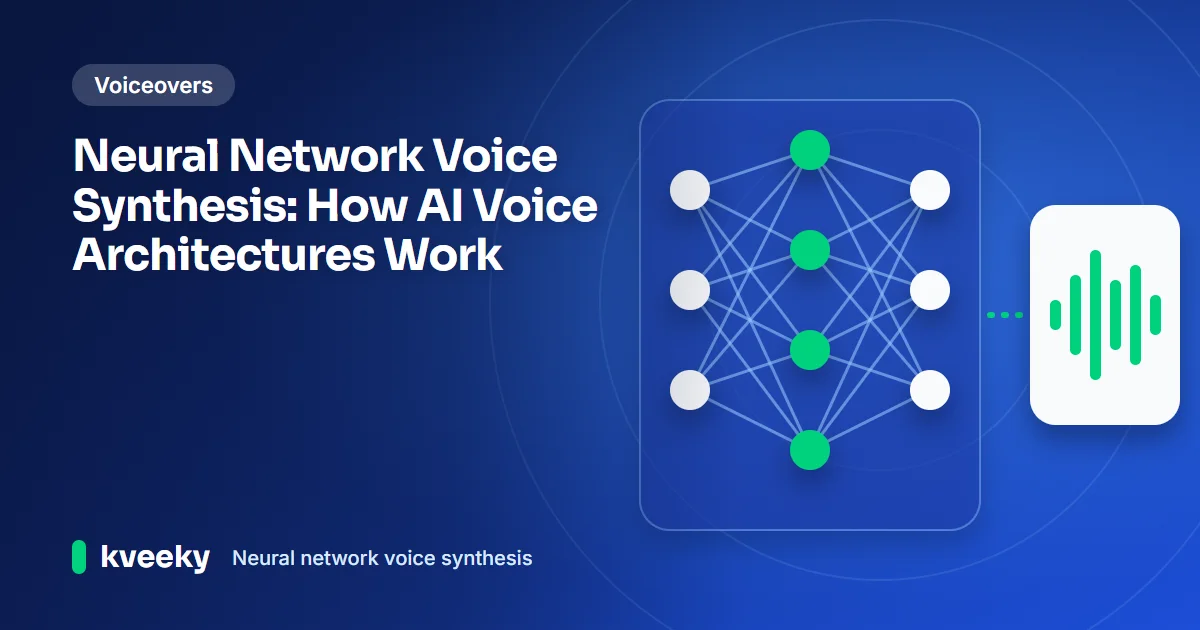
Neural network voice synthesis is how modern AI voices are made. A neural network learns from hours of recorded speech, then predicts how new text should sound and generates the audio itself. Many systems pair an acoustic model, such as Tacotron or FastSpeech, with a neural vocoder, such as HiFi-GAN.
Last updated: October 7, 2026. Every research claim was checked against the original paper on arXiv, and the 2026 model releases against each vendor's own announcement.
This guide is for video producers, educators and curious creators who want to understand the models behind AI voices. We explain each architecture in plain words, show how they fit together, and say what matters when you make a voiceover.
Neural network voice synthesis means a trained neural network turns text into speech: an acoustic model (Tacotron, FastSpeech) plans the sound as a mel spectrogram, and a neural vocoder (WaveNet, HiFi-GAN) turns that plan into audio. End-to-end models such as VITS do both in one model. For a creator, the design shows up as speed, control and how naturally a voice reads names.
Key Takeaways
- Modern voice generators use neural networks, not rules. Rule-based logic now mostly survives in text clean-up, such as expanding numbers and abbreviations.
- Most neural TTS has 2 models: an acoustic model that plans the speech as a mel spectrogram, and a vocoder that turns that plan into sound.
- The big milestones: WaveNet (2016), Tacotron 2 (2017), FastSpeech (2019), HiFi-GAN (2020), VITS (2021) and VALL-E (2023), each linked to its paper below.
- Quality got close to recordings in lab tests. Tacotron 2 scored 4.53 out of 5 against 4.58 for professionally recorded speech (arXiv, retrieved 2026-10-06).
- For creators, architecture shows up as control: speed, emotion and how well a voice handles names. Those settings come from the model design.
On this page: What is neural TTS? · Neural vs rule-based · How it fits together · Key architectures · End-to-end or modular? · Neural TTS vs recording · Video production · Latest advances · 2026 models · FAQ
What neural TTS is
Neural TTS is text to speech in which neural networks do the work that rules and recorded clips used to do. The network is trained on pairs of text and audio. It learns how letters map to sounds, how long each sound lasts and how pitch rises and falls.
The term "neural voice" simply means a voice produced this way. It doesn't mean the voice copies a brain. "Neural" refers to the artificial neural network, a stack of simple math units that learn patterns from data.
Deep learning voice synthesis and machine learning speech synthesis describe the same field. Deep learning is the branch of machine learning that uses many-layered neural networks. For a gentler, step-by-step overview of the whole process, start with our hub guide on how text-to-speech AI works.
Neural networks vs rule-based
Modern AI voice generators use neural networks to produce the voice. Rule-based logic still appears in the text front end, for example turning "$9" into "nine dollars." It no longer decides how the voice sounds.
Older approaches still appear where size and speed matter more than naturalness. Here is how they compare with neural TTS.
| Approach | How it works | Strength | Weakness |
|---|---|---|---|
| Rule-based (formant) | Hand-written rules shape an artificial sound source | Tiny, fast, predictable | Clearly robotic |
| Concatenative | Joins short clips cut from one speaker's recordings | Real human sound inside each clip | Audible joins, hard to change emotion |
| Statistical parametric (HMM) | A hidden Markov model predicts speech features, a signal vocoder plays them | Flexible, small | Muffled, over-smoothed sound |
| Neural TTS | Neural networks predict features and generate the waveform | Natural rhythm, many voices from one model | Needs training data and GPUs; can misread rare words |
The quality gap was measured early. In 2016, listeners rated WaveNet as clearly more natural than the best parametric and concatenative systems. That held in English and Mandarin (van den Oord et al., arXiv, retrieved 2026-10-06).
Neural TTS architecture diagram
Most neural TTS systems split the job into clear parts. Each part is a separate network, or a separate block inside one network.
- Text front end. Cleans the text and converts it into phonemes, the small sound units of a language.
- Encoder. Turns each phoneme into a list of numbers that also carries context from nearby words.
- Attention or duration predictor. Decides how many audio frames each phoneme gets. Older models learn this with attention; newer ones predict durations directly.
- Decoder. Writes a mel spectrogram, a time-by-frequency picture of the speech. It's like sheet music for the voice.
- Neural vocoder. Turns the spectrogram into thousands of audio samples per second. Our guide to neural vocoder architectures covers this last step in depth.
A speaker embedding tells the decoder which voice to use. It is a short list of numbers that captures timbre and accent, so one model can speak in many voices.
Show me: 6 terms in plain words
- Mel spectrogram
- A time-by-frequency picture of the speech. It is like sheet music for the voice.
- Vocoder
- The network that turns the spectrogram into thousands of audio samples per second.
- Autoregressive
- Predicting each audio sample from all the samples before it, as WaveNet does.
- Attention
- A mechanism that lets the decoder look back at the right part of the text for each frame.
- MOS (mean opinion score)
- A 1 to 5 listener rating. Each paper’s MOS comes from its own listening test, so scores are not comparable across papers.
- Speaker embedding
- A short list of numbers that captures timbre and accent, so one model can speak in many voices.
Key neural architectures
Each architecture fixed a problem the previous one left open. This timeline lists the models most often cited, with the claim each paper made.
| Model (year) | Type | What it changed |
|---|---|---|
| WaveNet (2016) | Autoregressive waveform model | Generated raw audio one sample at a time; rated more natural than older systems |
| Deep Voice (2017) | Multi-stage neural pipeline | Replaced each classic TTS stage with a neural network |
| Tacotron (2017) | Sequence-to-sequence with attention | Learned speech directly from characters, end to end |
| Tacotron 2 (2017) | Seq2seq + WaveNet vocoder | Mel spectrogram plus neural vocoder; MOS 4.53 vs 4.58 for recordings |
| Transformer TTS (2018) | Self-attention | Replaced recurrent layers; trained about 4.25x faster than Tacotron 2 |
| FastSpeech (2019) | Non-autoregressive Transformer | Parallel generation, fewer skipped words, speed control |
| FastSpeech 2 (2020) | Non-autoregressive with variance inputs | Added pitch, energy and duration as inputs |
| HiFi-GAN (2020) | GAN vocoder | Fast, high-quality waveform generation |
| VITS (2021) | End-to-end (VAE + flows + GAN) | One model from text to waveform, with varied rhythm |
| VALL-E (2023) | Neural codec language model | Treated TTS as language modeling; cloned voices from 3-second prompts |
Pick the problem. The answers come from the timeline table above.
WaveNet: modeling raw audio
WaveNet predicts each audio sample from all the samples before it. This is called autoregressive generation. One WaveNet could also speak in many voices by being told the speaker's identity (arXiv 1609.03499).
The catch was speed. Generating tens of thousands of samples per second one at a time was slow. Parallel WaveNet later fixed this with a distilled model that ran more than 20 times faster than real time and served Google Assistant voices (arXiv 1711.10433).
Deep Voice: a team of neural networks
Deep Voice kept the classic TTS stages but built each one from a neural network. Its paper lists 5 blocks: phoneme segmentation, grapheme-to-phoneme conversion, phoneme duration, fundamental frequency (pitch) prediction and audio synthesis (arXiv 1702.07825).
Tacotron and Tacotron 2: attention-based sequence-to-sequence
Tacotron reads characters and writes spectrogram frames. An attention mechanism lets the decoder look back at the right part of the text for each frame. It learns which letters line up with which moment of audio.
The first Tacotron scored a mean opinion score (MOS) of 3.82 out of 5 on US English, beating a production parametric system (arXiv 1703.10135). Tacotron 2 paired the same idea with a modified WaveNet vocoder and reached 4.53 (arXiv 1712.05884).
Attention had a weakness. On long or unusual sentences it could lose its place, which made the voice skip or repeat words.
Transformer TTS: self-attention instead of recurrence
Recurrent networks process text one step at a time. Transformer TTS replaced them with multi-head self-attention, so the model handles a whole sentence in parallel. Its authors reported about 4.25x faster training than Tacotron 2 and a MOS of 4.39 against 4.44 for human speech (arXiv 1809.08895).
FastSpeech and FastSpeech 2: speed and control
FastSpeech drops step-by-step decoding. A length regulator stretches each phoneme to a predicted number of frames, and all frames are generated at once. The paper reports mel spectrogram generation 270x faster than autoregressive Transformer TTS, almost no skipped or repeated words, and smooth speed control (arXiv 1905.09263).
FastSpeech 2 also feeds pitch, energy and duration into the model during training, then predicts them at run time (arXiv 2006.04558). Explicit inputs like these make separate speed and pitch controls straightforward to build.
Flow-based and GAN-based models
Flow-based models such as WaveGlow use reversible math steps to turn simple noise into speech, without autoregression (arXiv 1811.00002). GAN-based models train a generator against a discriminator that tries to spot fake audio.
This adversarial training pushes the generator toward realistic detail. HiFi-GAN, a GAN vocoder, generated 22.05 kHz audio 167.9 times faster than real time on one V100 GPU (arXiv 2010.05646).
VITS: one end-to-end model
VITS combines a variational autoencoder, normalizing flows and adversarial training in a single model. A stochastic duration predictor lets the same sentence come out with different rhythms. On the LJ Speech dataset, its MOS was comparable to the real recordings (arXiv 2106.06103).
Enter the length of the audio. The factors are the numbers reported in the HiFi-GAN and Parallel WaveNet papers cited above.
Paper results on specific hardware. Original WaveNet generated one sample at a time and was the slow baseline these models improved on. A product you use online adds network and queue time.
End-to-end vs modular
Pick end-to-end if you want the simplest training setup and the most natural default sound. Pick a modular pipeline if you need to inspect, fix or swap one stage, such as pronunciation or the vocoder.
| Question | End-to-end (e.g. VITS) | Modular (e.g. FastSpeech 2 + HiFi-GAN) |
|---|---|---|
| Training | One model, one training run | Several models trained and tuned separately |
| Fixing a problem | Harder to see which part caused it | You can check the spectrogram, then the vocoder |
| Swapping parts | Retrain the whole model | Replace the vocoder or front end on its own |
| Fine control | Depends on what the model exposes | Pitch, energy and duration are explicit inputs |
| Best fit | Research, single-voice products | Production systems that need debugging and control |
The debugging point matters more than it looks. Explainable TTS is hard with one large model, because you can't easily see why a word came out wrong. A modular pipeline gives you checkpoints: phonemes, durations, spectrogram, waveform.
Most creators never make this choice directly. You pick a tool, and the tool's design decides how much control you get.
Neural TTS vs recordings
In controlled tests, the best neural voices score close to recordings. Tacotron 2 scored 4.53 against 4.58 for professional recordings, and Transformer TTS 4.39 against 4.44. Those are lab results on single, clean voices, not a guarantee for every product or script.
| Factor | Neural TTS | Human voice recording |
|---|---|---|
| Edits | Change the text and regenerate the line | Book another session |
| Consistency | Same voice and tone every time | Varies by day, mic and room |
| Languages | Many languages from one tool | One actor per language, usually |
| Emotional range | Good for narration; set by tags and settings | Better for drama, comedy and big emotional shifts |
| Rare words | Can misread names and jargon until you respell them | Asks or checks before recording |
How "close" is measured matters too. Our guide to synthetic speech intelligibility metrics explains MOS, word error rate and why they can disagree.
Neural synthesis in video production
Neural voice synthesis fits into video work as a fast, editable voiceover track. You write the script, generate the voice, and change any line without re-recording the rest.
- Write for the ear. Use short sentences and put pauses where a narrator would breathe.
- Pick a voice and a delivery. Choose a voice that fits the topic, then set speed and emotion.
- Generate and listen once. Respell any word the model misreads, the same fix the front end needs.
- Export and edit. Download the audio and line up your cuts to the voice, not the other way around.
In Kveeky, you paste your script, pick from 700+ AI voices, set the speed and one of 6 emotions, and download the audio. For flat-sounding lines, our tips on prosody modeling in AI voiceovers go deeper.
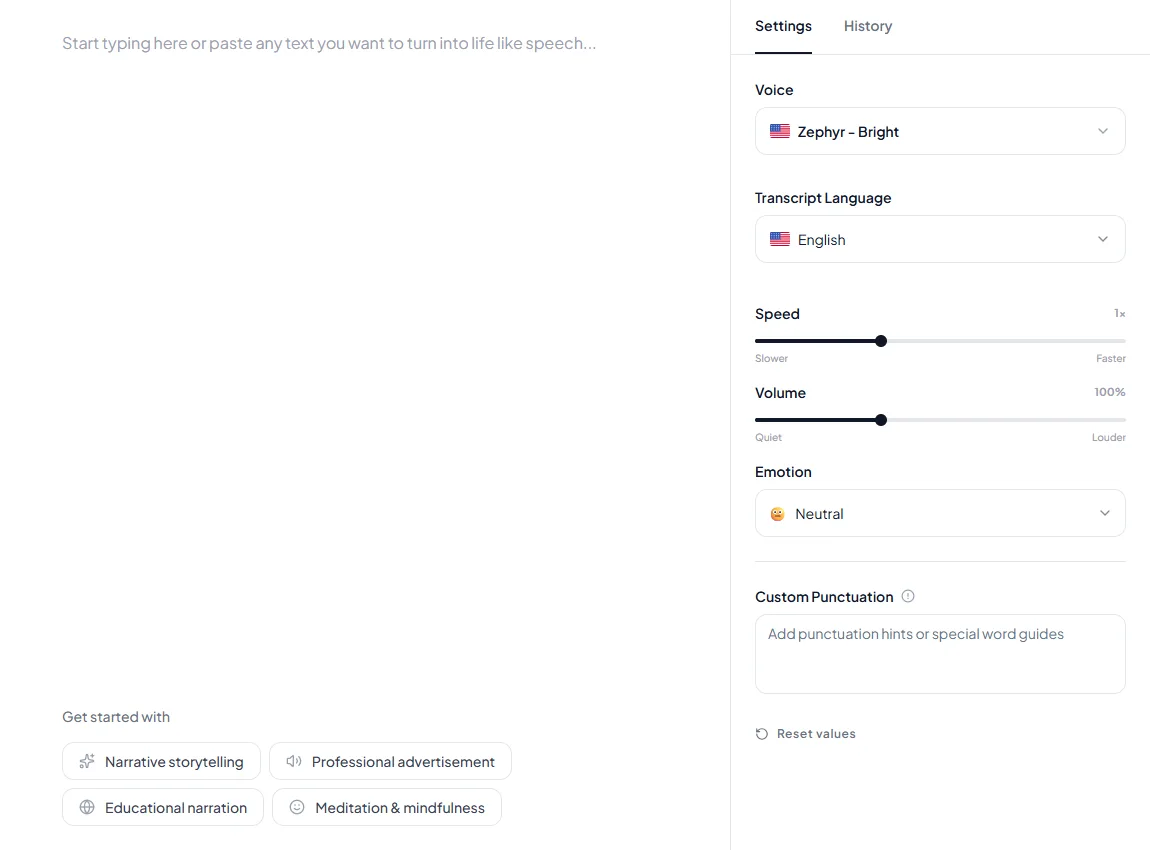
Generate the same line three times with one voice, changing only the setting in brackets. Listen for rhythm and stress, and respell any word the voice misreads, such as a name.
Latest TTS model advances
One major shift since 2023 is treating speech like language. VALL-E converts audio into discrete codes with a neural audio codec, then predicts those codes the way a text model predicts words (arXiv 2301.02111, retrieved 2026-10-06).
Three trends stand out in recent research:
- Zero-shot voice cloning. VALL-E was trained on 60,000 hours of English speech and could copy an unseen voice from a 3-second recording. Our explainer on zero-shot voice cloning covers the trade-offs.
- Better vocoders and codecs. Universal vocoders such as BigVGAN aim to work across many speakers and recording conditions (arXiv 2206.04658).
- Faster, smaller models. Non-autoregressive designs and efficient vocoders make it practical to run some models on your own computer. Our overview of open-source TTS toolkits lists where to start.
Cloning from seconds of audio also raises consent questions. Use your own voice, or a voice you have written permission to use.
New models and trends in 2026
The 2026 releases follow the trends above: speech treated like language, voice cloning from seconds of audio, and smaller models that run closer to the user. Every fact below comes from the vendor's own announcement or the paper, with its date.
| Date | Model | What is new | Weights and license |
|---|---|---|---|
| January 13, 2026 | Kyutai Pocket TTS | 100M parameters, runs faster than real time on a laptop CPU | Open, CC-BY-4.0 |
| March 23, 2026 | Mistral Voxtral TTS | 4B parameters, 9 languages, voice adaptation from a 3-second reference | Open, CC BY-NC 4.0 (non-commercial) |
| April 15, 2026 | Google Gemini 3.1 Flash TTS | Preview, more than 70 languages, audio tags to steer style and pace | API only |
| September 23, 2026 | Google Gemini 3.8 Flash TTS and Flash-Lite TTS | Rolling out, voice design from a text description, voice replication with recorded consent | API only |
| September 28, 2026 | ElevenLabs Eleven v4 and v4 Turbo | More than 90 languages, instant clones from 10 seconds of audio | API only |
What is Mistral's Voxtral 4B text-to-speech model?
Voxtral TTS is Mistral AI's 4B-parameter text-to-speech model, released on March 23, 2026. Its open weights use a non-commercial CC BY-NC 4.0 license (Mistral AI, retrieved 2026-10-07).
It speaks 9 languages: English, French, German, Spanish, Dutch, Portuguese, Italian, Hindi and Arabic. It can adapt to a new voice from a reference as short as 3 seconds.
Its paper describes a hybrid design: semantic speech tokens are generated one by one, then flow matching produces the acoustic tokens (arXiv 2603.25551, retrieved 2026-10-07). For creators, "open weights" doesn't mean free for business use here, because the license rules out commercial use.
What is Gemini 3.1 Flash TTS, and what came after it?
Gemini 3.1 Flash TTS is Google's text-to-speech model announced on April 15, 2026, in preview for developers and in Google Vids. It covers more than 70 languages and added audio tags, which are instructions inside the text that steer style and pace (Google, retrieved 2026-10-07).
On September 23, 2026, Google followed with Gemini 3.8 Flash TTS and Flash-Lite TTS. Developers can design a voice from a text description. They can also replicate a voice from a 30-second sample, with a consent recording from the owner (Google, retrieved 2026-10-07).
Google says every clip from its Gemini audio models carries a SynthID watermark.
Is Google's "Neural Expressive" update a new voice model?
No. Neural Expressive is a new design language for the Gemini app, covering animations, colors, typography and haptics (Google, May 19, 2026, retrieved 2026-10-07). The voice news in that post was smaller: fewer cut-offs in Gemini Live and regional dialect voices that Google says will arrive later.
What are the latency benchmarks for real-time TTS APIs?
The key number is time to first audio: how long a model takes from receiving text to returning the first audio. The evaluation company Coval published a dated snapshot of median times. It measured 103 ms for Palabra TTS v1, 196 ms for Inworld TTS-2 and 202 ms for ElevenLabs Flash v2.5 (Coval, July 23, 2026, retrieved 2026-10-07).
Treat any ranking as a snapshot, because results move as vendors ship updates. Vendor figures are often measured differently: Mistral quotes 70 ms of model latency for Voxtral TTS, which leaves out the network round trip. Latency matters for phone agents and live assistants, not for a voiceover you generate once and download.
Can text to speech run on-device or on embedded hardware?
Yes, small models now can.
Kyutai's Pocket TTS has 100 million parameters. It runs about 6 times faster than real time on 2 CPU cores of a MacBook Air M4 (Kyutai model card, retrieved 2026-10-07). It takes about 200 ms to the first audio chunk, supports 6 languages and is licensed CC-BY-4.0.
On-device speech helps with privacy, offline use and devices such as kiosks or appliances. The trade-off is a smaller voice range and fewer languages than large cloud models.
What do these releases mean for creators and small teams?
Expect more control through tags and plain-language directions, cloning that asks for proof of consent, and watermarks on more AI audio. Open weights don't always mean commercial rights, so read the license before you build on a model. In Kveeky, the same ideas show up as an Emotion setting with 6 choices, a speed control, and commercial usage rights on every paid plan.
Frequently asked questions
What is Voxtral 4B TTS?
Voxtral TTS is a 4B-parameter text-to-speech model from Mistral AI, released on March 23, 2026. It speaks 9 languages, and its open weights use a non-commercial CC BY-NC 4.0 license.
What is a good latency for a real-time TTS API?
For phone agents and live assistants, look at time to first audio. In Coval's July 2026 snapshot, the fastest tracked models had medians between about 100 and 200 ms. For downloaded voiceovers, latency hardly matters.
What does neural voice mean?
A neural voice is a synthetic voice produced by a neural network trained on recorded speech. The network generates new audio for each script instead of stitching together stored clips, which is why neural voices sound smoother than older TTS.
What tools use neural networks to mimic human voice nuances?
Commercial AI voice generators, cloud speech services and open-source TTS toolkits commonly use neural models today. The nuances come from prosody prediction: models such as FastSpeech 2 predict pitch, energy and duration for every sound.
What is the difference between deep learning and machine learning voice synthesis?
They describe the same field at different levels. Machine learning voice synthesis includes older statistical models such as hidden Markov models. Deep learning voice synthesis means the many-layered neural networks behind WaveNet, Tacotron and later models.
What is adversarial training in AI voice generation?
Adversarial training pits 2 networks against each other. A generator makes audio, and a discriminator tries to tell it apart from real speech. GAN vocoders such as HiFi-GAN use this to produce sharper, more realistic audio.
Does neural TTS need a lot of training data?
Training a high-quality voice from scratch usually takes many hours of clean, transcribed audio. Newer models trained on huge multi-speaker datasets can adapt to a new voice from a short sample, though quality varies.
Is Tacotron still relevant?
Mostly as a foundation. Its mel spectrogram plus vocoder design shaped later models, and both Transformer TTS and FastSpeech measured themselves against Tacotron 2. Newer systems often replace its attention with duration prediction.
- Text to Speech vs Voice Cloning: Which Should You Use?
- AI Voice With Emotion: How to Control Emotion in AI Voiceovers
- Is Voice Cloning Legal?
- AI Voice Generators and Deepfake Detection Explained
- How to Make Your AI Voiceover Sound Less Robotic in 5 Minutes
- AI Voiceover for Video: A Practical Guide for Video Producers
- Free vs Paid Text to Speech: What You Actually Get in 2026
- Google Text to Speech: How to Use It, Change the Voice and When to Use Something Else (2026)
- Browse AI voices
- Hindi text to speech
How we checked this guide
This guide is written by Govind Kumar for the Kveeky team. Disclosure: Kveeky makes an AI voice generator. We describe published research and don't claim any of it is the model behind a specific product, including ours.
- Model claims come from the original papers on arXiv, all retrieved October 6, 2026.
- Papers: WaveNet, Parallel WaveNet, Deep Voice, Tacotron, Tacotron 2, Transformer TTS, FastSpeech, FastSpeech 2, WaveGlow, HiFi-GAN, VITS, BigVGAN and VALL-E.
- 2026 model facts come from each vendor's own announcement, all retrieved October 7, 2026. Vendor figures are the vendors' own claims.
- Mistral AI, "Speaking of Voxtral", March 23, 2026, and the paper "Voxtral TTS", arXiv 2603.25551.
- Google, "Gemini 3.1 Flash TTS: the next generation of expressive AI speech", April 15, 2026.
- Google, "The Gemini app becomes more agentic, delivering proactive, 24/7 help", May 19, 2026.
- Google, "Gemini 3.8 text-to-speech says hello", September 23, 2026.
- ElevenLabs, "Introducing Eleven v4, our most emotive model", September 28, 2026.
- Kyutai, Pocket TTS model card on Hugging Face, and the Kyutai blog for the release date ("Pocket TTS: a high-quality TTS with voice cloning that runs on CPU", January 13, 2026).
- Latency figures come from Coval, "TTS Latency 2026: The Production Speed Metric for Voice AI", July 23, 2026,, retrieved October 7, 2026. They are a snapshot, not a fixed ranking.
- MOS figures are the authors' own listening tests on their datasets. They are not comparable across papers.
- Kveeky features and the 700+ voice count come from kveeky.com/pricing, retrieved October 6, 2026. No Kveeky usage data is used in this guide.
Want to hear how much the acoustic model's prosody matters? Generate one explainer line at normal speed, then again slightly slower with a different Emotion setting, and compare. Our page on AI voiceovers for explainer videos shows where that kind of control pays off.
Turn your script into a voiceover
Paste your text, pick a voice and download the audio. Free to start, no credit card.